{"title":"Multiple responsive self-healing behavior of amino-functionalized CuS-modified thermo-reversible polyurethane containing double dynamic covalent bonds","authors":"Jiaofeng Ye, Haocheng Liu, Danbin Zhu, Chenyang Guo, Yanhua Liu, Libang Feng","doi":"10.1016/j.eurpolymj.2025.113792","DOIUrl":null,"url":null,"abstract":"<div><div>A self-healing polyurethane with five-fold response to thermal, near-infrared light, microwave, sunlight and UV light is prepared by introducing amino-functionalized copper sulfide (CuS-NH<sub>2</sub>) nanoparticles into thermally reversible polyurethane containing both Diels-Alder and disulfide bonds. The prepared polyurethane exhibits optimal comprehensive mechanical properties and self-healing performance when the addition amount of CuS-NH<sub>2</sub> is 0.3 wt%. The polyurethane with quite high tensile strength (14.3 MPa), hardness (75 HA), elongation at break (625 %), and toughness (24.85 MJ/m<sup>3</sup>) can be obtained. Cracks in the modified polyurethane can be self-healed repeatedly through heat-treated at 120 °C for 6 min, or irradiated with 4 W/m<sup>2</sup> of near infrared light at a wavelength of 808 nm for 60 s, or treated under a 250 W microwave for 80 s, and followed by a heat treatment for 12 h at 60 °C. More importantly, the damaged sample can also be repaired multiply after being treated to simulated sunlight or irradiated with 250–380 nm UV light for 6 h. Results show that the quickest self-healing speed and highest repair efficiency can be resulted when the materials are exposed to near-infrared light. The self-healing behavior is achieved through the cooperation of thermo-reversible Diels-Alder reaction, disulfide bonds exchange, dissociation and regeneration of hydrogen bonds, directional migration of CuS-NH<sub>2</sub> nanoparticles. These findings give important implication for the development of multi-responsive self-healing materials with efficient self-healing capability. Meanwhile, it provides various ideal selections for damage repair under different environments.</div></div>","PeriodicalId":315,"journal":{"name":"European Polymer Journal","volume":"228 ","pages":"Article 113792"},"PeriodicalIF":6.3000,"publicationDate":"2025-03-19","publicationTypes":"Journal Article","fieldsOfStudy":null,"isOpenAccess":false,"openAccessPdf":"","citationCount":"0","resultStr":null,"platform":"Semanticscholar","paperid":null,"PeriodicalName":"European Polymer Journal","FirstCategoryId":"92","ListUrlMain":"https://www.sciencedirect.com/science/article/pii/S0014305725000801","RegionNum":2,"RegionCategory":"化学","ArticlePicture":[],"TitleCN":null,"AbstractTextCN":null,"PMCID":null,"EPubDate":"2025/2/3 0:00:00","PubModel":"Epub","JCR":"Q1","JCRName":"POLYMER SCIENCE","Score":null,"Total":0}
引用次数: 0
Abstract
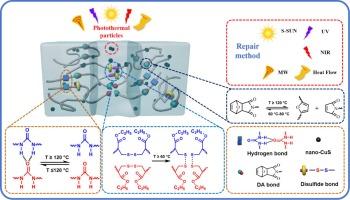
A self-healing polyurethane with five-fold response to thermal, near-infrared light, microwave, sunlight and UV light is prepared by introducing amino-functionalized copper sulfide (CuS-NH2) nanoparticles into thermally reversible polyurethane containing both Diels-Alder and disulfide bonds. The prepared polyurethane exhibits optimal comprehensive mechanical properties and self-healing performance when the addition amount of CuS-NH2 is 0.3 wt%. The polyurethane with quite high tensile strength (14.3 MPa), hardness (75 HA), elongation at break (625 %), and toughness (24.85 MJ/m3) can be obtained. Cracks in the modified polyurethane can be self-healed repeatedly through heat-treated at 120 °C for 6 min, or irradiated with 4 W/m2 of near infrared light at a wavelength of 808 nm for 60 s, or treated under a 250 W microwave for 80 s, and followed by a heat treatment for 12 h at 60 °C. More importantly, the damaged sample can also be repaired multiply after being treated to simulated sunlight or irradiated with 250–380 nm UV light for 6 h. Results show that the quickest self-healing speed and highest repair efficiency can be resulted when the materials are exposed to near-infrared light. The self-healing behavior is achieved through the cooperation of thermo-reversible Diels-Alder reaction, disulfide bonds exchange, dissociation and regeneration of hydrogen bonds, directional migration of CuS-NH2 nanoparticles. These findings give important implication for the development of multi-responsive self-healing materials with efficient self-healing capability. Meanwhile, it provides various ideal selections for damage repair under different environments.
期刊介绍:
European Polymer Journal is dedicated to publishing work on fundamental and applied polymer chemistry and macromolecular materials. The journal covers all aspects of polymer synthesis, including polymerization mechanisms and chemical functional transformations, with a focus on novel polymers and the relationships between molecular structure and polymer properties. In addition, we welcome submissions on bio-based or renewable polymers, stimuli-responsive systems and polymer bio-hybrids. European Polymer Journal also publishes research on the biomedical application of polymers, including drug delivery and regenerative medicine. The main scope is covered but not limited to the following core research areas:
Polymer synthesis and functionalization
• Novel synthetic routes for polymerization, functional modification, controlled/living polymerization and precision polymers.
Stimuli-responsive polymers
• Including shape memory and self-healing polymers.
Supramolecular polymers and self-assembly
• Molecular recognition and higher order polymer structures.
Renewable and sustainable polymers
• Bio-based, biodegradable and anti-microbial polymers and polymeric bio-nanocomposites.
Polymers at interfaces and surfaces
• Chemistry and engineering of surfaces with biological relevance, including patterning, antifouling polymers and polymers for membrane applications.
Biomedical applications and nanomedicine
• Polymers for regenerative medicine, drug delivery molecular release and gene therapy
The scope of European Polymer Journal no longer includes Polymer Physics.



 京公网安备 11010802042870号
京ICP备2023020795号-1
京公网安备 11010802042870号
京ICP备2023020795号-1

 分享
分享
 求助内容:
求助内容: 应助结果提醒方式:
 扫码关注我们
