Jingyang Shi , Jing Lv , Jieliang Wang , Zhao Cao , Wenda Lu , Yongdan Cao , Xu Wu , Xiaoping Wang , Jiayan Tang , Zhenyue Zhang , Ru-an Chi
{"title":"Flotation separation of parisite from calcium-bearing gangue minerals using polyaspartic acid as a depressant","authors":"Jingyang Shi , Jing Lv , Jieliang Wang , Zhao Cao , Wenda Lu , Yongdan Cao , Xu Wu , Xiaoping Wang , Jiayan Tang , Zhenyue Zhang , Ru-an Chi","doi":"10.1016/j.mineng.2025.109198","DOIUrl":null,"url":null,"abstract":"<div><div>The flotation separation of parisite from calcium-bearing gangue minerals, such as fluorite and calcite, poses a significant challenge in the rare earth ore production process. In this study, an eco-friendly and highly selective depressant polyaspartic acid (PASP) was adopted in the flotation separation of parisite from calcite and fluorite, and its depression mechanism was investigated through various surface analysis and testing methods, including zeta potential tests, contact angle measurements, Fourier transform infrared spectroscopy (FTIR), X-ray photoelectron spectroscopy (XPS), and atomic force microscopy (AFM). The flotation test results indicated that PASP significantly inhibited the flotation of fluorite and calcite, with negligible effect on parisite when using octyl hydroxamic acid (OHA) as a collector at weak alkaline pH. The artificial mixed mineral flotation proved that PASP could achieve effective flotation separation of parisite from calcite and fluorite. Zeta potential tests and FTIR analyses demonstrated that the adsorption of PASP prevented OHA adsorption on calcite and fluorite surfaces, with minimal impact on OHA adsorption on parisite surface. XPS analyses confirmed that PASP was mainly chemisorbed on the surfaces of calcite and fluorite through the chelation reaction between polar groups (–NH– and –COO<sup>−</sup>) of PASP with the Ca<sup>2+</sup> on these surfaces. AFM clearly showed the agglomerative adsorption of PASP on the surfaces of fluorite and calcite. Thus, PASP could be an efficient depressant for calcite and fluorite in parisite flotation, providing novel insights into addressing rare earth ore flotation challenges.</div></div>","PeriodicalId":18594,"journal":{"name":"Minerals Engineering","volume":"224 ","pages":"Article 109198"},"PeriodicalIF":5.0000,"publicationDate":"2025-02-06","publicationTypes":"Journal Article","fieldsOfStudy":null,"isOpenAccess":false,"openAccessPdf":"","citationCount":"0","resultStr":null,"platform":"Semanticscholar","paperid":null,"PeriodicalName":"Minerals Engineering","FirstCategoryId":"5","ListUrlMain":"https://www.sciencedirect.com/science/article/pii/S0892687525000263","RegionNum":2,"RegionCategory":"工程技术","ArticlePicture":[],"TitleCN":null,"AbstractTextCN":null,"PMCID":null,"EPubDate":"","PubModel":"","JCR":"Q1","JCRName":"ENGINEERING, CHEMICAL","Score":null,"Total":0}
引用次数: 0
Abstract
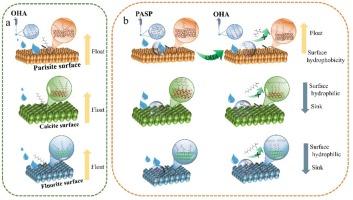
The flotation separation of parisite from calcium-bearing gangue minerals, such as fluorite and calcite, poses a significant challenge in the rare earth ore production process. In this study, an eco-friendly and highly selective depressant polyaspartic acid (PASP) was adopted in the flotation separation of parisite from calcite and fluorite, and its depression mechanism was investigated through various surface analysis and testing methods, including zeta potential tests, contact angle measurements, Fourier transform infrared spectroscopy (FTIR), X-ray photoelectron spectroscopy (XPS), and atomic force microscopy (AFM). The flotation test results indicated that PASP significantly inhibited the flotation of fluorite and calcite, with negligible effect on parisite when using octyl hydroxamic acid (OHA) as a collector at weak alkaline pH. The artificial mixed mineral flotation proved that PASP could achieve effective flotation separation of parisite from calcite and fluorite. Zeta potential tests and FTIR analyses demonstrated that the adsorption of PASP prevented OHA adsorption on calcite and fluorite surfaces, with minimal impact on OHA adsorption on parisite surface. XPS analyses confirmed that PASP was mainly chemisorbed on the surfaces of calcite and fluorite through the chelation reaction between polar groups (–NH– and –COO−) of PASP with the Ca2+ on these surfaces. AFM clearly showed the agglomerative adsorption of PASP on the surfaces of fluorite and calcite. Thus, PASP could be an efficient depressant for calcite and fluorite in parisite flotation, providing novel insights into addressing rare earth ore flotation challenges.
期刊介绍:
The purpose of the journal is to provide for the rapid publication of topical papers featuring the latest developments in the allied fields of mineral processing and extractive metallurgy. Its wide ranging coverage of research and practical (operating) topics includes physical separation methods, such as comminution, flotation concentration and dewatering, chemical methods such as bio-, hydro-, and electro-metallurgy, analytical techniques, process control, simulation and instrumentation, and mineralogical aspects of processing. Environmental issues, particularly those pertaining to sustainable development, will also be strongly covered.



 京公网安备 11010802042870号
京ICP备2023020795号-1
京公网安备 11010802042870号
京ICP备2023020795号-1

 分享
分享
 求助内容:
求助内容: 应助结果提醒方式:
 扫码关注我们
