{"title":"Ruthenium-Catalyzed Chemoselective Olefin Transfer Hydrogenation of alpha, beta-Unsaturated Carbonyl Systems By Using EtOH as Hydrogen Source","authors":"Alicia Beaufils, Prof. Dr. Martin Albrecht","doi":"10.1002/cctc.202401596","DOIUrl":null,"url":null,"abstract":"<p>The use of EtOH as hydrogen donor is remarkably under explored in transfer hydrogenation reactions, even though EtOH represents an appealing hydrogen source. With the cationic ruthenium complex [Ru(PYA)(cymene)]<sup>+</sup>, <b>1</b>, containing a N,N-bidentate amino-functionalized pyridinium amidate (PYA) ligand as catalyst precursor, we here demonstrate the first example of chemoselective room temperature transfer hydrogenation of the C═C bond in α,β-unsaturated ketones using EtOH as benign hydrogen source to yield a variety of functionalized ketones. The reaction proceeds under mild conditions with K<sub>2</sub>CO<sub>3</sub> as base and conventiently at room temperature. A broad substrate scope, including various functionalized α,β-unsaturated carbonyl groups, demonstrates the general applicability of this method. Preliminary mechanistic studies suggest the formation of an alkoxide complex [<b>1</b>]–OEt as an initially formed species, and the requirement for EtOH to induce hydride transfer, suggesting a protic activation of the catalyst.</p>","PeriodicalId":141,"journal":{"name":"ChemCatChem","volume":"17 3","pages":""},"PeriodicalIF":3.9000,"publicationDate":"2024-10-30","publicationTypes":"Journal Article","fieldsOfStudy":null,"isOpenAccess":false,"openAccessPdf":"https://onlinelibrary.wiley.com/doi/epdf/10.1002/cctc.202401596","citationCount":"0","resultStr":null,"platform":"Semanticscholar","paperid":null,"PeriodicalName":"ChemCatChem","FirstCategoryId":"92","ListUrlMain":"https://chemistry-europe.onlinelibrary.wiley.com/doi/10.1002/cctc.202401596","RegionNum":3,"RegionCategory":"化学","ArticlePicture":[],"TitleCN":null,"AbstractTextCN":null,"PMCID":null,"EPubDate":"","PubModel":"","JCR":"Q2","JCRName":"CHEMISTRY, PHYSICAL","Score":null,"Total":0}
引用次数: 0
Abstract
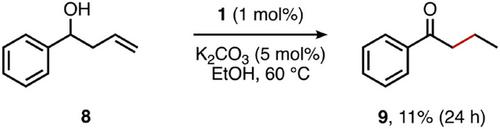
The use of EtOH as hydrogen donor is remarkably under explored in transfer hydrogenation reactions, even though EtOH represents an appealing hydrogen source. With the cationic ruthenium complex [Ru(PYA)(cymene)]+, 1, containing a N,N-bidentate amino-functionalized pyridinium amidate (PYA) ligand as catalyst precursor, we here demonstrate the first example of chemoselective room temperature transfer hydrogenation of the C═C bond in α,β-unsaturated ketones using EtOH as benign hydrogen source to yield a variety of functionalized ketones. The reaction proceeds under mild conditions with K2CO3 as base and conventiently at room temperature. A broad substrate scope, including various functionalized α,β-unsaturated carbonyl groups, demonstrates the general applicability of this method. Preliminary mechanistic studies suggest the formation of an alkoxide complex [1]–OEt as an initially formed species, and the requirement for EtOH to induce hydride transfer, suggesting a protic activation of the catalyst.
期刊介绍:
With an impact factor of 4.495 (2018), ChemCatChem is one of the premier journals in the field of catalysis. The journal provides primary research papers and critical secondary information on heterogeneous, homogeneous and bio- and nanocatalysis. The journal is well placed to strengthen cross-communication within between these communities. Its authors and readers come from academia, the chemical industry, and government laboratories across the world. It is published on behalf of Chemistry Europe, an association of 16 European chemical societies, and is supported by the German Catalysis Society.






 京公网安备 11010802042870号
京ICP备2023020795号-1
京公网安备 11010802042870号
京ICP备2023020795号-1

 分享
分享
 求助内容:
求助内容: 应助结果提醒方式:
 扫码关注我们
