Life 2.0: a comprehensive cross-sectional profiling of long-term allogeneic hematopoietic cell transplantation survivors compared to a matched general population cohort
Hélène Schoemans, Kathy Goris, Steffen Fieuws, Koen Theunissen, Kristel Buvé, Liesbet Lammertijn, Greet Bries, Hilde Demuynck, Vincent Maertens, Helena Maes, Stef Meers, Christine Schuermans, Inge Vrelust, Hadewijch De Samblanx, Griet Huysmans, Vibeke Vergote, Marielle Beckers, Johan Maertens, Sabina De Geest, Fabienne Dobbels
{"title":"Life 2.0: a comprehensive cross-sectional profiling of long-term allogeneic hematopoietic cell transplantation survivors compared to a matched general population cohort","authors":"Hélène Schoemans, Kathy Goris, Steffen Fieuws, Koen Theunissen, Kristel Buvé, Liesbet Lammertijn, Greet Bries, Hilde Demuynck, Vincent Maertens, Helena Maes, Stef Meers, Christine Schuermans, Inge Vrelust, Hadewijch De Samblanx, Griet Huysmans, Vibeke Vergote, Marielle Beckers, Johan Maertens, Sabina De Geest, Fabienne Dobbels","doi":"10.1038/s41409-025-02521-5","DOIUrl":null,"url":null,"abstract":"Long-term survivors after allogeneic cell transplantation (HCT) have unique needs. We performed a cross-sectional case-control study to describe the survivorship profile of 244 adult allogeneic transplantation recipients at a median of 8.4 years post-HCT and compared it to controls from the general population (matched 1:3 based on age, gender, and province of residence). The most prevalent medical complications were graft versus host disease (46.7%), impaired kidney function (63.9%), and the presence of a metabolic syndrome (33.6%). Survivors were significantly more likely to report a sub-optimal perceived health status than controls (82.0% versus 52.1% respectively, OR 4.57, p < 0.0001). They also reported significantly lower employment rates (42.6% versus 55.6% respectively, OR 0.389, p < 0.0001) and more polypharmacy (32.0% versus 9.6% respectively, OR 5.0, p < 0.0001) than matched counterparts. Social support and mental health were generally preserved. Apart for a concerning tendency to medication non-adherence, low physical activity (54.5%), and inappropriate exposition to UV (44.7%), health-related behavior was adequate. Many survivors have a health status comparable to chronically ill patients and, if so, should be managed as such. Novel patient-centered initiatives based on chronic care models could support survivors in preventing and dealing with long-term complications, regaining functionality, and returning to their role in society.","PeriodicalId":9126,"journal":{"name":"Bone Marrow Transplantation","volume":"60 4","pages":"507-518"},"PeriodicalIF":5.2000,"publicationDate":"2025-02-06","publicationTypes":"Journal Article","fieldsOfStudy":null,"isOpenAccess":false,"openAccessPdf":"","citationCount":"0","resultStr":null,"platform":"Semanticscholar","paperid":null,"PeriodicalName":"Bone Marrow Transplantation","FirstCategoryId":"3","ListUrlMain":"https://www.nature.com/articles/s41409-025-02521-5","RegionNum":2,"RegionCategory":"医学","ArticlePicture":[],"TitleCN":null,"AbstractTextCN":null,"PMCID":null,"EPubDate":"","PubModel":"","JCR":"Q1","JCRName":"HEMATOLOGY","Score":null,"Total":0}
引用次数: 0
Abstract
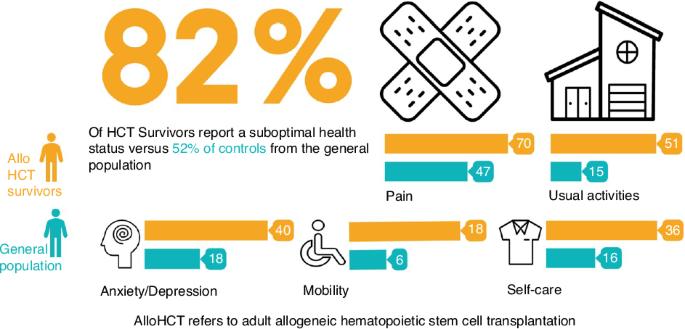
Long-term survivors after allogeneic cell transplantation (HCT) have unique needs. We performed a cross-sectional case-control study to describe the survivorship profile of 244 adult allogeneic transplantation recipients at a median of 8.4 years post-HCT and compared it to controls from the general population (matched 1:3 based on age, gender, and province of residence). The most prevalent medical complications were graft versus host disease (46.7%), impaired kidney function (63.9%), and the presence of a metabolic syndrome (33.6%). Survivors were significantly more likely to report a sub-optimal perceived health status than controls (82.0% versus 52.1% respectively, OR 4.57, p < 0.0001). They also reported significantly lower employment rates (42.6% versus 55.6% respectively, OR 0.389, p < 0.0001) and more polypharmacy (32.0% versus 9.6% respectively, OR 5.0, p < 0.0001) than matched counterparts. Social support and mental health were generally preserved. Apart for a concerning tendency to medication non-adherence, low physical activity (54.5%), and inappropriate exposition to UV (44.7%), health-related behavior was adequate. Many survivors have a health status comparable to chronically ill patients and, if so, should be managed as such. Novel patient-centered initiatives based on chronic care models could support survivors in preventing and dealing with long-term complications, regaining functionality, and returning to their role in society.
同种异体细胞移植(HCT)后的长期幸存者有独特的需求。我们进行了一项横断面病例对照研究,描述了244名成人同种异体移植受者在hct后平均8.4年的生存概况,并将其与普通人群的对照进行了比较(根据年龄、性别和居住省份匹配1:3)。最常见的医学并发症是移植物抗宿主病(46.7%)、肾功能受损(63.9%)和代谢综合征(33.6%)。与对照组相比,幸存者更有可能报告亚理想的感知健康状况(分别为82.0%和52.1%,OR 4.57, p
期刊介绍:
Bone Marrow Transplantation publishes high quality, peer reviewed original research that addresses all aspects of basic biology and clinical use of haemopoietic stem cell transplantation.
The broad scope of the journal thus encompasses topics such as stem cell biology, e.g., kinetics and cytokine control, transplantation immunology e.g., HLA and matching techniques, translational research, and clinical results of specific transplant protocols. Bone Marrow Transplantation publishes 24 issues a year.



 京公网安备 11010802042870号
京ICP备2023020795号-1
京公网安备 11010802042870号
京ICP备2023020795号-1

 分享
分享
 求助内容:
求助内容: 应助结果提醒方式:
 扫码关注我们
