The potential of the serum uric acid to high-density lipoprotein cholesterol ratio as a predictive biomarker of diabetes risk: a study based on NHANES 2005-2018.
{"title":"The potential of the serum uric acid to high-density lipoprotein cholesterol ratio as a predictive biomarker of diabetes risk: a study based on NHANES 2005-2018.","authors":"Jianming Yin, Chuanjie Zheng, Xiaoqian Lin, Chaoqiang Huang, Zhanhui Hu, Shuyuan Lin, Yiqian Qu","doi":"10.3389/fendo.2024.1499417","DOIUrl":null,"url":null,"abstract":"<p><p>Previous studies have indicated an association between UHR and diabetes risk, but evidence from large-scale and diverse populations remains limited. This study aims to verify UHR's independent role in diabetes risk prediction in a large sample population and assess its applicability across different populations. We drew upon data from 30,813 participants collected during the 2005-2018 NHANES cycle. The association between UHR and the risk of diabetes was explored using multivariate logistic regression models, with key predictive factors identified through LASSO regression. Model effectiveness was evaluated through receiver operating characteristic (ROC) curves, decision curve analysis (DCA), and calibration metrics. Additionally, restricted cubic spline (RCS) and threshold effect assessments were applied to examine the nonlinear association between UHR and diabetes risk. The results showed that UHR levels were notably elevated in individuals with diabetes when compared to those without diabetes (<i>p</i> < 0.001). The occurrence of diabetes showed a marked increase across ascending UHR quartiles (6.63%, 10.88%, 14.15%, 18.02%; <i>p</i> < 0.001). Results from multivariate logistic regression indicated that elevated UHR was strongly linked to a heightened risk of diabetes; participants in the highest UHR quartile were found to have nearly four times the risk compared to those in the lowest quartile (OR = 4.063, 95% CI: 3.536-4.669, <i>p</i> < 0.001). Subgroup analyses demonstrated that the predictive effect of UHR was more pronounced in females. Key variables selected via LASSO regression improved the model's performance. Restricted cubic spline (RCS) analysis indicated an inflection point at UHR = 10; beyond this point, diabetes risk accelerated, and when UHR exceeded 18, the risk increased significantly (OR > 1). ROC curve analysis showed the baseline model (M1) had an area under the curve (AUC) of 0.797, while the multivariable model (M4) after LASSO selection had an AUC of 0.789. Decision curve analysis and calibration curves validated the model's predictive ability and consistency. This study indicates that UHR may be an independent predictor of diabetes risk, showing a positive correlation with diabetes and a more pronounced predictive effect in females.</p>","PeriodicalId":12447,"journal":{"name":"Frontiers in Endocrinology","volume":"15 ","pages":"1499417"},"PeriodicalIF":4.6000,"publicationDate":"2025-01-23","publicationTypes":"Journal Article","fieldsOfStudy":null,"isOpenAccess":false,"openAccessPdf":"https://www.ncbi.nlm.nih.gov/pmc/articles/PMC11798810/pdf/","citationCount":"0","resultStr":null,"platform":"Semanticscholar","paperid":null,"PeriodicalName":"Frontiers in Endocrinology","FirstCategoryId":"3","ListUrlMain":"https://doi.org/10.3389/fendo.2024.1499417","RegionNum":2,"RegionCategory":"医学","ArticlePicture":[],"TitleCN":null,"AbstractTextCN":null,"PMCID":null,"EPubDate":"2024/1/1 0:00:00","PubModel":"eCollection","JCR":"Q2","JCRName":"ENDOCRINOLOGY & METABOLISM","Score":null,"Total":0}
引用次数: 0
Abstract
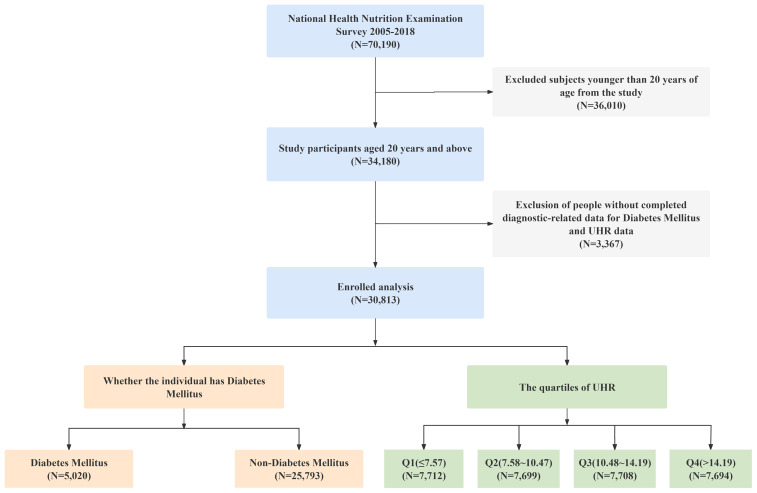
Previous studies have indicated an association between UHR and diabetes risk, but evidence from large-scale and diverse populations remains limited. This study aims to verify UHR's independent role in diabetes risk prediction in a large sample population and assess its applicability across different populations. We drew upon data from 30,813 participants collected during the 2005-2018 NHANES cycle. The association between UHR and the risk of diabetes was explored using multivariate logistic regression models, with key predictive factors identified through LASSO regression. Model effectiveness was evaluated through receiver operating characteristic (ROC) curves, decision curve analysis (DCA), and calibration metrics. Additionally, restricted cubic spline (RCS) and threshold effect assessments were applied to examine the nonlinear association between UHR and diabetes risk. The results showed that UHR levels were notably elevated in individuals with diabetes when compared to those without diabetes (p < 0.001). The occurrence of diabetes showed a marked increase across ascending UHR quartiles (6.63%, 10.88%, 14.15%, 18.02%; p < 0.001). Results from multivariate logistic regression indicated that elevated UHR was strongly linked to a heightened risk of diabetes; participants in the highest UHR quartile were found to have nearly four times the risk compared to those in the lowest quartile (OR = 4.063, 95% CI: 3.536-4.669, p < 0.001). Subgroup analyses demonstrated that the predictive effect of UHR was more pronounced in females. Key variables selected via LASSO regression improved the model's performance. Restricted cubic spline (RCS) analysis indicated an inflection point at UHR = 10; beyond this point, diabetes risk accelerated, and when UHR exceeded 18, the risk increased significantly (OR > 1). ROC curve analysis showed the baseline model (M1) had an area under the curve (AUC) of 0.797, while the multivariable model (M4) after LASSO selection had an AUC of 0.789. Decision curve analysis and calibration curves validated the model's predictive ability and consistency. This study indicates that UHR may be an independent predictor of diabetes risk, showing a positive correlation with diabetes and a more pronounced predictive effect in females.
期刊介绍:
Frontiers in Endocrinology is a field journal of the "Frontiers in" journal series.
In today’s world, endocrinology is becoming increasingly important as it underlies many of the challenges societies face - from obesity and diabetes to reproduction, population control and aging. Endocrinology covers a broad field from basic molecular and cellular communication through to clinical care and some of the most crucial public health issues. The journal, thus, welcomes outstanding contributions in any domain of endocrinology.
Frontiers in Endocrinology publishes articles on the most outstanding discoveries across a wide research spectrum of Endocrinology. The mission of Frontiers in Endocrinology is to bring all relevant Endocrinology areas together on a single platform.






 京公网安备 11010802042870号
京ICP备2023020795号-1
京公网安备 11010802042870号
京ICP备2023020795号-1

 分享
分享
 求助内容:
求助内容: 应助结果提醒方式:
 扫码关注我们
