Meaghan Jane O'Donnell, Rezan Abdul Kadir, Karin P. M. van Galen, Michelle Lavin, the EAHAD Women and Girls Working Group
{"title":"Are Women Welcome in Haemophilia Trials?","authors":"Meaghan Jane O'Donnell, Rezan Abdul Kadir, Karin P. M. van Galen, Michelle Lavin, the EAHAD Women and Girls Working Group","doi":"10.1111/hae.70001","DOIUrl":null,"url":null,"abstract":"<p>We read with interest the letter from Fedewa et al., focused on the inclusion of female participants in interventional clinical trial for haemophilia [<span>1</span>]. The specific needs of women and girls with haemophilia have long been overlooked, with recognition of women as affected by, rather than just carriers of, haemophilia only introduced in 2021 [<span>2</span>]. Care for women with haemophilia and carriers in our treatment centres has historically focused on pregnancy management, primarily to ensure early detection and management of male offspring. The specific needs of women and girls with haemophilia are often overlooked in clinical trials and treatment guidelines and therapeutic equivalency is often assumed between males and females in the absence of evidence. Indeed, even in the recent 2024 ISTH guidelines, the only reference to women with haemophilia is to state twice ‘<i>Since haemophilia can also affect women, all the recommendations in this guideline, whether strong or conditional, also apply to women who have low plasma levels of FVIII or FIX and a propensity toward bleeding</i>’ [<span>3</span>]. These two identical statements comprise only 0.5% of the total guideline word count (68/12,483 words), with no further tailoring of approaches to women and girls with haemophilia [<span>3</span>]. While the role of prophylaxis for males with haemophilia is now established, data on the use of prophylaxis for heavy menstrual bleeding (HMB) in women with haemophilia are lacking. As part of our work in the European Association for Haemophilia and Allied Disorders (EAHAD) we have recently undertaken a project similar to that described by Fedewa et al. Our review focused on examining the evidence base, if any, for the use of prophylaxis in women with haemophilia for the management of HMB (periodic prophylaxis). Our project outcomes complement that of Fedewa et al., highlighting not only the failure to enrol women in clinical trials in haemophilia but also the lack of female-specific entry criteria and outcomes in haemophilia trial design.</p><p>In contrast to Fedewa et al., we searched not only clinicaltrials.gov (NCT) but also the European Union Drug Regulating Authorities Clinical Trials Database (EU) and Health Canada's Clinical Trials Database (CCTD) [<span>4-6</span>]. Our search focused on studies conducted over a shorter timeframe (2014–2024), with databases interrogated between August 13th and October 5th 2024. As the aim of our work was to examine the impact of prophylaxis on menstrual-related outcomes in completed studies, we excluded duplicates, those which prematurely terminated or studies which did not relate to the use of prophylaxis. Focusing on studies for which women and girls with haemophilia with the potential to menstruate (>12 yo) were eligible to enrol, we recorded the number and gender of participants ultimately enrolled to each study. Where results were not posted on the associated regulatory website, PubMed (https://pubmed.ncbi.nlm.nih.gov) was searched for linked publications using the clinical trial number. For each study we recorded any female-specific data included in the predefined inclusion criteria or outcomes as well as contraceptive requirements if stated.</p><p>The flow of studies reviewed is outlined in Figure 1. Due to a low yield using the initial search terms (haemophilia AND prophylaxis AND menstrual/menstruation; three studies resulted on Clinicaltrials.gov) we broadened the search terms to include all interventional studies using the terms ‘haemophilia AND prophylaxis’. This identified a total of 262 studies—157 NCT, 88 EU and 17 CCTD. Following the exclusion of duplicates (<i>n</i> = 63), those not focused on prophylaxis (<i>n</i> = 54) or prematurely terminated (<i>n</i> = 32), 113 studies remained for a full assessment.</p><p>The majority of studies (91/113, 80%) offered recruitment only to males or children. Of the 22 studies open to females, only three studies ultimately reported recruiting women stated to be >12 yo. This may be related to recruitment bias or perhaps the lack of recognition or registration of females with haemophilia in the centres involved. Of these 113 interventional studies between 2014 and 2024, enrolment data identified 4503 participants, of which five were women >12 years old (yo) (with one person possibly double counted in an extension study) [<span>7-9</span>]. Three further females potentially of menstrual age recruited to the HAVEN-6 study; however data to date does not specify their age, only that 21.9% of overall participants were aged <12 yo [<span>10</span>].</p><p>Of greater concern is the lack of inclusion of female specific inclusion criteria or outcomes. Only one study included HMB (baseline Pictorial Bleeding Assessment Chart, PBAC, >150) in the inclusion criteria [<span>9</span>]. Of the 22 studies in which women could enrol, 13/22 (59%) required contraceptive use for females in comparison to 3/22 (14%) for male participants. Despite widespread use of traditional haemophilia outcomes (annualized bleed rate), female specific outcomes were included in just three studies (reduction in menstrual bleeding; self reported or measured by the PBAC, use of the Menorrhagia Impact Questionnaire or Menstrual Bleed Questionnaire) [<span>9-11</span>].</p><p>Recruiting women with haemophilia to clinical trials may be considered challenging, but the low rates of female involvement are made starker by comparison to the numbers reported enrolled to experimental gene therapy studies (<i>n</i> = 364) or paediatric studies (<i>n</i> = 1095) during the same time period. As the majority of studies were registered with clinicaltrials.gov, our reported rates of females enrolled are similar to that observed by Fedewa et al. [<span>1</span>]. Of concern, however, is that this work focuses on the last 10 rather than 20 years and still shows limited progress.</p><p>Our data highlight that the majority of interventional haemophilia clinical trials fail to offer recruitment to women with haemophilia. Even for those studies open to females, the majority ultimately recruited only males. Female-specific bleeding was largely ignored in haemophilia trial design, incorporated into inclusion criteria in only one study and as an outcome measure in only two completed and one recruiting study. Clinical trials frequently place an additional burden of contraception on female participants, presenting another barrier to the participation of women in trials. Outcome measures used in haemophilia clinical trials remain centred around annualized bleed rate or joint bleed rate. With the introduction of extended half-life and novel therapies in haemophilia, the conversation is increasingly focused on a ‘zero bleed’ or ‘bleed free’ life. While aspirational, this underscores the male bias in outcomes for haemophilia as the ‘zero bleed’ axiom is not compatible with physiologically bleeding experienced by women through menstruation.</p><p>The lack of female participation in studies may be easily dismissed as a lack of interest, however, the recent NBDF State of the Science Research Summit highlighted that ‘<i>understanding, diagnosing, and treating inherited BDs in persons with the potential to menstruate will best be advanced by studies designed with and for this population</i>’ [<span>12</span>]. Involvement of WwH as lived experience experts (LEE) in haemophilia trials & design is therefore not only a clinical necessity but also addresses a key identified need within the patient community [<span>13</span>].</p><p>The continued failure to address menstruation in trial design further marginalizes the experiences of affected women with haemophilia and leaves healthcare providers without evidence to guide clinical practice. As a community, it is incumbent upon us that we co-design clinical trials to meet the challenges all our patients face and ensure equity not only in inclusion but in outcome assessment, with suggested action items in Table 1. The Sex and Gender Equity in Research (SAGER) guidelines provide a framework which should be applied to all future studies, encouraging researchers to address sex and gender issues relevant to the topic and ensure integration throughout study design, implementation and reporting [<span>14</span>]. We hope this work and the paper by Fedewa et al. act as catalysts for more balanced inclusion in future haemophilia interventional studies.</p><p>M.J.O'D and M.L. collected and analysed the data. M.J.O'D, R.A.K., K.P.M.G. and M.L. were involved in writing and reviewing the paper.</p><p>Generative AI (e.g., ChatGPT) was not used at any stage in this work.</p><p>This study used data which was openly available; no individual patient data was reviewed or accessed.</p><p>Meaghan Jane O'Donnell and Rezan Abdul Kadir have no COIs to declare. Karin P. M. van Galen has received unrestricted research grants from Octapharma and served as speaker for Sobi, Takeda and CLS Behring. Michelle Lavin has served on an advisory board for CSL Behring, as a consultant for Sobi, CSL Behring and Band Therapeutics, received speaker fees from Sobi and Takeda and unrestricted research funding from Takeda.</p>","PeriodicalId":12819,"journal":{"name":"Haemophilia","volume":"31 3","pages":"575-577"},"PeriodicalIF":3.0000,"publicationDate":"2025-02-07","publicationTypes":"Journal Article","fieldsOfStudy":null,"isOpenAccess":false,"openAccessPdf":"https://onlinelibrary.wiley.com/doi/epdf/10.1111/hae.70001","citationCount":"0","resultStr":null,"platform":"Semanticscholar","paperid":null,"PeriodicalName":"Haemophilia","FirstCategoryId":"3","ListUrlMain":"https://onlinelibrary.wiley.com/doi/10.1111/hae.70001","RegionNum":2,"RegionCategory":"医学","ArticlePicture":[],"TitleCN":null,"AbstractTextCN":null,"PMCID":null,"EPubDate":"","PubModel":"","JCR":"Q2","JCRName":"HEMATOLOGY","Score":null,"Total":0}
引用次数: 0
Abstract
We read with interest the letter from Fedewa et al., focused on the inclusion of female participants in interventional clinical trial for haemophilia [1]. The specific needs of women and girls with haemophilia have long been overlooked, with recognition of women as affected by, rather than just carriers of, haemophilia only introduced in 2021 [2]. Care for women with haemophilia and carriers in our treatment centres has historically focused on pregnancy management, primarily to ensure early detection and management of male offspring. The specific needs of women and girls with haemophilia are often overlooked in clinical trials and treatment guidelines and therapeutic equivalency is often assumed between males and females in the absence of evidence. Indeed, even in the recent 2024 ISTH guidelines, the only reference to women with haemophilia is to state twice ‘Since haemophilia can also affect women, all the recommendations in this guideline, whether strong or conditional, also apply to women who have low plasma levels of FVIII or FIX and a propensity toward bleeding’ [3]. These two identical statements comprise only 0.5% of the total guideline word count (68/12,483 words), with no further tailoring of approaches to women and girls with haemophilia [3]. While the role of prophylaxis for males with haemophilia is now established, data on the use of prophylaxis for heavy menstrual bleeding (HMB) in women with haemophilia are lacking. As part of our work in the European Association for Haemophilia and Allied Disorders (EAHAD) we have recently undertaken a project similar to that described by Fedewa et al. Our review focused on examining the evidence base, if any, for the use of prophylaxis in women with haemophilia for the management of HMB (periodic prophylaxis). Our project outcomes complement that of Fedewa et al., highlighting not only the failure to enrol women in clinical trials in haemophilia but also the lack of female-specific entry criteria and outcomes in haemophilia trial design.
In contrast to Fedewa et al., we searched not only clinicaltrials.gov (NCT) but also the European Union Drug Regulating Authorities Clinical Trials Database (EU) and Health Canada's Clinical Trials Database (CCTD) [4-6]. Our search focused on studies conducted over a shorter timeframe (2014–2024), with databases interrogated between August 13th and October 5th 2024. As the aim of our work was to examine the impact of prophylaxis on menstrual-related outcomes in completed studies, we excluded duplicates, those which prematurely terminated or studies which did not relate to the use of prophylaxis. Focusing on studies for which women and girls with haemophilia with the potential to menstruate (>12 yo) were eligible to enrol, we recorded the number and gender of participants ultimately enrolled to each study. Where results were not posted on the associated regulatory website, PubMed (https://pubmed.ncbi.nlm.nih.gov) was searched for linked publications using the clinical trial number. For each study we recorded any female-specific data included in the predefined inclusion criteria or outcomes as well as contraceptive requirements if stated.
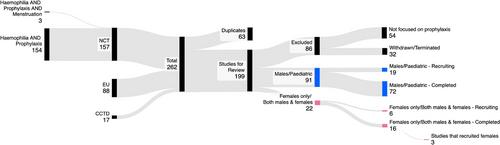
The flow of studies reviewed is outlined in Figure 1. Due to a low yield using the initial search terms (haemophilia AND prophylaxis AND menstrual/menstruation; three studies resulted on Clinicaltrials.gov) we broadened the search terms to include all interventional studies using the terms ‘haemophilia AND prophylaxis’. This identified a total of 262 studies—157 NCT, 88 EU and 17 CCTD. Following the exclusion of duplicates (n = 63), those not focused on prophylaxis (n = 54) or prematurely terminated (n = 32), 113 studies remained for a full assessment.
The majority of studies (91/113, 80%) offered recruitment only to males or children. Of the 22 studies open to females, only three studies ultimately reported recruiting women stated to be >12 yo. This may be related to recruitment bias or perhaps the lack of recognition or registration of females with haemophilia in the centres involved. Of these 113 interventional studies between 2014 and 2024, enrolment data identified 4503 participants, of which five were women >12 years old (yo) (with one person possibly double counted in an extension study) [7-9]. Three further females potentially of menstrual age recruited to the HAVEN-6 study; however data to date does not specify their age, only that 21.9% of overall participants were aged <12 yo [10].
Of greater concern is the lack of inclusion of female specific inclusion criteria or outcomes. Only one study included HMB (baseline Pictorial Bleeding Assessment Chart, PBAC, >150) in the inclusion criteria [9]. Of the 22 studies in which women could enrol, 13/22 (59%) required contraceptive use for females in comparison to 3/22 (14%) for male participants. Despite widespread use of traditional haemophilia outcomes (annualized bleed rate), female specific outcomes were included in just three studies (reduction in menstrual bleeding; self reported or measured by the PBAC, use of the Menorrhagia Impact Questionnaire or Menstrual Bleed Questionnaire) [9-11].
Recruiting women with haemophilia to clinical trials may be considered challenging, but the low rates of female involvement are made starker by comparison to the numbers reported enrolled to experimental gene therapy studies (n = 364) or paediatric studies (n = 1095) during the same time period. As the majority of studies were registered with clinicaltrials.gov, our reported rates of females enrolled are similar to that observed by Fedewa et al. [1]. Of concern, however, is that this work focuses on the last 10 rather than 20 years and still shows limited progress.
Our data highlight that the majority of interventional haemophilia clinical trials fail to offer recruitment to women with haemophilia. Even for those studies open to females, the majority ultimately recruited only males. Female-specific bleeding was largely ignored in haemophilia trial design, incorporated into inclusion criteria in only one study and as an outcome measure in only two completed and one recruiting study. Clinical trials frequently place an additional burden of contraception on female participants, presenting another barrier to the participation of women in trials. Outcome measures used in haemophilia clinical trials remain centred around annualized bleed rate or joint bleed rate. With the introduction of extended half-life and novel therapies in haemophilia, the conversation is increasingly focused on a ‘zero bleed’ or ‘bleed free’ life. While aspirational, this underscores the male bias in outcomes for haemophilia as the ‘zero bleed’ axiom is not compatible with physiologically bleeding experienced by women through menstruation.
The lack of female participation in studies may be easily dismissed as a lack of interest, however, the recent NBDF State of the Science Research Summit highlighted that ‘understanding, diagnosing, and treating inherited BDs in persons with the potential to menstruate will best be advanced by studies designed with and for this population’ [12]. Involvement of WwH as lived experience experts (LEE) in haemophilia trials & design is therefore not only a clinical necessity but also addresses a key identified need within the patient community [13].
The continued failure to address menstruation in trial design further marginalizes the experiences of affected women with haemophilia and leaves healthcare providers without evidence to guide clinical practice. As a community, it is incumbent upon us that we co-design clinical trials to meet the challenges all our patients face and ensure equity not only in inclusion but in outcome assessment, with suggested action items in Table 1. The Sex and Gender Equity in Research (SAGER) guidelines provide a framework which should be applied to all future studies, encouraging researchers to address sex and gender issues relevant to the topic and ensure integration throughout study design, implementation and reporting [14]. We hope this work and the paper by Fedewa et al. act as catalysts for more balanced inclusion in future haemophilia interventional studies.
M.J.O'D and M.L. collected and analysed the data. M.J.O'D, R.A.K., K.P.M.G. and M.L. were involved in writing and reviewing the paper.
Generative AI (e.g., ChatGPT) was not used at any stage in this work.
This study used data which was openly available; no individual patient data was reviewed or accessed.
Meaghan Jane O'Donnell and Rezan Abdul Kadir have no COIs to declare. Karin P. M. van Galen has received unrestricted research grants from Octapharma and served as speaker for Sobi, Takeda and CLS Behring. Michelle Lavin has served on an advisory board for CSL Behring, as a consultant for Sobi, CSL Behring and Band Therapeutics, received speaker fees from Sobi and Takeda and unrestricted research funding from Takeda.
期刊介绍:
Haemophilia is an international journal dedicated to the exchange of information regarding the comprehensive care of haemophilia. The Journal contains review articles, original scientific papers and case reports related to haemophilia care, with frequent supplements. Subjects covered include:
clotting factor deficiencies, both inherited and acquired: haemophilia A, B, von Willebrand''s disease, deficiencies of factor V, VII, X and XI
replacement therapy for clotting factor deficiencies
component therapy in the developing world
transfusion transmitted disease
haemophilia care and paediatrics, orthopaedics, gynaecology and obstetrics
nursing
laboratory diagnosis
carrier detection
psycho-social concerns
economic issues
audit
inherited platelet disorders.




 京公网安备 11010802042870号
京ICP备2023020795号-1
京公网安备 11010802042870号
京ICP备2023020795号-1

 分享
分享
 求助内容:
求助内容: 应助结果提醒方式:
 扫码关注我们
