Beau Mostyn Sullivan, Amanda M George, Debra Rickwood
{"title":"Construction and validation of the motives for smartphone use questionnaire.","authors":"Beau Mostyn Sullivan, Amanda M George, Debra Rickwood","doi":"10.1556/2006.2025.00006","DOIUrl":null,"url":null,"abstract":"<p><strong>Background and aims: </strong>Smartphones have been so widely adopted that many consider them essential for modern life. However, some people use their phone excessively, which can cause functional impairment or harm, termed problematic smartphone use (PSU). Smartphone use motives may help explain why users engage in general smartphone use and PSU, but existing measures may not capture certain motives which research suggests are important to smartphone use. To address this, across two studies, we constructed and validated a Motives for Smartphone Use Questionnaire (MSUQ) among young adults.</p><p><strong>Methods and results: </strong>In Study 1, the Delphi method was used, whereby engagement with a panel of 23 international academic experts resulted in a pool of 62 smartphone use motives items that measure 11 proposed motives. In Study 2, the 62 items were administered to 680 young adults aged 18-25 years (Mage = 22.50, SD = 2.16). Results from exploratory and confirmatory factor analyses found that the MSUQ has a seven-factor structure, assessing smartphone use to cope, pass time, socialize, obtain social comfort, feel safe, fulfil social obligations, and seek information. These motives differentially influenced PSU and smartphone usage.</p><p><strong>Conclusions: </strong>The MSUQ is a valid measure of motives for smartphone use. It was developed specifically for smartphone use and it includes motives not captured in prior measures.</p>","PeriodicalId":15049,"journal":{"name":"Journal of Behavioral Addictions","volume":" ","pages":"373-393"},"PeriodicalIF":6.2000,"publicationDate":"2025-02-06","publicationTypes":"Journal Article","fieldsOfStudy":null,"isOpenAccess":false,"openAccessPdf":"https://www.ncbi.nlm.nih.gov/pmc/articles/PMC11974415/pdf/","citationCount":"0","resultStr":null,"platform":"Semanticscholar","paperid":null,"PeriodicalName":"Journal of Behavioral Addictions","FirstCategoryId":"3","ListUrlMain":"https://doi.org/10.1556/2006.2025.00006","RegionNum":1,"RegionCategory":"医学","ArticlePicture":[],"TitleCN":null,"AbstractTextCN":null,"PMCID":null,"EPubDate":"2025/3/28 0:00:00","PubModel":"Print","JCR":"Q1","JCRName":"PSYCHIATRY","Score":null,"Total":0}
引用次数: 0
Abstract
Background and aims: Smartphones have been so widely adopted that many consider them essential for modern life. However, some people use their phone excessively, which can cause functional impairment or harm, termed problematic smartphone use (PSU). Smartphone use motives may help explain why users engage in general smartphone use and PSU, but existing measures may not capture certain motives which research suggests are important to smartphone use. To address this, across two studies, we constructed and validated a Motives for Smartphone Use Questionnaire (MSUQ) among young adults.
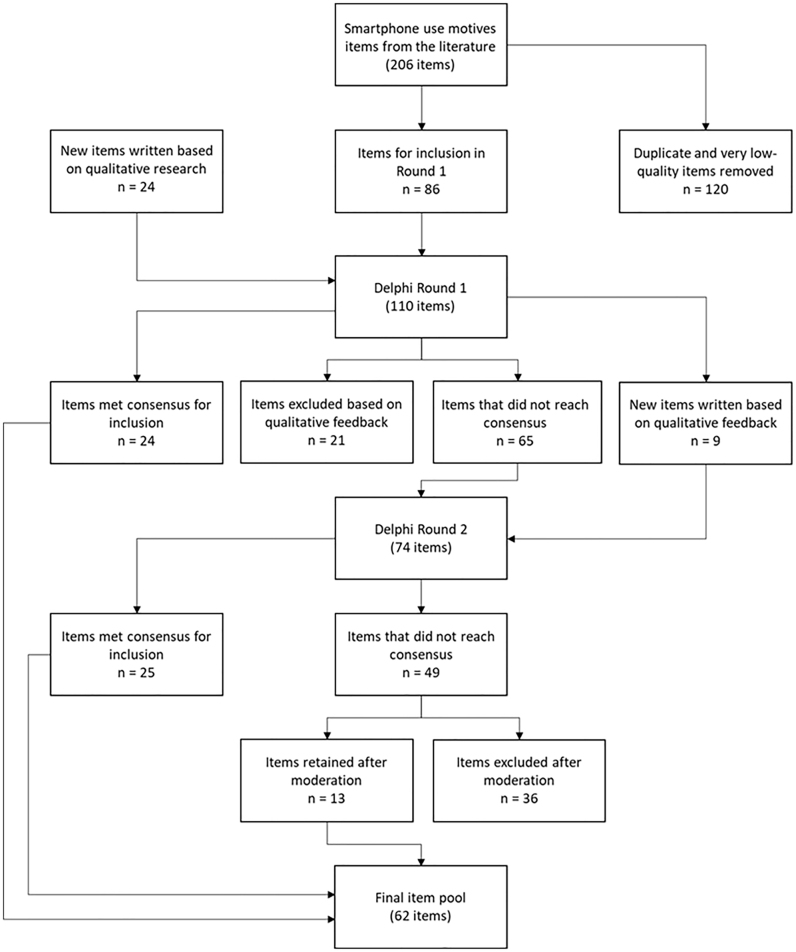
Methods and results: In Study 1, the Delphi method was used, whereby engagement with a panel of 23 international academic experts resulted in a pool of 62 smartphone use motives items that measure 11 proposed motives. In Study 2, the 62 items were administered to 680 young adults aged 18-25 years (Mage = 22.50, SD = 2.16). Results from exploratory and confirmatory factor analyses found that the MSUQ has a seven-factor structure, assessing smartphone use to cope, pass time, socialize, obtain social comfort, feel safe, fulfil social obligations, and seek information. These motives differentially influenced PSU and smartphone usage.
Conclusions: The MSUQ is a valid measure of motives for smartphone use. It was developed specifically for smartphone use and it includes motives not captured in prior measures.
期刊介绍:
The aim of Journal of Behavioral Addictions is to create a forum for the scientific information exchange with regard to behavioral addictions. The journal is a broad focused interdisciplinary one that publishes manuscripts on different approaches of non-substance addictions, research reports focusing on the addictive patterns of various behaviors, especially disorders of the impulsive-compulsive spectrum, and also publishes reviews in these topics. Coverage ranges from genetic and neurobiological research through psychological and clinical psychiatric approaches to epidemiological, sociological and anthropological aspects.



 京公网安备 11010802042870号
京ICP备2023020795号-1
京公网安备 11010802042870号
京ICP备2023020795号-1

 分享
分享
 求助内容:
求助内容: 应助结果提醒方式:
 扫码关注我们
