Durga Kulkarni, Bohee Lee, Nabihah Farhana Ismail, Ahmed Ehsanur Rahman, Julia Spinardi, Moe H Kyaw, Harish Nair
{"title":"Incidence, severity, risk factors and outcomes of SARS-CoV-2 reinfections during the Omicron period: a systematic review and meta-analysis.","authors":"Durga Kulkarni, Bohee Lee, Nabihah Farhana Ismail, Ahmed Ehsanur Rahman, Julia Spinardi, Moe H Kyaw, Harish Nair","doi":"10.7189/jogh.15.04032","DOIUrl":null,"url":null,"abstract":"<p><strong>Background: </strong>Our previous systematic review estimated the cumulative incidence of SARS-CoV-2 reinfections as 1.16% (95% CI = 1.01-1.33%) during the pre-Omicron period. The Omicron variant that emerged in November 2021 was significantly genetically distinct from the previous SARS-CoV-2 variants and thus, more transmissible and posed an increased risk of SARS-CoV-2 reinfections in the population. We, therefore, conducted a fresh systematic review and meta-analysis to estimate the SARS-CoV-2 reinfection burden during the Omicron period.</p><p><strong>Methods: </strong>We searched CINAHL, Medline, Global Health, Embase, and WHO COVID-19 in October 2023 for studies reporting the SARS-CoV-2 reinfection incidence during the Omicron period. The quality of the included studies was assessed using the Joanna Briggs Institute checklists. Random effects meta-analyses were conducted to estimate the incidence, and requirement of hospitalisation of SARS-CoV-2 reinfections. Symptomatic severity of reinfections and case fatality rates were analysed narratively.</p><p><strong>Results: </strong>Thirty-six studies were included. The reinfection cumulative incidence during the Omicron period was 3.35% (95% CI = 1.95-5.72%) based on data from 28 studies. The cumulative incidence was higher in 18-59-year-old adults (6.62% (95% CI = 3.22-13.12%)) compared to other age groups and in health care workers (9.88% (95% CI = 5.18-18.03%)) compared to the general population (2.48% (95% CI = 1.34-4.54%)). We estimated about 1.81% (95% CI = 0.18-15.87%) of the reinfected cases required hospitalisation based on limited and highly variable data.</p><p><strong>Conclusions: </strong>There was an increased risk of reinfections during the Omicron period compared to the pre-Omicron period. The incidence was higher in 18-59-year-old adults and health care workers and generally less severe during the Omicron period. However, data were limited on disease severity and long-term outcomes.</p><p><strong>Registration: </strong>PROSPERO: CRD42023482598.</p>","PeriodicalId":48734,"journal":{"name":"Journal of Global Health","volume":"15 ","pages":"04032"},"PeriodicalIF":4.3000,"publicationDate":"2025-02-07","publicationTypes":"Journal Article","fieldsOfStudy":null,"isOpenAccess":false,"openAccessPdf":"https://www.ncbi.nlm.nih.gov/pmc/articles/PMC11803431/pdf/","citationCount":"0","resultStr":null,"platform":"Semanticscholar","paperid":null,"PeriodicalName":"Journal of Global Health","FirstCategoryId":"3","ListUrlMain":"https://doi.org/10.7189/jogh.15.04032","RegionNum":3,"RegionCategory":"医学","ArticlePicture":[],"TitleCN":null,"AbstractTextCN":null,"PMCID":null,"EPubDate":"","PubModel":"","JCR":"Q1","JCRName":"PUBLIC, ENVIRONMENTAL & OCCUPATIONAL HEALTH","Score":null,"Total":0}
引用次数: 0
Abstract
Background: Our previous systematic review estimated the cumulative incidence of SARS-CoV-2 reinfections as 1.16% (95% CI = 1.01-1.33%) during the pre-Omicron period. The Omicron variant that emerged in November 2021 was significantly genetically distinct from the previous SARS-CoV-2 variants and thus, more transmissible and posed an increased risk of SARS-CoV-2 reinfections in the population. We, therefore, conducted a fresh systematic review and meta-analysis to estimate the SARS-CoV-2 reinfection burden during the Omicron period.
Methods: We searched CINAHL, Medline, Global Health, Embase, and WHO COVID-19 in October 2023 for studies reporting the SARS-CoV-2 reinfection incidence during the Omicron period. The quality of the included studies was assessed using the Joanna Briggs Institute checklists. Random effects meta-analyses were conducted to estimate the incidence, and requirement of hospitalisation of SARS-CoV-2 reinfections. Symptomatic severity of reinfections and case fatality rates were analysed narratively.
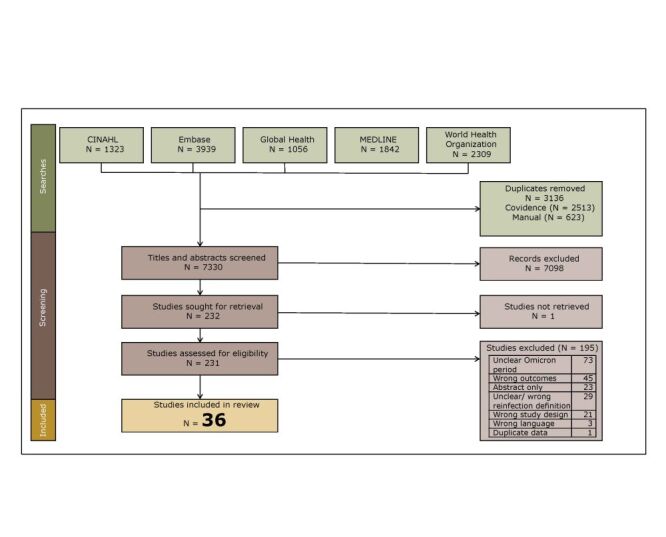
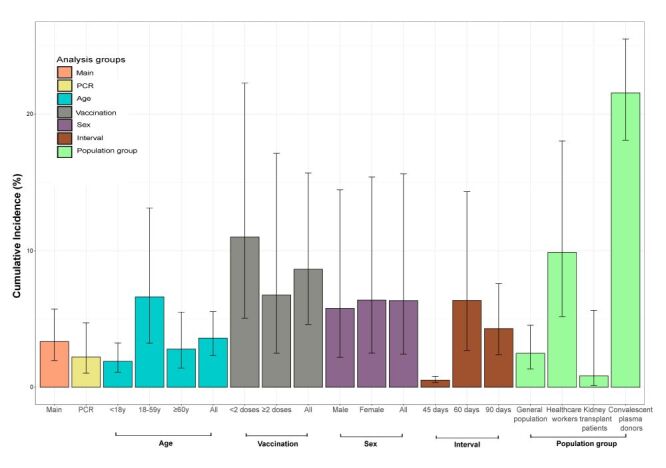
Results: Thirty-six studies were included. The reinfection cumulative incidence during the Omicron period was 3.35% (95% CI = 1.95-5.72%) based on data from 28 studies. The cumulative incidence was higher in 18-59-year-old adults (6.62% (95% CI = 3.22-13.12%)) compared to other age groups and in health care workers (9.88% (95% CI = 5.18-18.03%)) compared to the general population (2.48% (95% CI = 1.34-4.54%)). We estimated about 1.81% (95% CI = 0.18-15.87%) of the reinfected cases required hospitalisation based on limited and highly variable data.
Conclusions: There was an increased risk of reinfections during the Omicron period compared to the pre-Omicron period. The incidence was higher in 18-59-year-old adults and health care workers and generally less severe during the Omicron period. However, data were limited on disease severity and long-term outcomes.
背景:我们之前的系统评价估计,在前欧米克隆时期,SARS-CoV-2再感染的累积发生率为1.16% (95% CI = 1.01-1.33%)。2021年11月出现的欧米克隆变体在遗传上与以前的SARS-CoV-2变体明显不同,因此更具传染性,并增加了人群中SARS-CoV-2再感染的风险。因此,我们进行了一项新的系统评价和荟萃分析,以估计欧米克隆期间SARS-CoV-2再感染负担。方法:我们于2023年10月检索了CINAHL、Medline、Global Health、Embase和WHO COVID-19,检索了报道了Omicron期间SARS-CoV-2再感染发生率的研究。采用乔安娜布里格斯研究所的检查表对纳入研究的质量进行评估。采用随机效应荟萃分析估计SARS-CoV-2再感染的发生率和住院需求。对再感染的症状严重程度和病死率进行叙述分析。结果:纳入36项研究。根据28项研究的数据,Omicron期间的再感染累积发生率为3.35% (95% CI = 1.95-5.72%)。与其他年龄组相比,18-59岁的成年人(6.62% (95% CI = 3.22-13.12%))的累积发病率较高,卫生保健工作者(9.88% (95% CI = 5.18-18.03%))的累积发病率高于一般人群(2.48% (95% CI = 1.34-4.54%))。根据有限和高度可变的数据,我们估计约1.81% (95% CI = 0.18-15.87%)的再感染病例需要住院治疗。结论:与前欧米克隆时期相比,欧米克隆期间再次感染的风险增加。18-59岁的成年人和卫生保健工作者的发病率较高,在欧米克隆期间通常不那么严重。然而,关于疾病严重程度和长期结果的数据有限。注册:普洛斯彼罗:CRD42023482598。
期刊介绍:
Journal of Global Health is a peer-reviewed journal published by the Edinburgh University Global Health Society, a not-for-profit organization registered in the UK. We publish editorials, news, viewpoints, original research and review articles in two issues per year.




 京公网安备 11010802042870号
京ICP备2023020795号-1
京公网安备 11010802042870号
京ICP备2023020795号-1

 分享
分享
 求助内容:
求助内容: 应助结果提醒方式:
 扫码关注我们
