Julia Linke, Thomas Rohrbach, Adam Hugh Clark, Camelia Borca, Thomas Huthwelker, Fabian Luca Buchauer, Mikkel Rykær Kraglund, Christodoulos Chatzichristodoulou, Eibhlin Meade, Julie Guehl, Mateusz Wojtas, Marco Ranocchiari, Thomas Justus Schmidt and Emiliana Fabbri
{"title":"The role of Fe incorporation into Ni-MOF-74 derived oxygen evolution electrocatalysts for anion exchange membrane water electrolysis†","authors":"Julia Linke, Thomas Rohrbach, Adam Hugh Clark, Camelia Borca, Thomas Huthwelker, Fabian Luca Buchauer, Mikkel Rykær Kraglund, Christodoulos Chatzichristodoulou, Eibhlin Meade, Julie Guehl, Mateusz Wojtas, Marco Ranocchiari, Thomas Justus Schmidt and Emiliana Fabbri","doi":"10.1039/D4EY00250D","DOIUrl":null,"url":null,"abstract":"<p >The performance of Ni-based oxygen evolution reaction (OER) electrocatalysts is enhanced upon Fe incorporation into the structure during the synthesis process or electrochemical Fe uptake from the electrolyte. In light of the promising potential of metal–organic framework (MOF) electrocatalysts for water splitting, Ni-MOF-74 is used as a model catalyst to study the effect of Fe incorporation from KOH electrolyte on the electrocatalyst's OER activity and stability. The insights obtained from X-ray diffraction and operando X-ray absorption spectroscopy characterization of Ni-MOF-74 and an amorphous Ni metal organic compound (Ni-MOC*) reveal that Fe uptake enhances OER by two processes: higher Ni oxidation states and enhanced flexibility of both, the electronic state and the local structure, when cycling the potential below and above the OER onset. To demonstrate the impressive OER activity and stability in Fe containing KOH, an Ni-MOC* anode was implemented in an anion exchange membrane water electrolyzer (AEM-WE) with 3 ppm Fe containing 1 M KOH electrolyte resulting in an outstanding cell voltage of 1.7 V (at an anode potential of 1.51 V) at 60 °C and 0.5 A cm<small><sup>−2</sup></small> exceeding 130 h of stable continuous operation.</p>","PeriodicalId":72877,"journal":{"name":"EES catalysis","volume":" 3","pages":" 505-514"},"PeriodicalIF":0.0000,"publicationDate":"2025-02-04","publicationTypes":"Journal Article","fieldsOfStudy":null,"isOpenAccess":false,"openAccessPdf":"https://www.ncbi.nlm.nih.gov/pmc/articles/PMC11791620/pdf/","citationCount":"0","resultStr":null,"platform":"Semanticscholar","paperid":null,"PeriodicalName":"EES catalysis","FirstCategoryId":"1085","ListUrlMain":"https://pubs.rsc.org/en/content/articlelanding/2025/ey/d4ey00250d","RegionNum":0,"RegionCategory":null,"ArticlePicture":[],"TitleCN":null,"AbstractTextCN":null,"PMCID":null,"EPubDate":"","PubModel":"","JCR":"","JCRName":"","Score":null,"Total":0}
引用次数: 0
Abstract
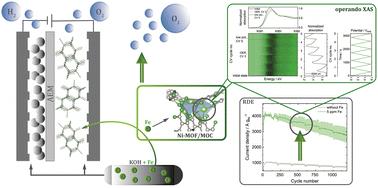
The performance of Ni-based oxygen evolution reaction (OER) electrocatalysts is enhanced upon Fe incorporation into the structure during the synthesis process or electrochemical Fe uptake from the electrolyte. In light of the promising potential of metal–organic framework (MOF) electrocatalysts for water splitting, Ni-MOF-74 is used as a model catalyst to study the effect of Fe incorporation from KOH electrolyte on the electrocatalyst's OER activity and stability. The insights obtained from X-ray diffraction and operando X-ray absorption spectroscopy characterization of Ni-MOF-74 and an amorphous Ni metal organic compound (Ni-MOC*) reveal that Fe uptake enhances OER by two processes: higher Ni oxidation states and enhanced flexibility of both, the electronic state and the local structure, when cycling the potential below and above the OER onset. To demonstrate the impressive OER activity and stability in Fe containing KOH, an Ni-MOC* anode was implemented in an anion exchange membrane water electrolyzer (AEM-WE) with 3 ppm Fe containing 1 M KOH electrolyte resulting in an outstanding cell voltage of 1.7 V (at an anode potential of 1.51 V) at 60 °C and 0.5 A cm−2 exceeding 130 h of stable continuous operation.



 京公网安备 11010802042870号
京ICP备2023020795号-1
京公网安备 11010802042870号
京ICP备2023020795号-1

 分享
分享

 求助内容:
求助内容: 应助结果提醒方式:
 扫码关注我们
