Yuwei Ye, Xuebin Jiang, Qing Liu, Shengfa Ye and Liang Deng
{"title":"[2Fe–2S] clusters supported by N-heterocyclic carbene ligands†","authors":"Yuwei Ye, Xuebin Jiang, Qing Liu, Shengfa Ye and Liang Deng","doi":"10.1039/D5QI00120J","DOIUrl":null,"url":null,"abstract":"<p >The di-ferrous [2Fe–2S]<small><sup>0</sup></small> state is the least understood oxidation level of the [2Fe–2S] unit, which is the smallest module of iron–sulfur clusters in enzymes. Reported synthetic models of the [2Fe–2S]<small><sup>0</sup></small> state utilize bulky anionic ligands to achieve their stabilization, and their highly reducing nature renders detailed structural and spectroscopic studies difficult. Herein, we report the stabilization of the di-ferrous [2Fe–2S]<small><sup>0</sup></small> state by using <em>N</em>-heterocyclic carbene (NHC) moieties as supporting ligands. The charge-neutral cluster [Fe<small><sub>2</sub></small>(<em>μ</em>-S)<small><sub>2</sub></small>(ICy)<small><sub>4</sub></small>] (<strong>1</strong>, ICy = 1,3-bis-cyclohexyl-imidazol-2-ylidene) is synthesized from the reaction of the iron(0) precursor [(ICy)<small><sub>2</sub></small>Fe(<em>η</em><small><sup>2</sup></small>-CH<small><sub>2</sub></small><img>CHSiMe<small><sub>3</sub></small>)] with SPPh<small><sub>3</sub></small>. The attenuated reducing power of <strong>1</strong> as compared to those clusters supported by anionic ligands allows its isolation in pure form. Further spectroscopic and theoretical studies established its <em>S</em> = 0 ground state resulting from <em>anti</em>-ferromagnetic coupling of two high-spin ferrous sites with an exchange-coupling constant <em>J</em> = −208 cm<small><sup>−1</sup></small>. The NHC ligand is also capable of stabilizing the mixed-valent complex [Fe<small><sub>2</sub></small>(<em>μ</em>-S)<small><sub>2</sub></small>(ICy)<small><sub>4</sub></small>][BPh<small><sub>4</sub></small>] (<strong>2</strong>), which is synthesized from the reaction of <strong>1</strong> with [Cp<small><sub>2</sub></small>Fe][BPh<small><sub>4</sub></small>] and identified as a Robin–Day Class II complex with an <em>S</em> = ½ ground state.</p>","PeriodicalId":79,"journal":{"name":"Inorganic Chemistry Frontiers","volume":" 13","pages":" 4247-4255"},"PeriodicalIF":6.4000,"publicationDate":"2025-02-08","publicationTypes":"Journal Article","fieldsOfStudy":null,"isOpenAccess":false,"openAccessPdf":"","citationCount":"0","resultStr":null,"platform":"Semanticscholar","paperid":null,"PeriodicalName":"Inorganic Chemistry Frontiers","FirstCategoryId":"92","ListUrlMain":"https://pubs.rsc.org/en/content/articlelanding/2025/qi/d5qi00120j","RegionNum":1,"RegionCategory":"化学","ArticlePicture":[],"TitleCN":null,"AbstractTextCN":null,"PMCID":null,"EPubDate":"","PubModel":"","JCR":"Q1","JCRName":"CHEMISTRY, INORGANIC & NUCLEAR","Score":null,"Total":0}
引用次数: 0
Abstract
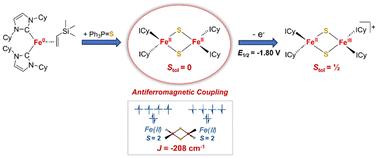
The di-ferrous [2Fe–2S]0 state is the least understood oxidation level of the [2Fe–2S] unit, which is the smallest module of iron–sulfur clusters in enzymes. Reported synthetic models of the [2Fe–2S]0 state utilize bulky anionic ligands to achieve their stabilization, and their highly reducing nature renders detailed structural and spectroscopic studies difficult. Herein, we report the stabilization of the di-ferrous [2Fe–2S]0 state by using N-heterocyclic carbene (NHC) moieties as supporting ligands. The charge-neutral cluster [Fe2(μ-S)2(ICy)4] (1, ICy = 1,3-bis-cyclohexyl-imidazol-2-ylidene) is synthesized from the reaction of the iron(0) precursor [(ICy)2Fe(η2-CH2CHSiMe3)] with SPPh3. The attenuated reducing power of 1 as compared to those clusters supported by anionic ligands allows its isolation in pure form. Further spectroscopic and theoretical studies established its S = 0 ground state resulting from anti-ferromagnetic coupling of two high-spin ferrous sites with an exchange-coupling constant J = −208 cm−1. The NHC ligand is also capable of stabilizing the mixed-valent complex [Fe2(μ-S)2(ICy)4][BPh4] (2), which is synthesized from the reaction of 1 with [Cp2Fe][BPh4] and identified as a Robin–Day Class II complex with an S = ½ ground state.




 京公网安备 11010802042870号
京ICP备2023020795号-1
京公网安备 11010802042870号
京ICP备2023020795号-1

 分享
分享
 求助内容:
求助内容: 应助结果提醒方式:
 扫码关注我们
