{"title":"A Digital Behavior Change Intervention for Health Promotion for Adults in Midlife: Protocol for a Multidimensional Assessment Study.","authors":"Dagmar Soleymani, Dominique Pougheon-Bertrand, Rémi Gagnayre","doi":"10.2196/60559","DOIUrl":null,"url":null,"abstract":"<p><strong>Background: </strong>To support lifelong health promotion and disease prevention, Santé publique France studied the methodology for building a social marketing scheme with a digital intervention targeting middle-aged adults, specifically socioeconomically disadvantaged groups. The digital intervention aims to encourage people aged 40-55 years to look after their health in the short and medium terms by adopting small actions relating to 8 health determinants: nutrition, physical activity, smoking, alcohol, stress, cognitive health, sleep, and environmental health. In the long term, the intervention intends to prevent frailty and reduce the burden of multimorbidities in older age, particularly for lower socioeconomic groups.</p><p><strong>Objective: </strong>This study aims to measure behavior changes among registered users of the future website. The protocol assesses the impact of the website based on users' implementation of small actions relating to the 8 health determinants. Specifically, it intends to evaluate the website's performance in terms of engaging a specific population, triggering behavior change, raising awareness about a multifactorial approach to health, and encouraging user interaction with the website's resources.</p><p><strong>Methods: </strong>The methodology is based on clinical assessments developed alongside the website according to the functionalities offered to registered users in their personalized space. The assessment tool design draws on logic models for digital interventions, and their consistency for digital applications is verified. The target audience is clearly defined from the outset. The protocol sets out a 3-step assessment: upon registration, after 3 weeks of use, and after 10 weeks of use (end of assessment). Users are divided into 2 groups (socioeconomically disadvantaged users and others) to characterize differences and make corrections. The protocol uses a mixed assessment approach based on website traffic and user login data. Specific and identifiable behavior changes are documented by monitoring the same individuals from T0 to T2, using verbatim comments to classify them into profiles and conducting semistructured individual interviews with a sample of users.</p><p><strong>Results: </strong>The protocol creates a multidimensional assessment of digital intervention, showing that during a given timeline, interactions with users can reveal their capabilities, opportunities, and motivations to adopt healthy lifestyles. The protocol's principles were integrated into the development of a personal account to assess users' behavior changes. Given the delayed launch of the website, no recruitment or effects analysis of the protocol took place.</p><p><strong>Conclusions: </strong>As no multidimensional assessment protocol is currently available for digital behavior change interventions, our methods reveal that the different framework stages can strengthen the effect measurement, consolidate the choice of assumptions used within the logic model and steer the digital intervention toward action while reducing the burden of information. The suitability of the assessment protocol remains to be evaluated given the delayed launch of the website.</p><p><strong>International registered report identifier (irrid): </strong>PRR1-10.2196/60559.</p>","PeriodicalId":14755,"journal":{"name":"JMIR Research Protocols","volume":"14 ","pages":"e60559"},"PeriodicalIF":1.5000,"publicationDate":"2025-02-07","publicationTypes":"Journal Article","fieldsOfStudy":null,"isOpenAccess":false,"openAccessPdf":"https://www.ncbi.nlm.nih.gov/pmc/articles/PMC11845890/pdf/","citationCount":"0","resultStr":null,"platform":"Semanticscholar","paperid":null,"PeriodicalName":"JMIR Research Protocols","FirstCategoryId":"1085","ListUrlMain":"https://doi.org/10.2196/60559","RegionNum":0,"RegionCategory":null,"ArticlePicture":[],"TitleCN":null,"AbstractTextCN":null,"PMCID":null,"EPubDate":"","PubModel":"","JCR":"Q3","JCRName":"HEALTH CARE SCIENCES & SERVICES","Score":null,"Total":0}
引用次数: 0
Abstract
Background: To support lifelong health promotion and disease prevention, Santé publique France studied the methodology for building a social marketing scheme with a digital intervention targeting middle-aged adults, specifically socioeconomically disadvantaged groups. The digital intervention aims to encourage people aged 40-55 years to look after their health in the short and medium terms by adopting small actions relating to 8 health determinants: nutrition, physical activity, smoking, alcohol, stress, cognitive health, sleep, and environmental health. In the long term, the intervention intends to prevent frailty and reduce the burden of multimorbidities in older age, particularly for lower socioeconomic groups.
Objective: This study aims to measure behavior changes among registered users of the future website. The protocol assesses the impact of the website based on users' implementation of small actions relating to the 8 health determinants. Specifically, it intends to evaluate the website's performance in terms of engaging a specific population, triggering behavior change, raising awareness about a multifactorial approach to health, and encouraging user interaction with the website's resources.
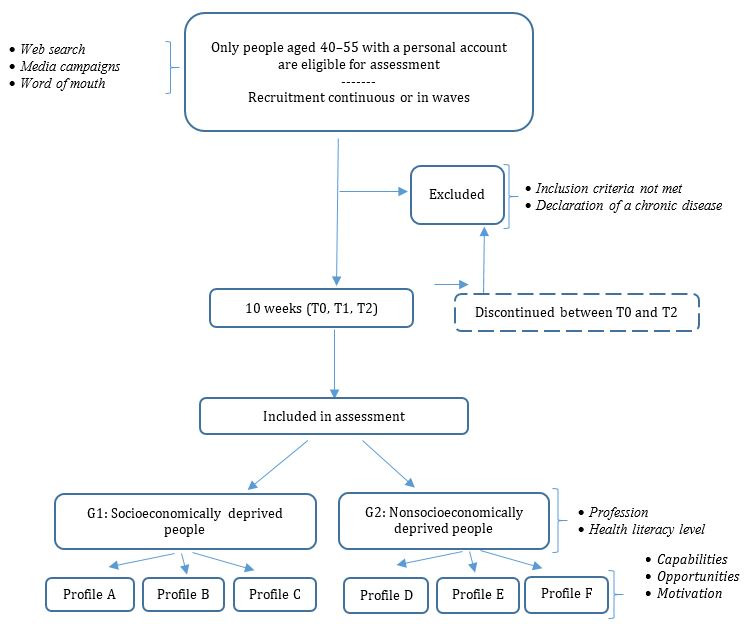
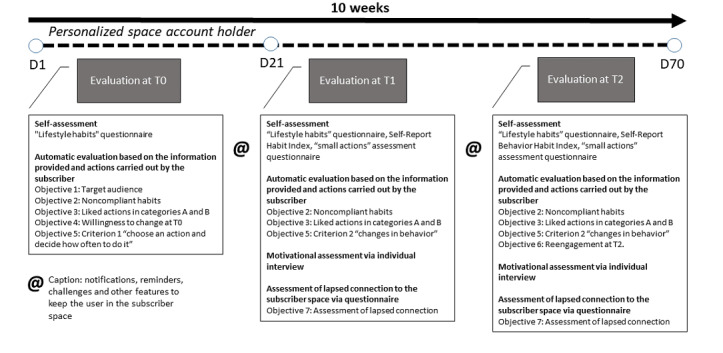
Methods: The methodology is based on clinical assessments developed alongside the website according to the functionalities offered to registered users in their personalized space. The assessment tool design draws on logic models for digital interventions, and their consistency for digital applications is verified. The target audience is clearly defined from the outset. The protocol sets out a 3-step assessment: upon registration, after 3 weeks of use, and after 10 weeks of use (end of assessment). Users are divided into 2 groups (socioeconomically disadvantaged users and others) to characterize differences and make corrections. The protocol uses a mixed assessment approach based on website traffic and user login data. Specific and identifiable behavior changes are documented by monitoring the same individuals from T0 to T2, using verbatim comments to classify them into profiles and conducting semistructured individual interviews with a sample of users.
Results: The protocol creates a multidimensional assessment of digital intervention, showing that during a given timeline, interactions with users can reveal their capabilities, opportunities, and motivations to adopt healthy lifestyles. The protocol's principles were integrated into the development of a personal account to assess users' behavior changes. Given the delayed launch of the website, no recruitment or effects analysis of the protocol took place.
Conclusions: As no multidimensional assessment protocol is currently available for digital behavior change interventions, our methods reveal that the different framework stages can strengthen the effect measurement, consolidate the choice of assumptions used within the logic model and steer the digital intervention toward action while reducing the burden of information. The suitability of the assessment protocol remains to be evaluated given the delayed launch of the website.
International registered report identifier (irrid): PRR1-10.2196/60559.





 京公网安备 11010802042870号
京ICP备2023020795号-1
京公网安备 11010802042870号
京ICP备2023020795号-1

 分享
分享
 求助内容:
求助内容: 应助结果提醒方式:
 扫码关注我们
