Charlie J E Davey, Anne Kiki Hartelust, Rick Helmus, Antonia Praetorius, Annemarie P van Wezel, Thomas L Ter Laak
{"title":"Presence, removal, and risks of psychopharmaceuticals in wastewater streams.","authors":"Charlie J E Davey, Anne Kiki Hartelust, Rick Helmus, Antonia Praetorius, Annemarie P van Wezel, Thomas L Ter Laak","doi":"10.1093/etojnl/vgae042","DOIUrl":null,"url":null,"abstract":"<p><p>Psychopharmaceuticals are used to treat psychological disorders and other conditions relating to the nervous system and are known to affect nontarget organisms at low concentrations. Their occurrence in the water cycle remains an understudied topic, with data lacking for many compounds, and risks not accounted for in removal targets. Therefore, this study aimed to provide insights into the presence, removal, and risks of psychopharmaceuticals in wastewater. Furthermore, the use of risk assessment in the context of proposed legislation is discussed. Thirty highly used psychopharmaceuticals were studied during 1 week in the wastewater of the Amsterdam West Wastewater Treatment Plant (WWTP) using solid phase extraction and ultra high performance liquid chromatography-quadrupole time of flight-high resolution mass spectrometry. Twenty target compounds were detected in the influent (17 ng-99 µg/L) and 16 in the effluent (34 ng/L-17 µg/L). Removal efficiencies during treatment ranged from 24% to >99%. Paracetamol, amphetamine, fluoxetine, levetiracetam, phenacetin, and sertraline demonstrated almost complete removal, whereas tramadol, lidocaine, lamotrigine, fluvoxamine, and carbamazepine had removals below 50%, with lidocaine demonstrating the lowest removal (24%). Utilizing existing ecotoxicity data, a preliminary risk assessment was performed to contextualize the calculated removal efficiencies. Here, sertraline and ibuprofen still demonstrated a potential risk, despite high removal efficiencies of both compounds. This study highlights that wastewater contains abundant numbers and ecotoxicologically relevant concentrations of psychopharmaceuticals that are insufficiently removed by the WWTP. The implementation of risk-based removal targets in legislation is discussed to facilitate the reduction in emissions of psychopharmaceuticals, for example, by adequate WWTP upgrades with advanced treatments to ensure a toxic-free environment.</p>","PeriodicalId":11793,"journal":{"name":"Environmental Toxicology and Chemistry","volume":"44 2","pages":"375-385"},"PeriodicalIF":2.8000,"publicationDate":"2025-02-01","publicationTypes":"Journal Article","fieldsOfStudy":null,"isOpenAccess":false,"openAccessPdf":"https://www.ncbi.nlm.nih.gov/pmc/articles/PMC11816319/pdf/","citationCount":"0","resultStr":null,"platform":"Semanticscholar","paperid":null,"PeriodicalName":"Environmental Toxicology and Chemistry","FirstCategoryId":"93","ListUrlMain":"https://doi.org/10.1093/etojnl/vgae042","RegionNum":4,"RegionCategory":"环境科学与生态学","ArticlePicture":[],"TitleCN":null,"AbstractTextCN":null,"PMCID":null,"EPubDate":"","PubModel":"","JCR":"Q2","JCRName":"ENVIRONMENTAL SCIENCES","Score":null,"Total":0}
引用次数: 0
Abstract
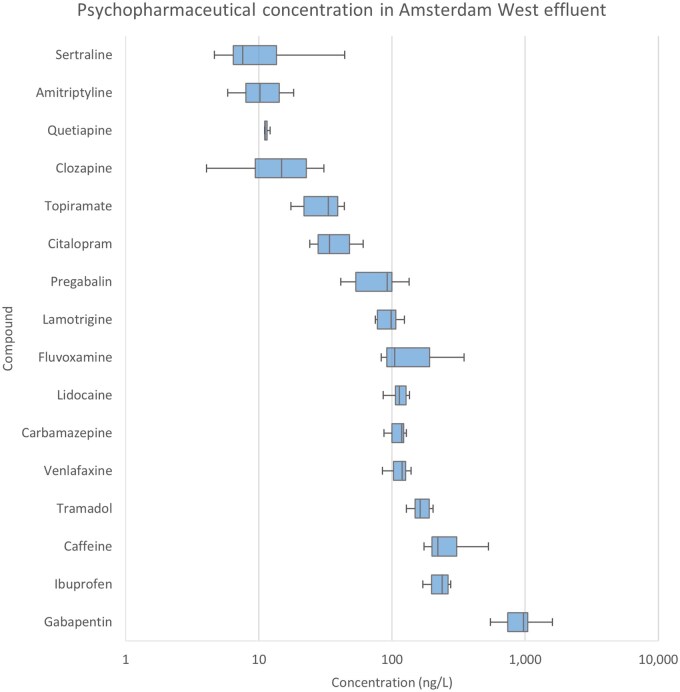
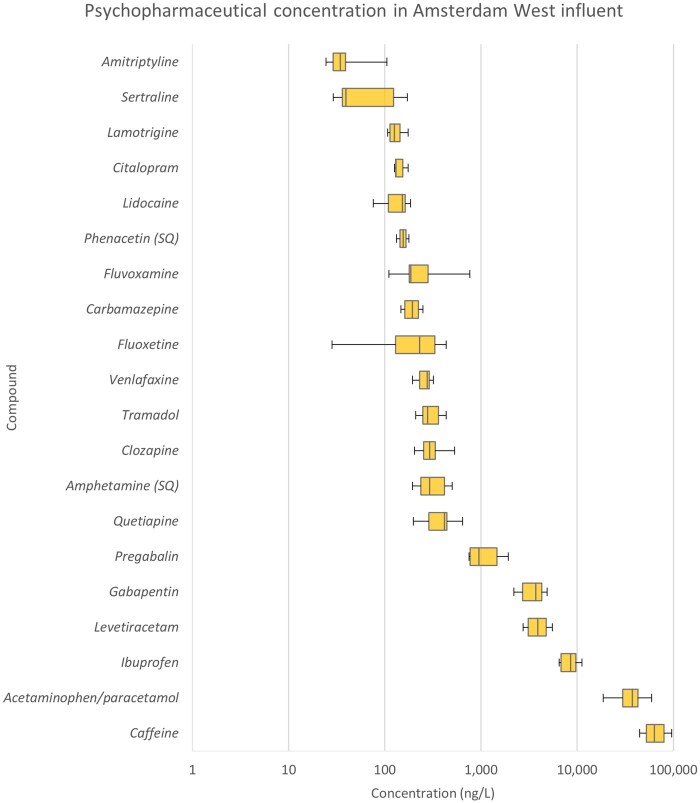
Psychopharmaceuticals are used to treat psychological disorders and other conditions relating to the nervous system and are known to affect nontarget organisms at low concentrations. Their occurrence in the water cycle remains an understudied topic, with data lacking for many compounds, and risks not accounted for in removal targets. Therefore, this study aimed to provide insights into the presence, removal, and risks of psychopharmaceuticals in wastewater. Furthermore, the use of risk assessment in the context of proposed legislation is discussed. Thirty highly used psychopharmaceuticals were studied during 1 week in the wastewater of the Amsterdam West Wastewater Treatment Plant (WWTP) using solid phase extraction and ultra high performance liquid chromatography-quadrupole time of flight-high resolution mass spectrometry. Twenty target compounds were detected in the influent (17 ng-99 µg/L) and 16 in the effluent (34 ng/L-17 µg/L). Removal efficiencies during treatment ranged from 24% to >99%. Paracetamol, amphetamine, fluoxetine, levetiracetam, phenacetin, and sertraline demonstrated almost complete removal, whereas tramadol, lidocaine, lamotrigine, fluvoxamine, and carbamazepine had removals below 50%, with lidocaine demonstrating the lowest removal (24%). Utilizing existing ecotoxicity data, a preliminary risk assessment was performed to contextualize the calculated removal efficiencies. Here, sertraline and ibuprofen still demonstrated a potential risk, despite high removal efficiencies of both compounds. This study highlights that wastewater contains abundant numbers and ecotoxicologically relevant concentrations of psychopharmaceuticals that are insufficiently removed by the WWTP. The implementation of risk-based removal targets in legislation is discussed to facilitate the reduction in emissions of psychopharmaceuticals, for example, by adequate WWTP upgrades with advanced treatments to ensure a toxic-free environment.
期刊介绍:
The Society of Environmental Toxicology and Chemistry (SETAC) publishes two journals: Environmental Toxicology and Chemistry (ET&C) and Integrated Environmental Assessment and Management (IEAM). Environmental Toxicology and Chemistry is dedicated to furthering scientific knowledge and disseminating information on environmental toxicology and chemistry, including the application of these sciences to risk assessment.[...]
Environmental Toxicology and Chemistry is interdisciplinary in scope and integrates the fields of environmental toxicology; environmental, analytical, and molecular chemistry; ecology; physiology; biochemistry; microbiology; genetics; genomics; environmental engineering; chemical, environmental, and biological modeling; epidemiology; and earth sciences. ET&C seeks to publish papers describing original experimental or theoretical work that significantly advances understanding in the area of environmental toxicology, environmental chemistry and hazard/risk assessment. Emphasis is given to papers that enhance capabilities for the prediction, measurement, and assessment of the fate and effects of chemicals in the environment, rather than simply providing additional data. The scientific impact of papers is judged in terms of the breadth and depth of the findings and the expected influence on existing or future scientific practice. Methodological papers must make clear not only how the work differs from existing practice, but the significance of these differences to the field. Site-based research or monitoring must have regional or global implications beyond the particular site, such as evaluating processes, mechanisms, or theory under a natural environmental setting.




 京公网安备 11010802042870号
京ICP备2023020795号-1
京公网安备 11010802042870号
京ICP备2023020795号-1

 分享
分享
 求助内容:
求助内容: 应助结果提醒方式:
 扫码关注我们
