Bart G van Hall, Christopher J Sweeney, Melanie Bottoms, Cornelis A M van Gestel
{"title":"The influence of soil organic matter content on the toxicity of pesticides to the springtail Folsomia candida.","authors":"Bart G van Hall, Christopher J Sweeney, Melanie Bottoms, Cornelis A M van Gestel","doi":"10.1093/etojnl/vgae048","DOIUrl":null,"url":null,"abstract":"<p><p>The European environmental risk assessment (ERA) of pesticides to soil invertebrates applies a correction factor (CF) of 2 to endpoints derived from toxicity tests with lipophilic pesticides (log Kow > 2) to correct for differences in organic matter (OM) content between artificial soil (AS) and natural soils. Because the applicability of this CF to springtails has never been assessed, this study investigated the influence of soil OM content on the toxicity of five pesticide active substances differing in lipophilicity to the springtail Folsomia candida. Toxicity tests following Organisation for Economic Cooperation and Development guideline 232 were conducted in AS containing 10%, 5%, and 2.5% peat and a natural soil (LUFA 2.2) with 4.5% OM. For all pesticides, toxicity (median lethal and median effect concentrations [LC50s, EC50s]) differed significantly between soils and strongly negatively correlated with soil OM content in AS (r2 > 0.88). Utilizing the regression equations derived from the data, LC50s and EC50s were calculated for soils with 10% and 5% OM. For EC50s, the differences in model-estimated toxicity between these soils ranged from 1.85 to 3.23, sometimes exceeding the CF of 2. To identify differences between species, data from a sister paper on the earthworm Eisenia andrei was used. Although ratios between model-estimated EC50s in soils containing 10% and 5% OM were similar between species (2.08-3.24 for earthworms), pesticide-specific toxicity-OM relationships differed in some cases. Non-lipophilic pesticides were influenced by soil OM content in a similar manner as the lipophilic pesticides, showing that the influence of soil properties on non-lipophilic pesticides may currently be overlooked. Overall, this study shows that the CF of 2 suffers from erroneous assumptions concerning lipophilicity, OM content, and toxicity. Further research is required to improve our mechanistic understanding of the relationship between toxicity and soil OM content, ultimately increasing the ecological relevance of CFs used in ERAs.</p>","PeriodicalId":11793,"journal":{"name":"Environmental Toxicology and Chemistry","volume":"44 2","pages":"524-533"},"PeriodicalIF":2.8000,"publicationDate":"2025-02-01","publicationTypes":"Journal Article","fieldsOfStudy":null,"isOpenAccess":false,"openAccessPdf":"https://www.ncbi.nlm.nih.gov/pmc/articles/PMC11816275/pdf/","citationCount":"0","resultStr":null,"platform":"Semanticscholar","paperid":null,"PeriodicalName":"Environmental Toxicology and Chemistry","FirstCategoryId":"93","ListUrlMain":"https://doi.org/10.1093/etojnl/vgae048","RegionNum":4,"RegionCategory":"环境科学与生态学","ArticlePicture":[],"TitleCN":null,"AbstractTextCN":null,"PMCID":null,"EPubDate":"","PubModel":"","JCR":"Q2","JCRName":"ENVIRONMENTAL SCIENCES","Score":null,"Total":0}
引用次数: 0
Abstract
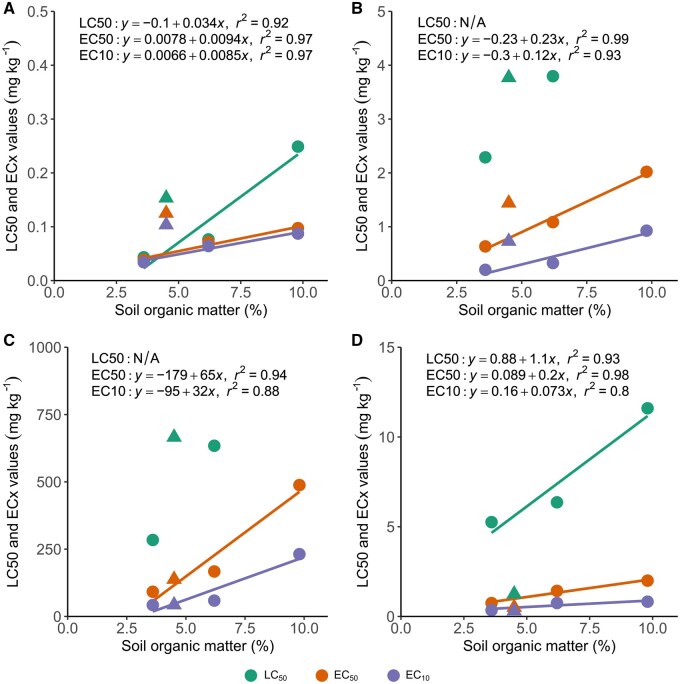
The European environmental risk assessment (ERA) of pesticides to soil invertebrates applies a correction factor (CF) of 2 to endpoints derived from toxicity tests with lipophilic pesticides (log Kow > 2) to correct for differences in organic matter (OM) content between artificial soil (AS) and natural soils. Because the applicability of this CF to springtails has never been assessed, this study investigated the influence of soil OM content on the toxicity of five pesticide active substances differing in lipophilicity to the springtail Folsomia candida. Toxicity tests following Organisation for Economic Cooperation and Development guideline 232 were conducted in AS containing 10%, 5%, and 2.5% peat and a natural soil (LUFA 2.2) with 4.5% OM. For all pesticides, toxicity (median lethal and median effect concentrations [LC50s, EC50s]) differed significantly between soils and strongly negatively correlated with soil OM content in AS (r2 > 0.88). Utilizing the regression equations derived from the data, LC50s and EC50s were calculated for soils with 10% and 5% OM. For EC50s, the differences in model-estimated toxicity between these soils ranged from 1.85 to 3.23, sometimes exceeding the CF of 2. To identify differences between species, data from a sister paper on the earthworm Eisenia andrei was used. Although ratios between model-estimated EC50s in soils containing 10% and 5% OM were similar between species (2.08-3.24 for earthworms), pesticide-specific toxicity-OM relationships differed in some cases. Non-lipophilic pesticides were influenced by soil OM content in a similar manner as the lipophilic pesticides, showing that the influence of soil properties on non-lipophilic pesticides may currently be overlooked. Overall, this study shows that the CF of 2 suffers from erroneous assumptions concerning lipophilicity, OM content, and toxicity. Further research is required to improve our mechanistic understanding of the relationship between toxicity and soil OM content, ultimately increasing the ecological relevance of CFs used in ERAs.
期刊介绍:
The Society of Environmental Toxicology and Chemistry (SETAC) publishes two journals: Environmental Toxicology and Chemistry (ET&C) and Integrated Environmental Assessment and Management (IEAM). Environmental Toxicology and Chemistry is dedicated to furthering scientific knowledge and disseminating information on environmental toxicology and chemistry, including the application of these sciences to risk assessment.[...]
Environmental Toxicology and Chemistry is interdisciplinary in scope and integrates the fields of environmental toxicology; environmental, analytical, and molecular chemistry; ecology; physiology; biochemistry; microbiology; genetics; genomics; environmental engineering; chemical, environmental, and biological modeling; epidemiology; and earth sciences. ET&C seeks to publish papers describing original experimental or theoretical work that significantly advances understanding in the area of environmental toxicology, environmental chemistry and hazard/risk assessment. Emphasis is given to papers that enhance capabilities for the prediction, measurement, and assessment of the fate and effects of chemicals in the environment, rather than simply providing additional data. The scientific impact of papers is judged in terms of the breadth and depth of the findings and the expected influence on existing or future scientific practice. Methodological papers must make clear not only how the work differs from existing practice, but the significance of these differences to the field. Site-based research or monitoring must have regional or global implications beyond the particular site, such as evaluating processes, mechanisms, or theory under a natural environmental setting.





 京公网安备 11010802042870号
京ICP备2023020795号-1
京公网安备 11010802042870号
京ICP备2023020795号-1

 分享
分享
 求助内容:
求助内容: 应助结果提醒方式:
 扫码关注我们
