Synergistic Enhancement of Carrier Dynamics in Eco-Friendly Perovskite Solar Cells through Fluorinated Iodide Additive-Induced Crystallographic and Interface Modifications
{"title":"Synergistic Enhancement of Carrier Dynamics in Eco-Friendly Perovskite Solar Cells through Fluorinated Iodide Additive-Induced Crystallographic and Interface Modifications","authors":"Utpal Kumar, Poonam Subudhi, Deepak Punetha","doi":"10.1002/adts.202401268","DOIUrl":null,"url":null,"abstract":"<p>This study explores advancements in tin (Sn)-based perovskite solar cells (PSCs), which face challenges compared to lead-based PSCs due to rapid crystallization kinetics and high defect densities in Sn perovskite films. To address these limitations, a synergistic strategy involving benzylamine and fluorine incorporation is employed to enhance device performance. Perovskite materials such as fluorobenzylammonium iodide (FBZAI), 2-fluorophenylethylammonium iodide (2-FPEAI), and 4-fluorooctylammonium iodide (FOEI) engineered formamidinium tin iodide (FASnI<sub>3</sub>) are evaluated. Key photovoltaic parameters, including fill factor (FF), open-circuit voltage (Voc), short-circuit current density (Jsc), and power conversion efficiency (PCE), are analyzed. Comprehensive investigations examine the impact of absorber layer thickness, defect density, bandgap tuning, temperature, and doping concentration. The 2-FPEAI-based device with spiro-OMeTAD (2,2′,7,7′-tetrakis(N,N-di-p-methoxyphenylamino)-9,9'-spirobifluorene)/2-FPEAI/C60 additives achieved a PCE of 14.65%, FF of 60.19%, Jsc of 24.325 mA/cm<sup>2</sup>, and Voc of 1.0005 V. FOEI-based devices with CuI (copper iodide)/FOEI/C60 delivered a PCE of 18.51%, FF of 75.33%, Jsc of 27.31 mA/cm<sup>2</sup>, and Voc of 0.899 V, while FBZAI devices showed a PCE of 16.13%, FF of 66.28%, Jsc of 26.47 mA/cm<sup>2</sup>, and Voc of 0.8925 V. These findings highlight the potential of lead-free PSCs for sustainable, high-performance photovoltaic applications.</p>","PeriodicalId":7219,"journal":{"name":"Advanced Theory and Simulations","volume":"8 5","pages":""},"PeriodicalIF":2.9000,"publicationDate":"2025-02-08","publicationTypes":"Journal Article","fieldsOfStudy":null,"isOpenAccess":false,"openAccessPdf":"","citationCount":"0","resultStr":null,"platform":"Semanticscholar","paperid":null,"PeriodicalName":"Advanced Theory and Simulations","FirstCategoryId":"5","ListUrlMain":"https://advanced.onlinelibrary.wiley.com/doi/10.1002/adts.202401268","RegionNum":4,"RegionCategory":"工程技术","ArticlePicture":[],"TitleCN":null,"AbstractTextCN":null,"PMCID":null,"EPubDate":"","PubModel":"","JCR":"Q1","JCRName":"MULTIDISCIPLINARY SCIENCES","Score":null,"Total":0}
引用次数: 0
Abstract
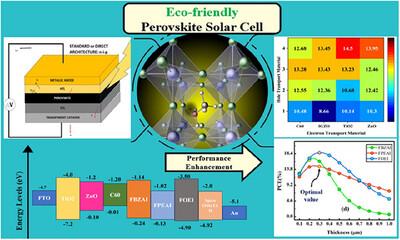
This study explores advancements in tin (Sn)-based perovskite solar cells (PSCs), which face challenges compared to lead-based PSCs due to rapid crystallization kinetics and high defect densities in Sn perovskite films. To address these limitations, a synergistic strategy involving benzylamine and fluorine incorporation is employed to enhance device performance. Perovskite materials such as fluorobenzylammonium iodide (FBZAI), 2-fluorophenylethylammonium iodide (2-FPEAI), and 4-fluorooctylammonium iodide (FOEI) engineered formamidinium tin iodide (FASnI3) are evaluated. Key photovoltaic parameters, including fill factor (FF), open-circuit voltage (Voc), short-circuit current density (Jsc), and power conversion efficiency (PCE), are analyzed. Comprehensive investigations examine the impact of absorber layer thickness, defect density, bandgap tuning, temperature, and doping concentration. The 2-FPEAI-based device with spiro-OMeTAD (2,2′,7,7′-tetrakis(N,N-di-p-methoxyphenylamino)-9,9'-spirobifluorene)/2-FPEAI/C60 additives achieved a PCE of 14.65%, FF of 60.19%, Jsc of 24.325 mA/cm2, and Voc of 1.0005 V. FOEI-based devices with CuI (copper iodide)/FOEI/C60 delivered a PCE of 18.51%, FF of 75.33%, Jsc of 27.31 mA/cm2, and Voc of 0.899 V, while FBZAI devices showed a PCE of 16.13%, FF of 66.28%, Jsc of 26.47 mA/cm2, and Voc of 0.8925 V. These findings highlight the potential of lead-free PSCs for sustainable, high-performance photovoltaic applications.
期刊介绍:
Advanced Theory and Simulations is an interdisciplinary, international, English-language journal that publishes high-quality scientific results focusing on the development and application of theoretical methods, modeling and simulation approaches in all natural science and medicine areas, including:
materials, chemistry, condensed matter physics
engineering, energy
life science, biology, medicine
atmospheric/environmental science, climate science
planetary science, astronomy, cosmology
method development, numerical methods, statistics






 京公网安备 11010802042870号
京ICP备2023020795号-1
京公网安备 11010802042870号
京ICP备2023020795号-1

 分享
分享
 求助内容:
求助内容: 应助结果提醒方式:
 扫码关注我们
