Haotian Zhang , Chuanfeng Zhao , Jing Li , Yan Yu , Annan Chen , Yikun Yang , Yan Xia , Jie Yang , Yue Sun , Yulei Chi , Xin Zhao , Yuan Wang , Jianping Huang
{"title":"Shortwave cloud warming effect observed over highly reflective Greenland","authors":"Haotian Zhang , Chuanfeng Zhao , Jing Li , Yan Yu , Annan Chen , Yikun Yang , Yan Xia , Jie Yang , Yue Sun , Yulei Chi , Xin Zhao , Yuan Wang , Jianping Huang","doi":"10.1016/j.scib.2025.01.027","DOIUrl":null,"url":null,"abstract":"<div><div>Clouds significantly influence the Earth’s energy budget, typically exerting a net global cooling effect by balancing shortwave radiation shading and longwave radiation trapping. However, here we report a shortwave warming effect by clouds over Greenland, contrary to the conventional belief of a cooling effect. We find that the shortwave cloud warming effect on the Earth-atmosphere system is particularly prominent for optically thin clouds. Utilizing satellite-based observations over Greenland during the summer season from 2013 to 2022, we identify a positive shortwave cloud radiative effect when the ratio of surface albedo to top-of-atmosphere (TOA) reflectivity reaches a critical threshold, implying that cloud-induced warming can occur in any place when the surface is bright enough compared with TOA. The shortwave warming effect (with radiative effect up to 25 W/m<sup>2</sup>) over Greenland is primarily concentrated in the peripheries and southern margins—regions experiencing the most intense ice melt. From a global perspective, these warming clouds can contribute up to 0.36 W/m<sup>2</sup> to the summer Earth-atmosphere system in the Northern Hemisphere. These findings are critical for understanding the radiation budget in the polar regions, improving predictions of polar ice melt, and enhancing our comprehension of the Earth’s energy budget.</div></div>","PeriodicalId":421,"journal":{"name":"Science Bulletin","volume":"70 6","pages":"Pages 951-959"},"PeriodicalIF":21.1000,"publicationDate":"2025-01-16","publicationTypes":"Journal Article","fieldsOfStudy":null,"isOpenAccess":false,"openAccessPdf":"","citationCount":"0","resultStr":null,"platform":"Semanticscholar","paperid":null,"PeriodicalName":"Science Bulletin","FirstCategoryId":"103","ListUrlMain":"https://www.sciencedirect.com/science/article/pii/S2095927325000519","RegionNum":1,"RegionCategory":"综合性期刊","ArticlePicture":[],"TitleCN":null,"AbstractTextCN":null,"PMCID":null,"EPubDate":"","PubModel":"","JCR":"Q1","JCRName":"MULTIDISCIPLINARY SCIENCES","Score":null,"Total":0}
引用次数: 0
Abstract
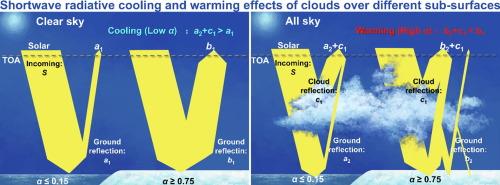
Clouds significantly influence the Earth’s energy budget, typically exerting a net global cooling effect by balancing shortwave radiation shading and longwave radiation trapping. However, here we report a shortwave warming effect by clouds over Greenland, contrary to the conventional belief of a cooling effect. We find that the shortwave cloud warming effect on the Earth-atmosphere system is particularly prominent for optically thin clouds. Utilizing satellite-based observations over Greenland during the summer season from 2013 to 2022, we identify a positive shortwave cloud radiative effect when the ratio of surface albedo to top-of-atmosphere (TOA) reflectivity reaches a critical threshold, implying that cloud-induced warming can occur in any place when the surface is bright enough compared with TOA. The shortwave warming effect (with radiative effect up to 25 W/m2) over Greenland is primarily concentrated in the peripheries and southern margins—regions experiencing the most intense ice melt. From a global perspective, these warming clouds can contribute up to 0.36 W/m2 to the summer Earth-atmosphere system in the Northern Hemisphere. These findings are critical for understanding the radiation budget in the polar regions, improving predictions of polar ice melt, and enhancing our comprehension of the Earth’s energy budget.
期刊介绍:
Science Bulletin (Sci. Bull., formerly known as Chinese Science Bulletin) is a multidisciplinary academic journal supervised by the Chinese Academy of Sciences (CAS) and co-sponsored by the CAS and the National Natural Science Foundation of China (NSFC). Sci. Bull. is a semi-monthly international journal publishing high-caliber peer-reviewed research on a broad range of natural sciences and high-tech fields on the basis of its originality, scientific significance and whether it is of general interest. In addition, we are committed to serving the scientific community with immediate, authoritative news and valuable insights into upcoming trends around the globe.



 京公网安备 11010802042870号
京ICP备2023020795号-1
京公网安备 11010802042870号
京ICP备2023020795号-1

 分享
分享
 求助内容:
求助内容: 应助结果提醒方式:
 扫码关注我们
