{"title":"Targeted therapy and immunotherapy for gastric cancer: rational strategies, novel advancements, challenges, and future perspectives.","authors":"Dong Luo, Yunmei Liu, Zhengmao Lu, Lei Huang","doi":"10.1186/s10020-025-01075-y","DOIUrl":null,"url":null,"abstract":"<p><p>Gastric cancer (GC) is one of the most common malignant tumors worldwide, and its treatment has been a focus of medical research. Herein we systematically review the current status of and advancements in targeted therapy and immunotherapy for GC, which have emerged as important treatment strategies in recent years with great potential, and summarize the efficacy and safety of such treatments. Targeted therapies against key targets in GC, including epidermal growth factor receptor (EGFR), human epidermal growth factor receptor 2 (HER2), and vascular endothelial growth factor (VEGF)/VEGF receptor (VEGFR), have shown remarkable therapeutic efficacies by inhibiting tumor progression and/or blood supply. In particular, markable breakthroughs have been made in HER2-targeting drugs for HER2-positive GC patients. To address intrinsic and acquired resistances to HER2-targeting drugs, novel therapeutic agents including bispecific antibodies and antibody-drug conjugates (ADC) targeting HER2 have been developed. Immunotherapy enhances the recognition and elimination of cancer cells by activating body anticancer immune system. Programmed cell death protein 1 (PD-1) and programmed cell death-ligand 1 (PD-L1) antibodies are the most commonly used immunotherapeutic agents and have been used with some success in GC treatment. Innovative immunotherapy modalities, including adoptive immune cell therapy, tumor vaccines, and non-specific immunomodulators therapy, and oncolytic viruses have shown promise in early-stage clinical trials for GC. Clinical trials have supported that targeted therapy and immunotherapy can significantly improve the survival and quality of life of GC patients. However, the effects of such therapies need to be further improved and more personalized, with advancement in researches on tumor immune microenvironment. Further studies remain needed to address the issues of drug resistance and adverse events pertaining to such therapies for GC. The combined application of such therapies and individualized treatment strategies should be further explored with novel drugs developed, to provide more effective treatments for GC patients.</p>","PeriodicalId":18813,"journal":{"name":"Molecular Medicine","volume":"31 1","pages":"52"},"PeriodicalIF":6.4000,"publicationDate":"2025-02-08","publicationTypes":"Journal Article","fieldsOfStudy":null,"isOpenAccess":false,"openAccessPdf":"https://www.ncbi.nlm.nih.gov/pmc/articles/PMC11806620/pdf/","citationCount":"0","resultStr":null,"platform":"Semanticscholar","paperid":null,"PeriodicalName":"Molecular Medicine","FirstCategoryId":"3","ListUrlMain":"https://doi.org/10.1186/s10020-025-01075-y","RegionNum":2,"RegionCategory":"医学","ArticlePicture":[],"TitleCN":null,"AbstractTextCN":null,"PMCID":null,"EPubDate":"","PubModel":"","JCR":"Q1","JCRName":"BIOCHEMISTRY & MOLECULAR BIOLOGY","Score":null,"Total":0}
引用次数: 0
Abstract
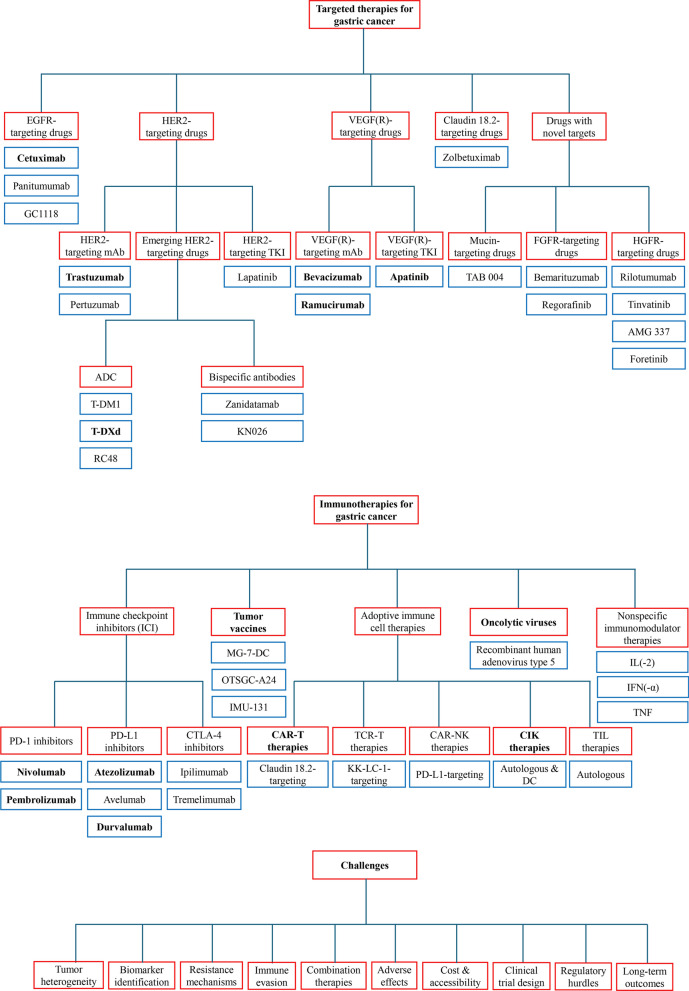
Gastric cancer (GC) is one of the most common malignant tumors worldwide, and its treatment has been a focus of medical research. Herein we systematically review the current status of and advancements in targeted therapy and immunotherapy for GC, which have emerged as important treatment strategies in recent years with great potential, and summarize the efficacy and safety of such treatments. Targeted therapies against key targets in GC, including epidermal growth factor receptor (EGFR), human epidermal growth factor receptor 2 (HER2), and vascular endothelial growth factor (VEGF)/VEGF receptor (VEGFR), have shown remarkable therapeutic efficacies by inhibiting tumor progression and/or blood supply. In particular, markable breakthroughs have been made in HER2-targeting drugs for HER2-positive GC patients. To address intrinsic and acquired resistances to HER2-targeting drugs, novel therapeutic agents including bispecific antibodies and antibody-drug conjugates (ADC) targeting HER2 have been developed. Immunotherapy enhances the recognition and elimination of cancer cells by activating body anticancer immune system. Programmed cell death protein 1 (PD-1) and programmed cell death-ligand 1 (PD-L1) antibodies are the most commonly used immunotherapeutic agents and have been used with some success in GC treatment. Innovative immunotherapy modalities, including adoptive immune cell therapy, tumor vaccines, and non-specific immunomodulators therapy, and oncolytic viruses have shown promise in early-stage clinical trials for GC. Clinical trials have supported that targeted therapy and immunotherapy can significantly improve the survival and quality of life of GC patients. However, the effects of such therapies need to be further improved and more personalized, with advancement in researches on tumor immune microenvironment. Further studies remain needed to address the issues of drug resistance and adverse events pertaining to such therapies for GC. The combined application of such therapies and individualized treatment strategies should be further explored with novel drugs developed, to provide more effective treatments for GC patients.
期刊介绍:
Molecular Medicine is an open access journal that focuses on publishing recent findings related to disease pathogenesis at the molecular or physiological level. These insights can potentially contribute to the development of specific tools for disease diagnosis, treatment, or prevention. The journal considers manuscripts that present material pertinent to the genetic, molecular, or cellular underpinnings of critical physiological or disease processes. Submissions to Molecular Medicine are expected to elucidate the broader implications of the research findings for human disease and medicine in a manner that is accessible to a wide audience.




 京公网安备 11010802042870号
京ICP备2023020795号-1
京公网安备 11010802042870号
京ICP备2023020795号-1

 分享
分享
 求助内容:
求助内容: 应助结果提醒方式:
 扫码关注我们
