{"title":"Correlations and Mechanisms between Temperature Stability and Structural Stability of PNN–PHT Piezoceramics","authors":"Xi Ouyang, Manwen Yao, Tongqing Yang, Xi Yao","doi":"10.1021/acsami.4c18783","DOIUrl":null,"url":null,"abstract":"The significance of temperature stability in piezoelectric materials is crucial as it directly impacts their reliability and consistency in piezoelectric performance under varying temperature conditions. However, the relationship between structural stability and temperature stability remains ambiguous. In this study, we aim to address this issue by constructing piezoceramics with low and high structural stability using the “high configurational entropy” (Pb (Ni<sub>0.11</sub>Hf<sub>0.33</sub>Ti<sub>0.34</sub>Nb<sub>0.22</sub>) O<sub>3</sub>) strategy and “tolerance factor” (Pb (Ni<sub>0.11</sub>Hf<sub>0.21</sub>Ti<sub>0.46</sub>Nb<sub>0.22</sub>) O<sub>3</sub>) strategy. The relationship between structural stability and temperature stability was then explored through temperature-dependent XRD, Raman, and piezoelectric property tests in the range of 25–250 °C. Our results successfully demonstrate a positive correlation between structural stability and temperature stability. The microstructure information analyzed by temperature-dependent XRD and Raman showed that Pb (Ni<sub>0.11</sub>Hf<sub>0.33</sub>Ti<sub>0.34</sub>Nb<sub>0.22</sub>) O<sub>3</sub> has a more abundant phase structure transition and higher ion disorder, which is directly reflected in its poor temperature stability in the piezoelectric property tests. On the other hand, Pb (Ni<sub>0.11</sub>Hf<sub>0.21</sub>Ti<sub>0.46</sub>Nb<sub>0.22</sub>) O<sub>3</sub> exhibited excellent temperature stability due to its stable phase structure and lower ion disorder. Specifically, the unipolar strain of piezoceramics with low structural stability decreases from 1.63% at 25 °C to 0.24% at 200 °C, while the unipolar strain of piezoceramics with high structural stability only changes from 0.78% at 25 °C to 0.79% at 225 °C. Additionally, our understanding of the high energy barrier imposed by a wide band gap, as well as the hindrance of domain switching and stabilization of domains through the pinning effect of defect dipoles, reveals the underlying mechanism of temperature stability. These findings provide a promising approach to the development of piezoceramics that can effectively function across a wide range of temperatures.","PeriodicalId":5,"journal":{"name":"ACS Applied Materials & Interfaces","volume":"144 1","pages":""},"PeriodicalIF":8.2000,"publicationDate":"2025-02-10","publicationTypes":"Journal Article","fieldsOfStudy":null,"isOpenAccess":false,"openAccessPdf":"","citationCount":"0","resultStr":null,"platform":"Semanticscholar","paperid":null,"PeriodicalName":"ACS Applied Materials & Interfaces","FirstCategoryId":"88","ListUrlMain":"https://doi.org/10.1021/acsami.4c18783","RegionNum":2,"RegionCategory":"材料科学","ArticlePicture":[],"TitleCN":null,"AbstractTextCN":null,"PMCID":null,"EPubDate":"","PubModel":"","JCR":"Q1","JCRName":"MATERIALS SCIENCE, MULTIDISCIPLINARY","Score":null,"Total":0}
引用次数: 0
Abstract
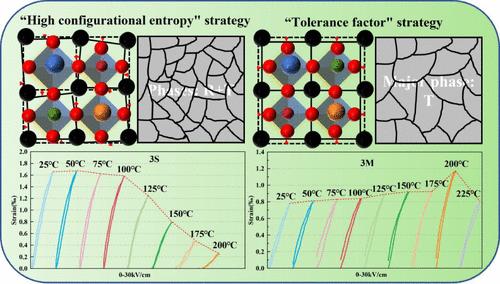
The significance of temperature stability in piezoelectric materials is crucial as it directly impacts their reliability and consistency in piezoelectric performance under varying temperature conditions. However, the relationship between structural stability and temperature stability remains ambiguous. In this study, we aim to address this issue by constructing piezoceramics with low and high structural stability using the “high configurational entropy” (Pb (Ni0.11Hf0.33Ti0.34Nb0.22) O3) strategy and “tolerance factor” (Pb (Ni0.11Hf0.21Ti0.46Nb0.22) O3) strategy. The relationship between structural stability and temperature stability was then explored through temperature-dependent XRD, Raman, and piezoelectric property tests in the range of 25–250 °C. Our results successfully demonstrate a positive correlation between structural stability and temperature stability. The microstructure information analyzed by temperature-dependent XRD and Raman showed that Pb (Ni0.11Hf0.33Ti0.34Nb0.22) O3 has a more abundant phase structure transition and higher ion disorder, which is directly reflected in its poor temperature stability in the piezoelectric property tests. On the other hand, Pb (Ni0.11Hf0.21Ti0.46Nb0.22) O3 exhibited excellent temperature stability due to its stable phase structure and lower ion disorder. Specifically, the unipolar strain of piezoceramics with low structural stability decreases from 1.63% at 25 °C to 0.24% at 200 °C, while the unipolar strain of piezoceramics with high structural stability only changes from 0.78% at 25 °C to 0.79% at 225 °C. Additionally, our understanding of the high energy barrier imposed by a wide band gap, as well as the hindrance of domain switching and stabilization of domains through the pinning effect of defect dipoles, reveals the underlying mechanism of temperature stability. These findings provide a promising approach to the development of piezoceramics that can effectively function across a wide range of temperatures.
期刊介绍:
ACS Applied Materials & Interfaces is a leading interdisciplinary journal that brings together chemists, engineers, physicists, and biologists to explore the development and utilization of newly-discovered materials and interfacial processes for specific applications. Our journal has experienced remarkable growth since its establishment in 2009, both in terms of the number of articles published and the impact of the research showcased. We are proud to foster a truly global community, with the majority of published articles originating from outside the United States, reflecting the rapid growth of applied research worldwide.



 京公网安备 11010802042870号
京ICP备2023020795号-1
京公网安备 11010802042870号
京ICP备2023020795号-1

 分享
分享
 求助内容:
求助内容: 应助结果提醒方式:
 扫码关注我们
