Sikai Ling, Xue Zhang, Yao Dai, Zhuofan Jiang, Xujiao Zhou, Sicong Lu, Xiaoqing Qian, Jianping Liu, Niklas Selfjord, Tugce Munise Satir, Anders Lundin, Julia Liz Touza, Mike Firth, Natalie Van Zuydam, Bilada Bilican, Pinar Akcakaya, Jiaxu Hong, Yujia Cai
{"title":"Customizable virus-like particles deliver CRISPR–Cas9 ribonucleoprotein for effective ocular neovascular and Huntington’s disease gene therapy","authors":"Sikai Ling, Xue Zhang, Yao Dai, Zhuofan Jiang, Xujiao Zhou, Sicong Lu, Xiaoqing Qian, Jianping Liu, Niklas Selfjord, Tugce Munise Satir, Anders Lundin, Julia Liz Touza, Mike Firth, Natalie Van Zuydam, Bilada Bilican, Pinar Akcakaya, Jiaxu Hong, Yujia Cai","doi":"10.1038/s41565-024-01851-7","DOIUrl":null,"url":null,"abstract":"In vivo CRISPR gene editing holds enormous potential for various diseases. Ideally, CRISPR delivery should be cell type-specific and time-restricted for optimal efficacy and safety, but customizable methods are lacking. Here we develop a cell-tropism programmable CRISPR–Cas9 ribonucleoprotein delivery system (RIDE) based on virus-like particles. The efficiency of RIDE was comparable to that of adeno-associated virus and lentiviral vectors and higher than lipid nanoparticles. RIDE could be readily reprogrammed to target dendritic cells, T cells and neurons, and significantly ameliorated the disease symptoms in both ocular neovascular and Huntington’s disease models via cell-specific gene editing. In addition, RIDE could efficiently edit the huntingtin gene in patients’ induced pluripotent stem cell-derived neurons and was tolerated in non-human primates. This study is expected to facilitate the development of in vivo CRISPR therapeutics. This paper reports a customizable CRISPR ribonucleoprotein delivery tool, dubbed RIDE, for the treatment of Huntington’s disease in mice, non-human primates and patients’ iPSC neurons.","PeriodicalId":18915,"journal":{"name":"Nature nanotechnology","volume":"20 4","pages":"543-553"},"PeriodicalIF":34.9000,"publicationDate":"2025-02-10","publicationTypes":"Journal Article","fieldsOfStudy":null,"isOpenAccess":false,"openAccessPdf":"https://www.nature.comhttps://www.nature.com/articles/s41565-024-01851-7.pdf","citationCount":"0","resultStr":null,"platform":"Semanticscholar","paperid":null,"PeriodicalName":"Nature nanotechnology","FirstCategoryId":"88","ListUrlMain":"https://www.nature.com/articles/s41565-024-01851-7","RegionNum":1,"RegionCategory":"材料科学","ArticlePicture":[],"TitleCN":null,"AbstractTextCN":null,"PMCID":null,"EPubDate":"","PubModel":"","JCR":"Q1","JCRName":"MATERIALS SCIENCE, MULTIDISCIPLINARY","Score":null,"Total":0}
引用次数: 0
Abstract
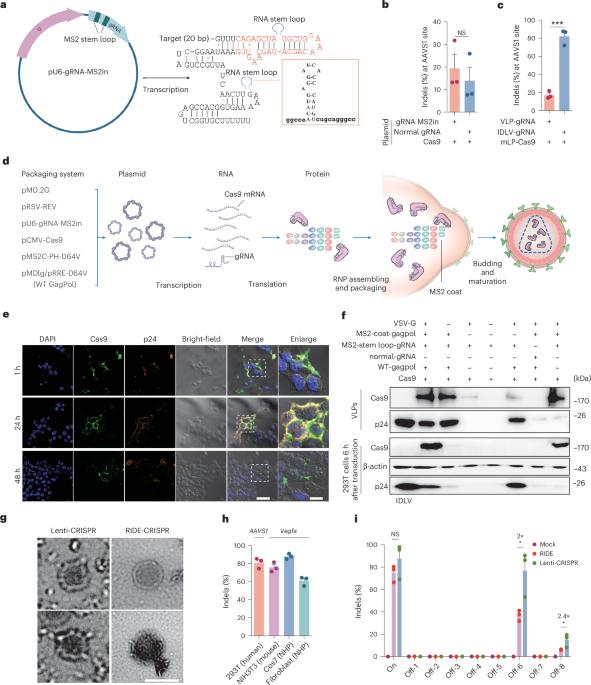
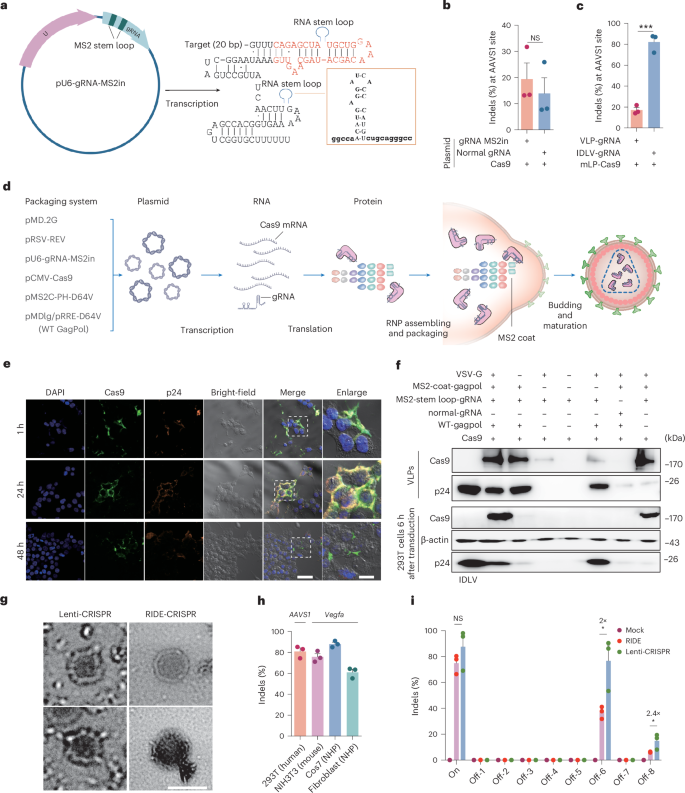
In vivo CRISPR gene editing holds enormous potential for various diseases. Ideally, CRISPR delivery should be cell type-specific and time-restricted for optimal efficacy and safety, but customizable methods are lacking. Here we develop a cell-tropism programmable CRISPR–Cas9 ribonucleoprotein delivery system (RIDE) based on virus-like particles. The efficiency of RIDE was comparable to that of adeno-associated virus and lentiviral vectors and higher than lipid nanoparticles. RIDE could be readily reprogrammed to target dendritic cells, T cells and neurons, and significantly ameliorated the disease symptoms in both ocular neovascular and Huntington’s disease models via cell-specific gene editing. In addition, RIDE could efficiently edit the huntingtin gene in patients’ induced pluripotent stem cell-derived neurons and was tolerated in non-human primates. This study is expected to facilitate the development of in vivo CRISPR therapeutics. This paper reports a customizable CRISPR ribonucleoprotein delivery tool, dubbed RIDE, for the treatment of Huntington’s disease in mice, non-human primates and patients’ iPSC neurons.
期刊介绍:
Nature Nanotechnology is a prestigious journal that publishes high-quality papers in various areas of nanoscience and nanotechnology. The journal focuses on the design, characterization, and production of structures, devices, and systems that manipulate and control materials at atomic, molecular, and macromolecular scales. It encompasses both bottom-up and top-down approaches, as well as their combinations.
Furthermore, Nature Nanotechnology fosters the exchange of ideas among researchers from diverse disciplines such as chemistry, physics, material science, biomedical research, engineering, and more. It promotes collaboration at the forefront of this multidisciplinary field. The journal covers a wide range of topics, from fundamental research in physics, chemistry, and biology, including computational work and simulations, to the development of innovative devices and technologies for various industrial sectors such as information technology, medicine, manufacturing, high-performance materials, energy, and environmental technologies. It includes coverage of organic, inorganic, and hybrid materials.



 京公网安备 11010802042870号
京ICP备2023020795号-1
京公网安备 11010802042870号
京ICP备2023020795号-1

 分享
分享
 求助内容:
求助内容: 应助结果提醒方式:
 扫码关注我们
