Nguyen T.B. Nguyen, Sira Gevers, Rutger N.U. Kok, Lotte M. Burgering, Hannah Neikes, Ninouk Akkerman, Max A. Betjes, Marlies C. Ludikhuize, Can Gulersonmez, Edwin C.A. Stigter, Yvonne Vercoulen, Jarno Drost, Hans Clevers, Michiel Vermeulen, Jeroen S. van Zon, Sander J. Tans, Boudewijn M.T. Burgering, Maria J. Rodríguez Colman
{"title":"Lactate controls cancer stemness and plasticity through epigenetic regulation","authors":"Nguyen T.B. Nguyen, Sira Gevers, Rutger N.U. Kok, Lotte M. Burgering, Hannah Neikes, Ninouk Akkerman, Max A. Betjes, Marlies C. Ludikhuize, Can Gulersonmez, Edwin C.A. Stigter, Yvonne Vercoulen, Jarno Drost, Hans Clevers, Michiel Vermeulen, Jeroen S. van Zon, Sander J. Tans, Boudewijn M.T. Burgering, Maria J. Rodríguez Colman","doi":"10.1016/j.cmet.2025.01.002","DOIUrl":null,"url":null,"abstract":"Tumors arise from uncontrolled cell proliferation driven by mutations in genes that regulate stem cell renewal and differentiation. Intestinal tumors, however, retain some hierarchical organization, maintaining both cancer stem cells (CSCs) and cancer differentiated cells (CDCs). This heterogeneity, coupled with cellular plasticity enabling CDCs to revert to CSCs, contributes to therapy resistance and relapse. Using genetically encoded fluorescent reporters in human tumor organoids, combined with our machine-learning-based cell tracker, CellPhenTracker, we simultaneously traced cell-type specification, metabolic changes, and reconstructed cell lineage trajectories during tumor organoid development. Our findings reveal distinctive metabolic phenotypes in CSCs and CDCs. We find that lactate regulates tumor dynamics, suppressing CSC differentiation and inducing dedifferentiation into a proliferative CSC state. Mechanistically, lactate increases histone acetylation, epigenetically activating MYC. Given that lactate’s regulation of MYC depends on the bromodomain-containing protein 4 (BRD4), targeting cancer metabolism and BRD4 inhibitors emerge as a promising strategy to prevent tumor relapse.","PeriodicalId":9840,"journal":{"name":"Cell metabolism","volume":"47 1","pages":""},"PeriodicalIF":30.9000,"publicationDate":"2025-02-10","publicationTypes":"Journal Article","fieldsOfStudy":null,"isOpenAccess":false,"openAccessPdf":"","citationCount":"0","resultStr":null,"platform":"Semanticscholar","paperid":null,"PeriodicalName":"Cell metabolism","FirstCategoryId":"99","ListUrlMain":"https://doi.org/10.1016/j.cmet.2025.01.002","RegionNum":1,"RegionCategory":"生物学","ArticlePicture":[],"TitleCN":null,"AbstractTextCN":null,"PMCID":null,"EPubDate":"","PubModel":"","JCR":"Q1","JCRName":"CELL BIOLOGY","Score":null,"Total":0}
引用次数: 0
Abstract
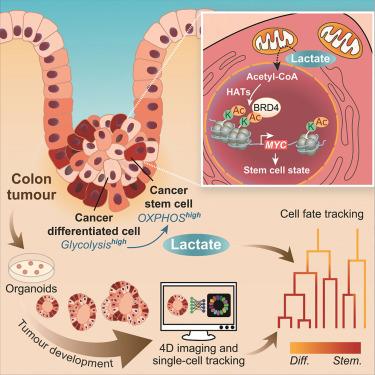
Tumors arise from uncontrolled cell proliferation driven by mutations in genes that regulate stem cell renewal and differentiation. Intestinal tumors, however, retain some hierarchical organization, maintaining both cancer stem cells (CSCs) and cancer differentiated cells (CDCs). This heterogeneity, coupled with cellular plasticity enabling CDCs to revert to CSCs, contributes to therapy resistance and relapse. Using genetically encoded fluorescent reporters in human tumor organoids, combined with our machine-learning-based cell tracker, CellPhenTracker, we simultaneously traced cell-type specification, metabolic changes, and reconstructed cell lineage trajectories during tumor organoid development. Our findings reveal distinctive metabolic phenotypes in CSCs and CDCs. We find that lactate regulates tumor dynamics, suppressing CSC differentiation and inducing dedifferentiation into a proliferative CSC state. Mechanistically, lactate increases histone acetylation, epigenetically activating MYC. Given that lactate’s regulation of MYC depends on the bromodomain-containing protein 4 (BRD4), targeting cancer metabolism and BRD4 inhibitors emerge as a promising strategy to prevent tumor relapse.
期刊介绍:
Cell Metabolism is a top research journal established in 2005 that focuses on publishing original and impactful papers in the field of metabolic research.It covers a wide range of topics including diabetes, obesity, cardiovascular biology, aging and stress responses, circadian biology, and many others.
Cell Metabolism aims to contribute to the advancement of metabolic research by providing a platform for the publication and dissemination of high-quality research and thought-provoking articles.



 京公网安备 11010802042870号
京ICP备2023020795号-1
京公网安备 11010802042870号
京ICP备2023020795号-1

 分享
分享
 求助内容:
求助内容: 应助结果提醒方式:
 扫码关注我们
