Marijn Schipper, Christiaan A. de Leeuw, Bernardo A. P. C. Maciel, Douglas P. Wightman, Nikki Hubers, Dorret I. Boomsma, Michael C. O’Donovan, Danielle Posthuma
{"title":"Prioritizing effector genes at trait-associated loci using multimodal evidence","authors":"Marijn Schipper, Christiaan A. de Leeuw, Bernardo A. P. C. Maciel, Douglas P. Wightman, Nikki Hubers, Dorret I. Boomsma, Michael C. O’Donovan, Danielle Posthuma","doi":"10.1038/s41588-025-02084-7","DOIUrl":null,"url":null,"abstract":"Genome-wide association studies (GWAS) yield large numbers of genetic loci associated with traits and diseases. Predicting the effector genes that mediate these locus-trait associations remains challenging. Here we present the FLAMES (fine-mapped locus assessment model of effector genes) framework, which predicts the most likely effector gene in a locus. FLAMES creates machine learning predictions from biological data linking single-nucleotide polymorphisms to genes, and then evaluates these scores together with gene-centric evidence of convergence of the GWAS signal in functional networks. We benchmark FLAMES on gene-locus pairs derived by expert curation, rare variant implication and domain knowledge of molecular traits. We demonstrate that combining single-nucleotide-polymorphism-based and convergence-based modalities outperforms prioritization strategies using a single line of evidence. Applying FLAMES, we resolve the FSHB locus in the GWAS for dizygotic twinning and further leverage this framework to find schizophrenia risk genes that converge with rare coding evidence and are relevant in different stages of life. FLAMES is a machine learning approach combining variant fine-mapping, SNP-to-gene annotations and convergence-based gene prioritization scores to identify candidate effector genes at genome-wide associated loci with high accuracy.","PeriodicalId":18985,"journal":{"name":"Nature genetics","volume":"57 2","pages":"323-333"},"PeriodicalIF":29.0000,"publicationDate":"2025-02-10","publicationTypes":"Journal Article","fieldsOfStudy":null,"isOpenAccess":false,"openAccessPdf":"","citationCount":"0","resultStr":null,"platform":"Semanticscholar","paperid":null,"PeriodicalName":"Nature genetics","FirstCategoryId":"99","ListUrlMain":"https://www.nature.com/articles/s41588-025-02084-7","RegionNum":1,"RegionCategory":"生物学","ArticlePicture":[],"TitleCN":null,"AbstractTextCN":null,"PMCID":null,"EPubDate":"","PubModel":"","JCR":"Q1","JCRName":"GENETICS & HEREDITY","Score":null,"Total":0}
引用次数: 0
Abstract
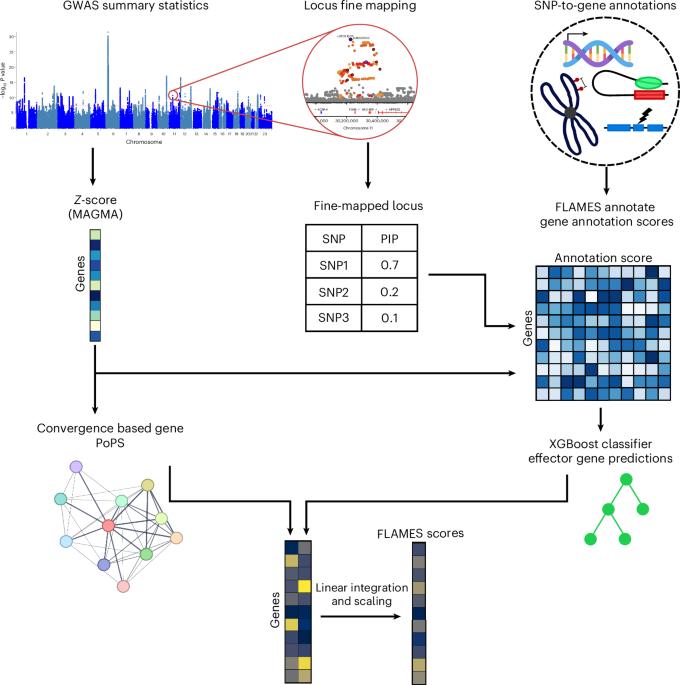
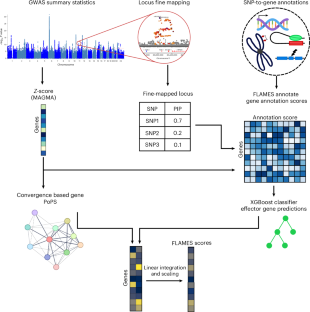
Genome-wide association studies (GWAS) yield large numbers of genetic loci associated with traits and diseases. Predicting the effector genes that mediate these locus-trait associations remains challenging. Here we present the FLAMES (fine-mapped locus assessment model of effector genes) framework, which predicts the most likely effector gene in a locus. FLAMES creates machine learning predictions from biological data linking single-nucleotide polymorphisms to genes, and then evaluates these scores together with gene-centric evidence of convergence of the GWAS signal in functional networks. We benchmark FLAMES on gene-locus pairs derived by expert curation, rare variant implication and domain knowledge of molecular traits. We demonstrate that combining single-nucleotide-polymorphism-based and convergence-based modalities outperforms prioritization strategies using a single line of evidence. Applying FLAMES, we resolve the FSHB locus in the GWAS for dizygotic twinning and further leverage this framework to find schizophrenia risk genes that converge with rare coding evidence and are relevant in different stages of life. FLAMES is a machine learning approach combining variant fine-mapping, SNP-to-gene annotations and convergence-based gene prioritization scores to identify candidate effector genes at genome-wide associated loci with high accuracy.
期刊介绍:
Nature Genetics publishes the very highest quality research in genetics. It encompasses genetic and functional genomic studies on human and plant traits and on other model organisms. Current emphasis is on the genetic basis for common and complex diseases and on the functional mechanism, architecture and evolution of gene networks, studied by experimental perturbation.
Integrative genetic topics comprise, but are not limited to:
-Genes in the pathology of human disease
-Molecular analysis of simple and complex genetic traits
-Cancer genetics
-Agricultural genomics
-Developmental genetics
-Regulatory variation in gene expression
-Strategies and technologies for extracting function from genomic data
-Pharmacological genomics
-Genome evolution



 京公网安备 11010802042870号
京ICP备2023020795号-1
京公网安备 11010802042870号
京ICP备2023020795号-1

 分享
分享
 求助内容:
求助内容: 应助结果提醒方式:
 扫码关注我们
