Xinchen Nan , Li Zhou , Tingxuan Sun , Mingrun Yu , Xiaoguo Song
{"title":"Strengthening mechanism of Al/Ti friction stir butt welded joints via ultrasonic-induced fast diffusion effects","authors":"Xinchen Nan , Li Zhou , Tingxuan Sun , Mingrun Yu , Xiaoguo Song","doi":"10.1016/j.jmatprotec.2025.118754","DOIUrl":null,"url":null,"abstract":"<div><div>The rapid advancement of the aerospace industry has intensified interest in Al/Ti heterostructures. However, the significant property differences between Al alloys and Ti alloys materials pose challenges for high-quality welding. The low interface bonding strength has long been a persistent issue in Al/Ti dissimilar alloy welding. Previous studies have shown that: ultrasonic vibration-assisted technology uniquely influences the types and growth sequence of interfacial compounds in dissimilar alloy friction stir butt welds, thereby improving joint properties. However, the mechanisms by which ultrasonic vibration affects the growth behavior of the compounds and enhances the properties of the joint remain unclear. In this study, ultrasonic-assisted friction stir butt welding of AA6061/Ti6Al4V dissimilar alloy was investigated. The results indicate that ultrasonic vibration induces a significant proliferation of dislocations in the joint without altering the heat input of the weld, thereby promoting element diffusion. As a result, the diffused interface (Al-TiAl<sub>3</sub>-Ti) gradually replaces the typical mixed interface (Al-TiAl<sub>3</sub>-TiAl-Ti) found in friction stir welding joints, leading to a reduction in lattice mismatch. In addition, ultrasonic vibration helps eliminate welding defects near the interface, further enhancing the quality and integrity of the joint. Consequently, the interface bonding strength increased from 152 MPa to 168 MPa.</div></div>","PeriodicalId":367,"journal":{"name":"Journal of Materials Processing Technology","volume":"338 ","pages":"Article 118754"},"PeriodicalIF":7.5000,"publicationDate":"2025-04-01","publicationTypes":"Journal Article","fieldsOfStudy":null,"isOpenAccess":false,"openAccessPdf":"","citationCount":"0","resultStr":null,"platform":"Semanticscholar","paperid":null,"PeriodicalName":"Journal of Materials Processing Technology","FirstCategoryId":"88","ListUrlMain":"https://www.sciencedirect.com/science/article/pii/S0924013625000445","RegionNum":2,"RegionCategory":"材料科学","ArticlePicture":[],"TitleCN":null,"AbstractTextCN":null,"PMCID":null,"EPubDate":"2025/2/3 0:00:00","PubModel":"Epub","JCR":"Q1","JCRName":"ENGINEERING, INDUSTRIAL","Score":null,"Total":0}
引用次数: 0
Abstract
The rapid advancement of the aerospace industry has intensified interest in Al/Ti heterostructures. However, the significant property differences between Al alloys and Ti alloys materials pose challenges for high-quality welding. The low interface bonding strength has long been a persistent issue in Al/Ti dissimilar alloy welding. Previous studies have shown that: ultrasonic vibration-assisted technology uniquely influences the types and growth sequence of interfacial compounds in dissimilar alloy friction stir butt welds, thereby improving joint properties. However, the mechanisms by which ultrasonic vibration affects the growth behavior of the compounds and enhances the properties of the joint remain unclear. In this study, ultrasonic-assisted friction stir butt welding of AA6061/Ti6Al4V dissimilar alloy was investigated. The results indicate that ultrasonic vibration induces a significant proliferation of dislocations in the joint without altering the heat input of the weld, thereby promoting element diffusion. As a result, the diffused interface (Al-TiAl3-Ti) gradually replaces the typical mixed interface (Al-TiAl3-TiAl-Ti) found in friction stir welding joints, leading to a reduction in lattice mismatch. In addition, ultrasonic vibration helps eliminate welding defects near the interface, further enhancing the quality and integrity of the joint. Consequently, the interface bonding strength increased from 152 MPa to 168 MPa.
期刊介绍:
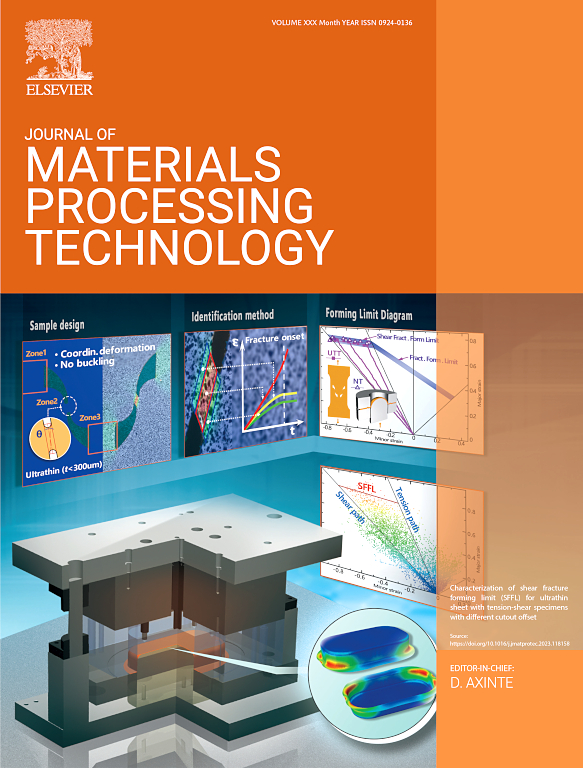
The Journal of Materials Processing Technology covers the processing techniques used in manufacturing components from metals and other materials. The journal aims to publish full research papers of original, significant and rigorous work and so to contribute to increased production efficiency and improved component performance.
Areas of interest to the journal include:
• Casting, forming and machining
• Additive processing and joining technologies
• The evolution of material properties under the specific conditions met in manufacturing processes
• Surface engineering when it relates specifically to a manufacturing process
• Design and behavior of equipment and tools.



 京公网安备 11010802042870号
京ICP备2023020795号-1
京公网安备 11010802042870号
京ICP备2023020795号-1

 分享
分享
 求助内容:
求助内容: 应助结果提醒方式:
 扫码关注我们
