{"title":"A Computational Design of Covalently Bonded Mixed Stacking Cocrystals","authors":"Lam H. Nguyen, Thanh N. Truong","doi":"10.1002/cplu.202500028","DOIUrl":null,"url":null,"abstract":"<p>In this study, a computational design of a new type of donor-acceptor mixed stacking cocrystals is introduced. Our approach involves functionalizing trisilasumanene frameworks with electron-donating groups (−CH<sub>3</sub>, −OH, −NH<sub>2</sub>) and electron-withdrawing groups (−F, −CN), and then stacking donors and acceptors alternatively while connecting them either by sp<sup>3</sup>- and sp-carbon chains. Using the B3LYP-D3/6-31+G(d) level of theory, we demonstrate that these covalently bonded cocrystals can overcome the issue of thermal and mechanical instabilities observed in the non-covalently mixed stacking. Furthermore, modifying donor and acceptor groups can vary the bandgaps, approximated by the highest occupied molecular orbital (HOMO) and the lowest unoccupied molecular orbital (LUMO) gaps, from 1.50 to 3.50 eV. The results also predict the covalently bonded mixed stacking cocrystals having much larger conductance via Yoshizawa model. In addition, variations in bridge lengths were found to have a small effect on the HOMO-LUMO gaps but allow for a new control parameter regarding the porosity of the materials. These results encourage experimental explorations.</p>","PeriodicalId":148,"journal":{"name":"ChemPlusChem","volume":"90 5","pages":""},"PeriodicalIF":2.8000,"publicationDate":"2025-02-10","publicationTypes":"Journal Article","fieldsOfStudy":null,"isOpenAccess":false,"openAccessPdf":"","citationCount":"0","resultStr":null,"platform":"Semanticscholar","paperid":null,"PeriodicalName":"ChemPlusChem","FirstCategoryId":"92","ListUrlMain":"https://chemistry-europe.onlinelibrary.wiley.com/doi/10.1002/cplu.202500028","RegionNum":4,"RegionCategory":"化学","ArticlePicture":[],"TitleCN":null,"AbstractTextCN":null,"PMCID":null,"EPubDate":"","PubModel":"","JCR":"Q2","JCRName":"CHEMISTRY, MULTIDISCIPLINARY","Score":null,"Total":0}
引用次数: 0
Abstract
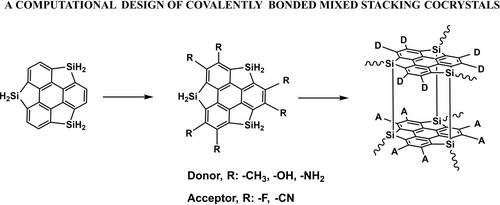
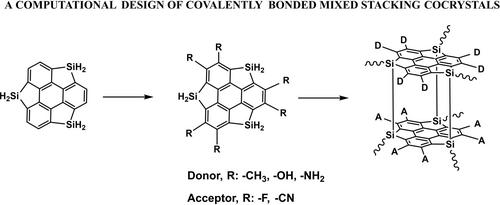
In this study, a computational design of a new type of donor-acceptor mixed stacking cocrystals is introduced. Our approach involves functionalizing trisilasumanene frameworks with electron-donating groups (−CH3, −OH, −NH2) and electron-withdrawing groups (−F, −CN), and then stacking donors and acceptors alternatively while connecting them either by sp3- and sp-carbon chains. Using the B3LYP-D3/6-31+G(d) level of theory, we demonstrate that these covalently bonded cocrystals can overcome the issue of thermal and mechanical instabilities observed in the non-covalently mixed stacking. Furthermore, modifying donor and acceptor groups can vary the bandgaps, approximated by the highest occupied molecular orbital (HOMO) and the lowest unoccupied molecular orbital (LUMO) gaps, from 1.50 to 3.50 eV. The results also predict the covalently bonded mixed stacking cocrystals having much larger conductance via Yoshizawa model. In addition, variations in bridge lengths were found to have a small effect on the HOMO-LUMO gaps but allow for a new control parameter regarding the porosity of the materials. These results encourage experimental explorations.
期刊介绍:
ChemPlusChem is a peer-reviewed, general chemistry journal that brings readers the very best in multidisciplinary research centering on chemistry. It is published on behalf of Chemistry Europe, an association of 16 European chemical societies.
Fully comprehensive in its scope, ChemPlusChem publishes articles covering new results from at least two different aspects (subfields) of chemistry or one of chemistry and one of another scientific discipline (one chemistry topic plus another one, hence the title ChemPlusChem). All suitable submissions undergo balanced peer review by experts in the field to ensure the highest quality, originality, relevance, significance, and validity.





 京公网安备 11010802042870号
京ICP备2023020795号-1
京公网安备 11010802042870号
京ICP备2023020795号-1

 分享
分享
 求助内容:
求助内容: 应助结果提醒方式:
 扫码关注我们
