{"title":"Risk factors for perioperative cerebral infarction in moyamoya disease: a meta-analysis.","authors":"Jincan Wu, Shiju Li, Ruixin Liang, Yanxu Wang, Fangyuan Shi, Xiaoming Pan, Xinyi Chen","doi":"10.3389/fneur.2025.1530137","DOIUrl":null,"url":null,"abstract":"<p><strong>Background: </strong>The present study explored the risk factors for cerebral infarction perioperative moyamoya disease by meta-analysis.</p><p><strong>Methods: </strong>The PubMed, Embase, Cochrane library, Web of science databases were searched for case-control/cohort studies on risk factors for the emergence of cerebral infarction perioperative moyamoya disease, the search was done from the database creation to June 1, 2024, and the data was analyzed by using stata15.0.</p><p><strong>Result: </strong>Ten retrospective cohort studies (<i>N</i> = 3,239) were included. Meta-analysis results suggested posterior cerebral artery involvement [OR = 2.62, 95%CI (1.36, 5.06)], preoperative magnetic resonance angiography [OR = 2.81, 95%CI (1.27, 6.22)], previous infarction [OR = 2.52, 95% CI (1.69, 3.75)] were risk factor for the development of cerebral infarction perioperative moyamoya disease.</p><p><strong>Conclusion: </strong>This study proves that posterior cerebral artery involvement and grade of preoperative magnetic resonance angiography is higher, and the previous infarction happened moyamoya disease a risk factor for cerebral infarction. Therefore, people with these risk factors should be intervened in advance to prevent the occurrence of perioperative cerebral infarction.</p>","PeriodicalId":12575,"journal":{"name":"Frontiers in Neurology","volume":"16 ","pages":"1530137"},"PeriodicalIF":2.8000,"publicationDate":"2025-01-24","publicationTypes":"Journal Article","fieldsOfStudy":null,"isOpenAccess":false,"openAccessPdf":"https://www.ncbi.nlm.nih.gov/pmc/articles/PMC11802441/pdf/","citationCount":"0","resultStr":null,"platform":"Semanticscholar","paperid":null,"PeriodicalName":"Frontiers in Neurology","FirstCategoryId":"3","ListUrlMain":"https://doi.org/10.3389/fneur.2025.1530137","RegionNum":3,"RegionCategory":"医学","ArticlePicture":[],"TitleCN":null,"AbstractTextCN":null,"PMCID":null,"EPubDate":"2025/1/1 0:00:00","PubModel":"eCollection","JCR":"Q2","JCRName":"CLINICAL NEUROLOGY","Score":null,"Total":0}
引用次数: 0
Abstract
Background: The present study explored the risk factors for cerebral infarction perioperative moyamoya disease by meta-analysis.
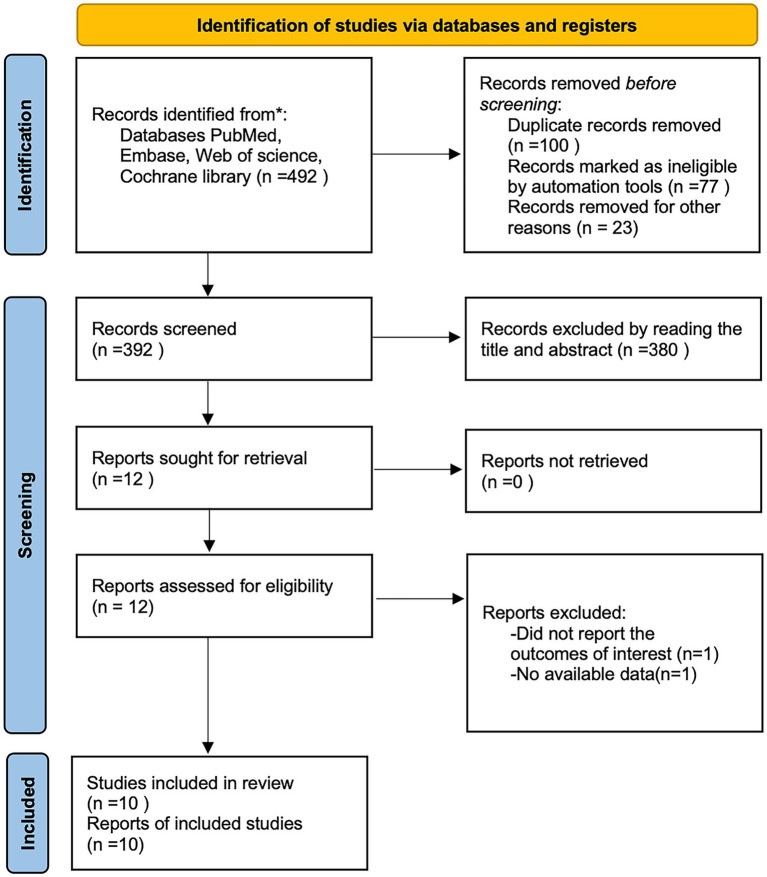
Methods: The PubMed, Embase, Cochrane library, Web of science databases were searched for case-control/cohort studies on risk factors for the emergence of cerebral infarction perioperative moyamoya disease, the search was done from the database creation to June 1, 2024, and the data was analyzed by using stata15.0.
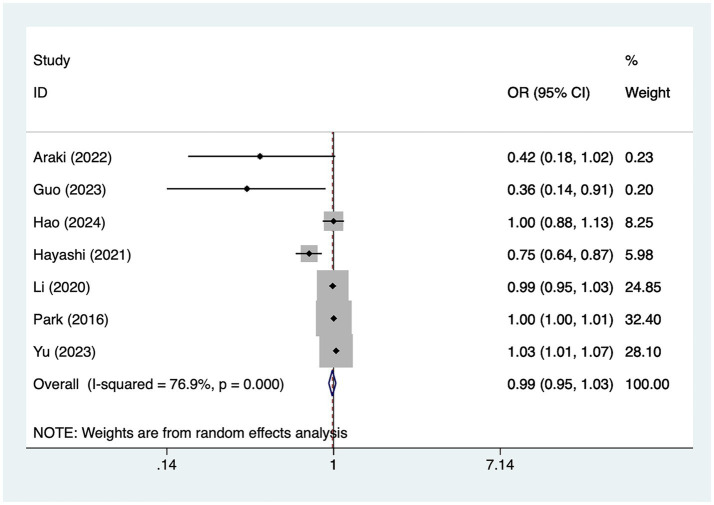
Result: Ten retrospective cohort studies (N = 3,239) were included. Meta-analysis results suggested posterior cerebral artery involvement [OR = 2.62, 95%CI (1.36, 5.06)], preoperative magnetic resonance angiography [OR = 2.81, 95%CI (1.27, 6.22)], previous infarction [OR = 2.52, 95% CI (1.69, 3.75)] were risk factor for the development of cerebral infarction perioperative moyamoya disease.
Conclusion: This study proves that posterior cerebral artery involvement and grade of preoperative magnetic resonance angiography is higher, and the previous infarction happened moyamoya disease a risk factor for cerebral infarction. Therefore, people with these risk factors should be intervened in advance to prevent the occurrence of perioperative cerebral infarction.
期刊介绍:
The section Stroke aims to quickly and accurately publish important experimental, translational and clinical studies, and reviews that contribute to the knowledge of stroke, its causes, manifestations, diagnosis, and management.





 京公网安备 11010802042870号
京ICP备2023020795号-1
京公网安备 11010802042870号
京ICP备2023020795号-1

 分享
分享
 求助内容:
求助内容: 应助结果提醒方式:
 扫码关注我们
