Mohit Kothari, Silas Alves-Costa, Abhishek Kumar, Gustavo G Nascimento, Jørgen Feldbæk Nielsen, Peter Svensson, Simple F Kothari
{"title":"Temporomandibular Disorders in Brain Injury Patients and Diagnostic Accuracy of the Assessment Tools.","authors":"Mohit Kothari, Silas Alves-Costa, Abhishek Kumar, Gustavo G Nascimento, Jørgen Feldbæk Nielsen, Peter Svensson, Simple F Kothari","doi":"10.1111/odi.15281","DOIUrl":null,"url":null,"abstract":"<p><strong>Objectives: </strong>To evaluate the presence, severity and progression of temporomandibular disorders (TMD) in acquired brain injury (ABI) population and determine the diagnostic accuracy of 3Q/TMD and Fonseca Anamnestic Index (FAI) against the gold standard, Diagnostic Criteria for TMD (DC/TMD).</p><p><strong>Methods: </strong>ABI individuals were assessed using 3Q/TMD and FAI at admission (n = 73) and Week 4 (n = 52), while DC/TMD was conducted only at Week 4. Diagnostic accuracy, sensitivity and specificity of 3Q/TMD and FAI were calculated against DC/TMD.</p><p><strong>Results: </strong>TMD was detected in 66.0% (3Q/TMD) and 27.8% (FAI) at admission, with mild (75%) to moderate (25%) severity which was mostly pain-related. TMD frequency decreased to 11.3% (3Q/TMD) and 17.3% (FAI) by Week 4. Accuracy rates were 0.82 for 3Q/TMD and 0.83 for FAI. Sensitivity was 0.33 (3Q/TMD) and 0.50 (FAI), while specificity was high at 0.93 (3Q/TMD) and 0.90 (FAI).</p><p><strong>Conclusions: </strong>TMD presence was higher in an ABI population compared to the general population however the frequency decreased over time. The high specificity and accuracy of 3Q/TMD and FAI indicate their potentials as screening tools but their low sensitivity limits their effectiveness in identifying all TMD cases. Patients with ABI should be assessed for TMD as part of their comprehensive care.</p>","PeriodicalId":19615,"journal":{"name":"Oral diseases","volume":" ","pages":"2251-2260"},"PeriodicalIF":2.9000,"publicationDate":"2025-07-01","publicationTypes":"Journal Article","fieldsOfStudy":null,"isOpenAccess":false,"openAccessPdf":"https://www.ncbi.nlm.nih.gov/pmc/articles/PMC12319349/pdf/","citationCount":"0","resultStr":null,"platform":"Semanticscholar","paperid":null,"PeriodicalName":"Oral diseases","FirstCategoryId":"3","ListUrlMain":"https://doi.org/10.1111/odi.15281","RegionNum":3,"RegionCategory":"医学","ArticlePicture":[],"TitleCN":null,"AbstractTextCN":null,"PMCID":null,"EPubDate":"2025/2/10 0:00:00","PubModel":"Epub","JCR":"Q1","JCRName":"DENTISTRY, ORAL SURGERY & MEDICINE","Score":null,"Total":0}
引用次数: 0
Abstract
Objectives: To evaluate the presence, severity and progression of temporomandibular disorders (TMD) in acquired brain injury (ABI) population and determine the diagnostic accuracy of 3Q/TMD and Fonseca Anamnestic Index (FAI) against the gold standard, Diagnostic Criteria for TMD (DC/TMD).
Methods: ABI individuals were assessed using 3Q/TMD and FAI at admission (n = 73) and Week 4 (n = 52), while DC/TMD was conducted only at Week 4. Diagnostic accuracy, sensitivity and specificity of 3Q/TMD and FAI were calculated against DC/TMD.
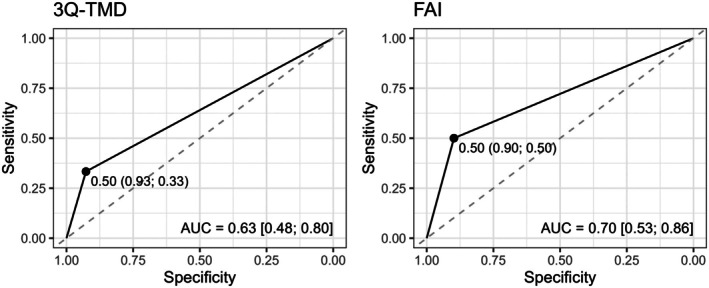
Results: TMD was detected in 66.0% (3Q/TMD) and 27.8% (FAI) at admission, with mild (75%) to moderate (25%) severity which was mostly pain-related. TMD frequency decreased to 11.3% (3Q/TMD) and 17.3% (FAI) by Week 4. Accuracy rates were 0.82 for 3Q/TMD and 0.83 for FAI. Sensitivity was 0.33 (3Q/TMD) and 0.50 (FAI), while specificity was high at 0.93 (3Q/TMD) and 0.90 (FAI).
Conclusions: TMD presence was higher in an ABI population compared to the general population however the frequency decreased over time. The high specificity and accuracy of 3Q/TMD and FAI indicate their potentials as screening tools but their low sensitivity limits their effectiveness in identifying all TMD cases. Patients with ABI should be assessed for TMD as part of their comprehensive care.
期刊介绍:
Oral Diseases is a multidisciplinary and international journal with a focus on head and neck disorders, edited by leaders in the field, Professor Giovanni Lodi (Editor-in-Chief, Milan, Italy), Professor Stefano Petti (Deputy Editor, Rome, Italy) and Associate Professor Gulshan Sunavala-Dossabhoy (Deputy Editor, Shreveport, LA, USA). The journal is pre-eminent in oral medicine. Oral Diseases specifically strives to link often-isolated areas of dentistry and medicine through broad-based scholarship that includes well-designed and controlled clinical research, analytical epidemiology, and the translation of basic science in pre-clinical studies. The journal typically publishes articles relevant to many related medical specialties including especially dermatology, gastroenterology, hematology, immunology, infectious diseases, neuropsychiatry, oncology and otolaryngology. The essential requirement is that all submitted research is hypothesis-driven, with significant positive and negative results both welcomed. Equal publication emphasis is placed on etiology, pathogenesis, diagnosis, prevention and treatment.




 京公网安备 11010802042870号
京ICP备2023020795号-1
京公网安备 11010802042870号
京ICP备2023020795号-1

 分享
分享
 求助内容:
求助内容: 应助结果提醒方式:
 扫码关注我们
