Tsaone Tamuhla, Anna K Coussens, Maleeka Abrahams, Melissa J Blumenthal, Francisco Lakay, Robert J Wilkinson, Catherine Riou, Peter Raubenheimer, Joel A Dave, Nicki Tiffin
{"title":"Implementation of a genotyped African population cohort, with virtual follow-up: A feasibility study in the Western Cape Province, South Africa.","authors":"Tsaone Tamuhla, Anna K Coussens, Maleeka Abrahams, Melissa J Blumenthal, Francisco Lakay, Robert J Wilkinson, Catherine Riou, Peter Raubenheimer, Joel A Dave, Nicki Tiffin","doi":"10.12688/wellcomeopenres.23009.2","DOIUrl":null,"url":null,"abstract":"<p><strong>Background: </strong>There is limited knowledge regarding African genetic drivers of disease due to prohibitive costs of large-scale genomic research in Africa.</p><p><strong>Methods: </strong>We piloted a scalable virtual genotyped cohort in South Africa that was affordable in this resource-limited context, cost-effective, scalable virtual genotyped cohort in South Africa, with participant recruitment using a tiered informed consent model and DNA collection by buccal swab. Genotype data was generated using the H3Africa Illumina micro-array, and phenotype data was derived from routine health data of participants. We demonstrated feasibility of nested case control genome wide association studies using these data for phenotypes type 2 diabetes mellitus (T2DM) and severe COVID-19.</p><p><strong>Results: </strong>2267346 variants were analysed in 459 participant samples, of which 229 (66.8%) are female. 78.6% of SNPs and 74% of samples passed quality control (QC). Principal component analysis showed extensive ancestry admixture in study participants. Of the 343 samples that passed QC, 93 participants had T2DM and 63 had severe COVID-19. For 1780 previously published COVID-19-associated variants, 3 SNPs in the pre-imputation data and 23 SNPS in the imputed data were significantly associated with severe COVID-19 cases compared to controls (p<0.05). For 2755 published T2DM associated variants, 69 SNPs in the pre-imputation data and 419 SNPs in the imputed data were significantly associated with T2DM cases when compared to controls (p<0.05).</p><p><strong>Conclusions: </strong>The results shown here are illustrative of what will be possible as the cohort expands in the future. Here we demonstrate the feasibility of this approach, recognising that the findings presented here are preliminary and require further validation once we have a sufficient sample size to improve statistical significance of findings.We implemented a genotyped population cohort with virtual follow up data in a resource-constrained African environment, demonstrating feasibility for scale up and novel health discoveries through nested case-control studies.</p>","PeriodicalId":23677,"journal":{"name":"Wellcome Open Research","volume":"9 ","pages":"620"},"PeriodicalIF":0.0000,"publicationDate":"2025-01-13","publicationTypes":"Journal Article","fieldsOfStudy":null,"isOpenAccess":false,"openAccessPdf":"https://www.ncbi.nlm.nih.gov/pmc/articles/PMC11806245/pdf/","citationCount":"0","resultStr":null,"platform":"Semanticscholar","paperid":null,"PeriodicalName":"Wellcome Open Research","FirstCategoryId":"1085","ListUrlMain":"https://doi.org/10.12688/wellcomeopenres.23009.2","RegionNum":0,"RegionCategory":null,"ArticlePicture":[],"TitleCN":null,"AbstractTextCN":null,"PMCID":null,"EPubDate":"2024/1/1 0:00:00","PubModel":"eCollection","JCR":"Q1","JCRName":"Medicine","Score":null,"Total":0}
引用次数: 0
Abstract
Background: There is limited knowledge regarding African genetic drivers of disease due to prohibitive costs of large-scale genomic research in Africa.
Methods: We piloted a scalable virtual genotyped cohort in South Africa that was affordable in this resource-limited context, cost-effective, scalable virtual genotyped cohort in South Africa, with participant recruitment using a tiered informed consent model and DNA collection by buccal swab. Genotype data was generated using the H3Africa Illumina micro-array, and phenotype data was derived from routine health data of participants. We demonstrated feasibility of nested case control genome wide association studies using these data for phenotypes type 2 diabetes mellitus (T2DM) and severe COVID-19.
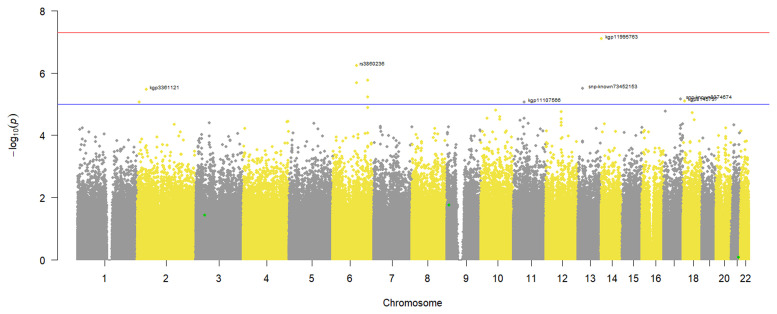
Results: 2267346 variants were analysed in 459 participant samples, of which 229 (66.8%) are female. 78.6% of SNPs and 74% of samples passed quality control (QC). Principal component analysis showed extensive ancestry admixture in study participants. Of the 343 samples that passed QC, 93 participants had T2DM and 63 had severe COVID-19. For 1780 previously published COVID-19-associated variants, 3 SNPs in the pre-imputation data and 23 SNPS in the imputed data were significantly associated with severe COVID-19 cases compared to controls (p<0.05). For 2755 published T2DM associated variants, 69 SNPs in the pre-imputation data and 419 SNPs in the imputed data were significantly associated with T2DM cases when compared to controls (p<0.05).
Conclusions: The results shown here are illustrative of what will be possible as the cohort expands in the future. Here we demonstrate the feasibility of this approach, recognising that the findings presented here are preliminary and require further validation once we have a sufficient sample size to improve statistical significance of findings.We implemented a genotyped population cohort with virtual follow up data in a resource-constrained African environment, demonstrating feasibility for scale up and novel health discoveries through nested case-control studies.
Wellcome Open ResearchBiochemistry, Genetics and Molecular Biology-Biochemistry, Genetics and Molecular Biology (all)
CiteScore
5.50
自引率
0.00%
发文量
426
审稿时长
1 weeks
期刊介绍:
Wellcome Open Research publishes scholarly articles reporting any basic scientific, translational and clinical research that has been funded (or co-funded) by Wellcome. Each publication must have at least one author who has been, or still is, a recipient of a Wellcome grant. Articles must be original (not duplications). All research, including clinical trials, systematic reviews, software tools, method articles, and many others, is welcome and will be published irrespective of the perceived level of interest or novelty; confirmatory and negative results, as well as null studies are all suitable. See the full list of article types here. All articles are published using a fully transparent, author-driven model: the authors are solely responsible for the content of their article. Invited peer review takes place openly after publication, and the authors play a crucial role in ensuring that the article is peer-reviewed by independent experts in a timely manner. Articles that pass peer review will be indexed in PubMed and elsewhere. Wellcome Open Research is an Open Research platform: all articles are published open access; the publishing and peer-review processes are fully transparent; and authors are asked to include detailed descriptions of methods and to provide full and easy access to source data underlying the results to improve reproducibility.






 京公网安备 11010802042870号
京ICP备2023020795号-1
京公网安备 11010802042870号
京ICP备2023020795号-1

 分享
分享
 求助内容:
求助内容: 应助结果提醒方式:
 扫码关注我们
