{"title":"Research on real-road NH3 emissions of China-6 heavy-duty natural gas and diesel vehicles","authors":"Zihao Ge, Changyu Wang, Zhe Ji, Yachao Wang, Luoshu Yang, Ying Huang, Liqun Lyu","doi":"10.1016/j.jhazmat.2025.137583","DOIUrl":null,"url":null,"abstract":"In this paper, ammonia (NH<sub>3</sub>) emissions of China-5 and three-way catalyst (TWC)-fitted China-6 heavy-duty NG vehicles and SCR-fitted China-6 diesel vehicles were characterized during real-road emission tests. The results showed that, due to side reactions within TWCs, real-world NH<sub>3</sub> emissions of China-6 NG vehicles were significantly higher than those of their diesel counterparts and those of China-5 NG vehicles without TWCs. For China-6 NG vehicles, NH<sub>3</sub> emissions occurred during the light-off of the TWCs and rich combustion. SCR-fitted China-6 heavy-duty diesel vehicles also had NH<sub>3</sub> emissions mainly caused by excessive SCR reductant injection and leakage from ammonia slip catalysts (ASC). China-5 heavy-duty NG vehicles emit little NH<sub>3</sub> for they utilized lean-combustion without SCR or TWC, where NH<sub>3</sub> forms. Although lean combustion NG engines hardly have NH<sub>3</sub> emissions, the extremely high engine-out NO<sub>x</sub> emissions restricted its further application.","PeriodicalId":361,"journal":{"name":"Journal of Hazardous Materials","volume":"169 1","pages":""},"PeriodicalIF":11.3000,"publicationDate":"2025-02-11","publicationTypes":"Journal Article","fieldsOfStudy":null,"isOpenAccess":false,"openAccessPdf":"","citationCount":"0","resultStr":null,"platform":"Semanticscholar","paperid":null,"PeriodicalName":"Journal of Hazardous Materials","FirstCategoryId":"93","ListUrlMain":"https://doi.org/10.1016/j.jhazmat.2025.137583","RegionNum":1,"RegionCategory":"环境科学与生态学","ArticlePicture":[],"TitleCN":null,"AbstractTextCN":null,"PMCID":null,"EPubDate":"","PubModel":"","JCR":"Q1","JCRName":"ENGINEERING, ENVIRONMENTAL","Score":null,"Total":0}
引用次数: 0
Abstract
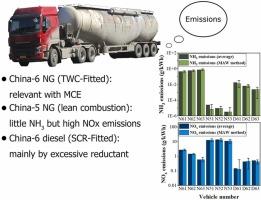
In this paper, ammonia (NH3) emissions of China-5 and three-way catalyst (TWC)-fitted China-6 heavy-duty NG vehicles and SCR-fitted China-6 diesel vehicles were characterized during real-road emission tests. The results showed that, due to side reactions within TWCs, real-world NH3 emissions of China-6 NG vehicles were significantly higher than those of their diesel counterparts and those of China-5 NG vehicles without TWCs. For China-6 NG vehicles, NH3 emissions occurred during the light-off of the TWCs and rich combustion. SCR-fitted China-6 heavy-duty diesel vehicles also had NH3 emissions mainly caused by excessive SCR reductant injection and leakage from ammonia slip catalysts (ASC). China-5 heavy-duty NG vehicles emit little NH3 for they utilized lean-combustion without SCR or TWC, where NH3 forms. Although lean combustion NG engines hardly have NH3 emissions, the extremely high engine-out NOx emissions restricted its further application.
期刊介绍:
The Journal of Hazardous Materials serves as a global platform for promoting cutting-edge research in the field of Environmental Science and Engineering. Our publication features a wide range of articles, including full-length research papers, review articles, and perspectives, with the aim of enhancing our understanding of the dangers and risks associated with various materials concerning public health and the environment. It is important to note that the term "environmental contaminants" refers specifically to substances that pose hazardous effects through contamination, while excluding those that do not have such impacts on the environment or human health. Moreover, we emphasize the distinction between wastes and hazardous materials in order to provide further clarity on the scope of the journal. We have a keen interest in exploring specific compounds and microbial agents that have adverse effects on the environment.



 京公网安备 11010802042870号
京ICP备2023020795号-1
京公网安备 11010802042870号
京ICP备2023020795号-1

 分享
分享
 求助内容:
求助内容: 应助结果提醒方式:
 扫码关注我们
