T. C. van Thiel, M. J. Weaver, F. Berto, P. Duivestein, M. Lemang, K. L. Schuurman, M. Žemlička, F. Hijazi, A. C. Bernasconi, C. Ferrer, E. Cataldo, E. Lachman, M. Field, Y. Mohan, F. K. de Vries, C. C. Bultink, J. C. van Oven, J. Y. Mutus, R. Stockill, S. Gröblacher
{"title":"Optical readout of a superconducting qubit using a piezo-optomechanical transducer","authors":"T. C. van Thiel, M. J. Weaver, F. Berto, P. Duivestein, M. Lemang, K. L. Schuurman, M. Žemlička, F. Hijazi, A. C. Bernasconi, C. Ferrer, E. Cataldo, E. Lachman, M. Field, Y. Mohan, F. K. de Vries, C. C. Bultink, J. C. van Oven, J. Y. Mutus, R. Stockill, S. Gröblacher","doi":"10.1038/s41567-024-02742-3","DOIUrl":null,"url":null,"abstract":"Superconducting quantum processors have made important progress in size and computing potential. However, the practical cryogenic limitations of operating large numbers of superconducting qubits are becoming a bottleneck for further scaling. Due to the low thermal conductivity and the dense optical multiplexing capacity of telecommunications fibre, converting qubit signal processing to the optical domain using microwave-to-optics transduction would substantially relax the strain on cryogenic space and thermal budgets. Here we demonstrate optical readout of a superconducting transmon qubit through an optical fibre connected via a coaxial cable to a fully integrated piezo-optomechanical transducer. Using a demolition readout technique, we achieve a single-shot readout fidelity of 81%. Our results illustrate the benefits of piezo-optomechanical transduction for low-dissipation operation of large quantum processors. Superconducting qubits are measured using microwaves, posing constraints on its size and thermal budgets. The electro-optic transceiver presented here can be used to perform optical readout without affecting qubit performance.","PeriodicalId":19100,"journal":{"name":"Nature Physics","volume":"21 3","pages":"401-405"},"PeriodicalIF":18.4000,"publicationDate":"2025-02-11","publicationTypes":"Journal Article","fieldsOfStudy":null,"isOpenAccess":false,"openAccessPdf":"","citationCount":"0","resultStr":null,"platform":"Semanticscholar","paperid":null,"PeriodicalName":"Nature Physics","FirstCategoryId":"101","ListUrlMain":"https://www.nature.com/articles/s41567-024-02742-3","RegionNum":1,"RegionCategory":"物理与天体物理","ArticlePicture":[],"TitleCN":null,"AbstractTextCN":null,"PMCID":null,"EPubDate":"","PubModel":"","JCR":"Q1","JCRName":"PHYSICS, MULTIDISCIPLINARY","Score":null,"Total":0}
引用次数: 0
Abstract
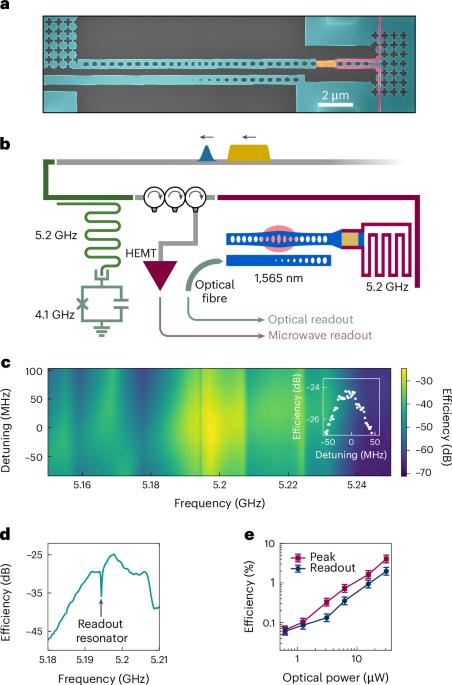
Superconducting quantum processors have made important progress in size and computing potential. However, the practical cryogenic limitations of operating large numbers of superconducting qubits are becoming a bottleneck for further scaling. Due to the low thermal conductivity and the dense optical multiplexing capacity of telecommunications fibre, converting qubit signal processing to the optical domain using microwave-to-optics transduction would substantially relax the strain on cryogenic space and thermal budgets. Here we demonstrate optical readout of a superconducting transmon qubit through an optical fibre connected via a coaxial cable to a fully integrated piezo-optomechanical transducer. Using a demolition readout technique, we achieve a single-shot readout fidelity of 81%. Our results illustrate the benefits of piezo-optomechanical transduction for low-dissipation operation of large quantum processors. Superconducting qubits are measured using microwaves, posing constraints on its size and thermal budgets. The electro-optic transceiver presented here can be used to perform optical readout without affecting qubit performance.
期刊介绍:
Nature Physics is dedicated to publishing top-tier original research in physics with a fair and rigorous review process. It provides high visibility and access to a broad readership, maintaining high standards in copy editing and production, ensuring rapid publication, and maintaining independence from academic societies and other vested interests.
The journal presents two main research paper formats: Letters and Articles. Alongside primary research, Nature Physics serves as a central source for valuable information within the physics community through Review Articles, News & Views, Research Highlights covering crucial developments across the physics literature, Commentaries, Book Reviews, and Correspondence.



 京公网安备 11010802042870号
京ICP备2023020795号-1
京公网安备 11010802042870号
京ICP备2023020795号-1

 分享
分享
 求助内容:
求助内容: 应助结果提醒方式:
 扫码关注我们
