Enhancing the synergistic effect by introducing Cu(Ⅱ)-PMS into the underwater bubble plasma treatment process for efficient degradation of emerging contaminants in water
{"title":"Enhancing the synergistic effect by introducing Cu(Ⅱ)-PMS into the underwater bubble plasma treatment process for efficient degradation of emerging contaminants in water","authors":"Zhijie Liu, Xin Li, Hezhi Guo, Zekai Zhang, Yongchun Wang, Polun Pang, Yuting Gao, He Guo","doi":"10.1016/j.cej.2025.160480","DOIUrl":null,"url":null,"abstract":"This paper presents a novel type of Underwater Bubble Plasma-Divalent Copper Salt-Peroxymonosulfate (UBP-Cu(Ⅱ)-PMS) for the efficient degradation of emerging contaminants in water. The results demonstrate that Cu(Ⅱ)-PMS can be effectively activated during UBP treatment process, generating two highly reactive free radicals (<img alt=\"radical dot\" src=\"https://sdfestaticassets-us-east-1.sciencedirectassets.com/shared-assets/55/entities/rad.gif\" style=\"vertical-align:middle\"/>OH and <span><span style=\"\"><math><msup is=\"true\"><mrow is=\"true\"><msub is=\"true\"><mrow is=\"true\"><mo is=\"true\">·</mo><mi is=\"true\" mathvariant=\"normal\">S</mi><mi is=\"true\" mathvariant=\"normal\">O</mi></mrow><mn is=\"true\">4</mn></msub></mrow><mi is=\"true\">_</mi></msup></math></span><span style=\"font-size: 90%; display: inline-block;\" tabindex=\"0\"></span><script type=\"math/mml\"><math><msup is=\"true\"><mrow is=\"true\"><msub is=\"true\"><mrow is=\"true\"><mo is=\"true\">·</mo><mi mathvariant=\"normal\" is=\"true\">S</mi><mi mathvariant=\"normal\" is=\"true\">O</mi></mrow><mn is=\"true\">4</mn></msub></mrow><mi is=\"true\">_</mi></msup></math></script></span>) that promote the degradation of high-concentration tetracycline hydrochloride (TC). A comparative analysis of UBP’s performance in activating persulfate (PS), PMS, and sulfite (S(IV)) for the synergistic degradation of TC revealed that PMS and UBP exhibited the strongest synergistic effect. When PMS is 0.5 g/L, the activation performance peaked, with the UBP-PMS system achieving an impressive 87.22 % degradation efficiency of TC within 20 min, which is 30.02 % higher than that of the single UBP system. Furthermore, upon introducing Cu(Ⅱ) into the UBP-PMS system, with PMS at 0.5 g/L and Cu(Ⅱ) at 0.05 g/L, the degradation efficiency of TC reached 95.73 %, and energy efficiency was measured at 1.5509 g·(kWh)<sup>−1</sup> within 20 min, surpassing other treatment systems. Free radical trapping experiments indicated that the primary reactive species responsible for TC degradation in UBP-Cu(Ⅱ)-PMS co-catalytic strategy include <img alt=\"radical dot\" src=\"https://sdfestaticassets-us-east-1.sciencedirectassets.com/shared-assets/55/entities/rad.gif\" style=\"vertical-align:middle\"/>OH, ONOOH/<span><span style=\"\"><math><msup is=\"true\"><mrow is=\"true\"><msub is=\"true\"><mrow is=\"true\"><mo is=\"true\">·</mo><mi is=\"true\" mathvariant=\"normal\">O</mi></mrow><mn is=\"true\">2</mn></msub></mrow><mi is=\"true\">_</mi></msup></math></span><span style=\"font-size: 90%; display: inline-block;\" tabindex=\"0\"></span><script type=\"math/mml\"><math><msup is=\"true\"><mrow is=\"true\"><msub is=\"true\"><mrow is=\"true\"><mo is=\"true\">·</mo><mi mathvariant=\"normal\" is=\"true\">O</mi></mrow><mn is=\"true\">2</mn></msub></mrow><mi is=\"true\">_</mi></msup></math></script></span>, <span><span style=\"\"><math><msup is=\"true\"><mrow is=\"true\"><msub is=\"true\"><mrow is=\"true\"><mo is=\"true\">·</mo><mi is=\"true\">S</mi><mi is=\"true\">O</mi></mrow><mn is=\"true\">4</mn></msub></mrow><mi is=\"true\">_</mi></msup></math></span><span style=\"font-size: 90%; display: inline-block;\" tabindex=\"0\"></span><script type=\"math/mml\"><math><msup is=\"true\"><mrow is=\"true\"><msub is=\"true\"><mrow is=\"true\"><mo is=\"true\">·</mo><mi is=\"true\">S</mi><mi is=\"true\">O</mi></mrow><mn is=\"true\">4</mn></msub></mrow><mi is=\"true\">_</mi></msup></math></script></span> and <sup>1</sup>O<sub>2</sub>. Fenton-like reaction enhances the concentration of <img alt=\"radical dot\" src=\"https://sdfestaticassets-us-east-1.sciencedirectassets.com/shared-assets/55/entities/rad.gif\" style=\"vertical-align:middle\"/>OH in the solution, while oxygen-sulfur radical reaction produces <span><span style=\"\"><math><msup is=\"true\"><mrow is=\"true\"><msub is=\"true\"><mrow is=\"true\"><mo is=\"true\">·</mo><mtext is=\"true\">SO</mtext></mrow><mtext is=\"true\">4</mtext></msub></mrow><mtext is=\"true\">\\_</mtext></msup></math></span><span style=\"font-size: 90%; display: inline-block;\" tabindex=\"0\"></span><script type=\"math/mml\"><math><msup is=\"true\"><mrow is=\"true\"><msub is=\"true\"><mrow is=\"true\"><mo is=\"true\">·</mo><mtext is=\"true\">SO</mtext></mrow><mtext is=\"true\">4</mtext></msub></mrow><mtext is=\"true\">\\_</mtext></msup></math></script></span>. The conversion between different valence states of Cu primarily involves electron transfer. Possible degradation pathways were proposed based on DFT calculations and LC-MS analysis during the synergistic treatment, and the toxicity of by-products generated during the degradation process was evaluated using T.E.S.T. software. Ultimately, a synergistic degradation mechanism for the UBP-Cu(Ⅱ)-PMS strategy was proposed. This study introduces a new activation strategy involving UBP-Cu(Ⅱ)-PMS and provides valuable insights into the degradation performance and mechanisms of emerging contaminants.","PeriodicalId":270,"journal":{"name":"Chemical Engineering Journal","volume":"35 1","pages":""},"PeriodicalIF":13.2000,"publicationDate":"2025-02-10","publicationTypes":"Journal Article","fieldsOfStudy":null,"isOpenAccess":false,"openAccessPdf":"","citationCount":"0","resultStr":null,"platform":"Semanticscholar","paperid":null,"PeriodicalName":"Chemical Engineering Journal","FirstCategoryId":"5","ListUrlMain":"https://doi.org/10.1016/j.cej.2025.160480","RegionNum":1,"RegionCategory":"工程技术","ArticlePicture":[],"TitleCN":null,"AbstractTextCN":null,"PMCID":null,"EPubDate":"","PubModel":"","JCR":"Q1","JCRName":"ENGINEERING, CHEMICAL","Score":null,"Total":0}
引用次数: 0
Abstract
This paper presents a novel type of Underwater Bubble Plasma-Divalent Copper Salt-Peroxymonosulfate (UBP-Cu(Ⅱ)-PMS) for the efficient degradation of emerging contaminants in water. The results demonstrate that Cu(Ⅱ)-PMS can be effectively activated during UBP treatment process, generating two highly reactive free radicals (OH and ) that promote the degradation of high-concentration tetracycline hydrochloride (TC). A comparative analysis of UBP’s performance in activating persulfate (PS), PMS, and sulfite (S(IV)) for the synergistic degradation of TC revealed that PMS and UBP exhibited the strongest synergistic effect. When PMS is 0.5 g/L, the activation performance peaked, with the UBP-PMS system achieving an impressive 87.22 % degradation efficiency of TC within 20 min, which is 30.02 % higher than that of the single UBP system. Furthermore, upon introducing Cu(Ⅱ) into the UBP-PMS system, with PMS at 0.5 g/L and Cu(Ⅱ) at 0.05 g/L, the degradation efficiency of TC reached 95.73 %, and energy efficiency was measured at 1.5509 g·(kWh)−1 within 20 min, surpassing other treatment systems. Free radical trapping experiments indicated that the primary reactive species responsible for TC degradation in UBP-Cu(Ⅱ)-PMS co-catalytic strategy include OH, ONOOH/, and 1O2. Fenton-like reaction enhances the concentration of OH in the solution, while oxygen-sulfur radical reaction produces . The conversion between different valence states of Cu primarily involves electron transfer. Possible degradation pathways were proposed based on DFT calculations and LC-MS analysis during the synergistic treatment, and the toxicity of by-products generated during the degradation process was evaluated using T.E.S.T. software. Ultimately, a synergistic degradation mechanism for the UBP-Cu(Ⅱ)-PMS strategy was proposed. This study introduces a new activation strategy involving UBP-Cu(Ⅱ)-PMS and provides valuable insights into the degradation performance and mechanisms of emerging contaminants.
期刊介绍:
The Chemical Engineering Journal is an international research journal that invites contributions of original and novel fundamental research. It aims to provide an international platform for presenting original fundamental research, interpretative reviews, and discussions on new developments in chemical engineering. The journal welcomes papers that describe novel theory and its practical application, as well as those that demonstrate the transfer of techniques from other disciplines. It also welcomes reports on carefully conducted experimental work that is soundly interpreted. The main focus of the journal is on original and rigorous research results that have broad significance. The Catalysis section within the Chemical Engineering Journal focuses specifically on Experimental and Theoretical studies in the fields of heterogeneous catalysis, molecular catalysis, and biocatalysis. These studies have industrial impact on various sectors such as chemicals, energy, materials, foods, healthcare, and environmental protection.
 OH and ) that promote the degradation of high-concentration tetracycline hydrochloride (TC). A comparative analysis of UBP’s performance in activating persulfate (PS), PMS, and sulfite (S(IV)) for the synergistic degradation of TC revealed that PMS and UBP exhibited the strongest synergistic effect. When PMS is 0.5 g/L, the activation performance peaked, with the UBP-PMS system achieving an impressive 87.22 % degradation efficiency of TC within 20 min, which is 30.02 % higher than that of the single UBP system. Furthermore, upon introducing Cu(Ⅱ) into the UBP-PMS system, with PMS at 0.5 g/L and Cu(Ⅱ) at 0.05 g/L, the degradation efficiency of TC reached 95.73 %, and energy efficiency was measured at 1.5509 g·(kWh)−1 within 20 min, surpassing other treatment systems. Free radical trapping experiments indicated that the primary reactive species responsible for TC degradation in UBP-Cu(Ⅱ)-PMS co-catalytic strategy include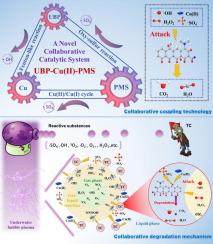



 京公网安备 11010802042870号
京ICP备2023020795号-1
京公网安备 11010802042870号
京ICP备2023020795号-1

 分享
分享
 求助内容:
求助内容: 应助结果提醒方式:
 扫码关注我们
