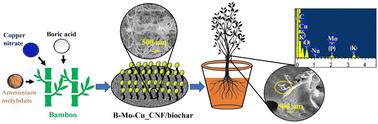
{"title":"A micro-nano formulation of multi-micronutrient- and carbon nanofiber-modified biochar for enhanced plant growth†","authors":"Abhishek Gupta, Rahul Gupta and Nishith Verma","doi":"10.1039/D4EN00802B","DOIUrl":null,"url":null,"abstract":"<p >This study introduces M_CNF/biochar, a novel plant growth stimulant comprising bamboo-derived biochar, boron (B), molybdenum (Mo), and copper (Cu)-carbon nanofibers (CNF). The prepared micro-nano formulation is successfully used to deliver the B–Mo–Cu multi micronutrients to <em>Cicer arietinum</em> (chickpea) plant, with the CNFs acting as a translocator for the micronutrients. The synthesized material is thoroughly characterized for its physicochemical properties using various analytical techniques. The results show that a M_CNF/biochar-dose of 1 g kg<small><sup>−1</sup></small> soil significantly enhances plant growth, as indicated by an increase in the fresh biomass, root and shoot lengths, and protein and chlorophyll contents. Furthermore, the soil's water-holding capacity increases by more than 90% with the mixing of M_CNF/biochar. The results also reveal that the total nitrogen content of the soil amended with M_CNF/biochar increases more than 4 times, post-30 days of plant growth, indicating an improvement in the nitrogen fixation capacity of the rhizosphere. This study has successfully presented the bamboo-derived biochar modified with micronutrients for sustainable agriculture.</p>","PeriodicalId":73,"journal":{"name":"Environmental Science: Nano","volume":" 3","pages":" 2076-2090"},"PeriodicalIF":5.1000,"publicationDate":"2025-02-11","publicationTypes":"Journal Article","fieldsOfStudy":null,"isOpenAccess":false,"openAccessPdf":"","citationCount":"0","resultStr":null,"platform":"Semanticscholar","paperid":null,"PeriodicalName":"Environmental Science: Nano","FirstCategoryId":"6","ListUrlMain":"https://pubs.rsc.org/en/content/articlelanding/2025/en/d4en00802b","RegionNum":2,"RegionCategory":"环境科学与生态学","ArticlePicture":[],"TitleCN":null,"AbstractTextCN":null,"PMCID":null,"EPubDate":"","PubModel":"","JCR":"Q1","JCRName":"CHEMISTRY, MULTIDISCIPLINARY","Score":null,"Total":0}
引用次数: 0
Abstract
This study introduces M_CNF/biochar, a novel plant growth stimulant comprising bamboo-derived biochar, boron (B), molybdenum (Mo), and copper (Cu)-carbon nanofibers (CNF). The prepared micro-nano formulation is successfully used to deliver the B–Mo–Cu multi micronutrients to Cicer arietinum (chickpea) plant, with the CNFs acting as a translocator for the micronutrients. The synthesized material is thoroughly characterized for its physicochemical properties using various analytical techniques. The results show that a M_CNF/biochar-dose of 1 g kg−1 soil significantly enhances plant growth, as indicated by an increase in the fresh biomass, root and shoot lengths, and protein and chlorophyll contents. Furthermore, the soil's water-holding capacity increases by more than 90% with the mixing of M_CNF/biochar. The results also reveal that the total nitrogen content of the soil amended with M_CNF/biochar increases more than 4 times, post-30 days of plant growth, indicating an improvement in the nitrogen fixation capacity of the rhizosphere. This study has successfully presented the bamboo-derived biochar modified with micronutrients for sustainable agriculture.
本研究介绍了一种新型植物生长刺激剂M_CNF/生物炭,它由竹源生物炭、硼(B)、钼(Mo)-和铜(Cu)-碳纳米纤维(CNF)组成。制备的微纳配方成功地将B-Mo-Cu多微量营养素输送到鹰嘴豆植物中,CNF作为微量营养素的转运器。利用各种分析技术对合成材料的理化性质进行了全面表征。结果表明:1 g kg - 1土壤中添加M_CNF/生物炭对植物生长有显著的促进作用,生物量、根长、芽长、蛋白质和叶绿素含量增加。此外,M_CNF/生物炭混合后,土壤的持水量增加了90%以上。在植物生长30 d后,土壤中总氮含量增加了4倍以上,表明根际固氮能力有所提高。本研究成功地为可持续农业提供了经微量元素修饰的竹源生物炭。
期刊介绍:
Environmental Science: Nano serves as a comprehensive and high-impact peer-reviewed source of information on the design and demonstration of engineered nanomaterials for environment-based applications. It also covers the interactions between engineered, natural, and incidental nanomaterials with biological and environmental systems. This scope includes, but is not limited to, the following topic areas:
Novel nanomaterial-based applications for water, air, soil, food, and energy sustainability
Nanomaterial interactions with biological systems and nanotoxicology
Environmental fate, reactivity, and transformations of nanoscale materials
Nanoscale processes in the environment
Sustainable nanotechnology including rational nanomaterial design, life cycle assessment, risk/benefit analysis



 京公网安备 11010802042870号
京ICP备2023020795号-1
京公网安备 11010802042870号
京ICP备2023020795号-1

 分享
分享
 求助内容:
求助内容: 应助结果提醒方式:
 扫码关注我们
