Xuejiao Cao , Xuan Luo , Amir Heydari , Safira M. Barros , Bradley Peter Kirk , Youhong Tang , Colin L. Raston
{"title":"Vortex fluidic mediated generation of fatty acid ethyl esters from vegetable oils for applications in cosmetic emulsions","authors":"Xuejiao Cao , Xuan Luo , Amir Heydari , Safira M. Barros , Bradley Peter Kirk , Youhong Tang , Colin L. Raston","doi":"10.1016/j.jclepro.2025.145006","DOIUrl":null,"url":null,"abstract":"<div><div>This study investigates the production of fatty acid ethyl esters (FAEE) for organic cosmetic applications, focusing on adhering to green chemistry principles and organic cosmetic standards. To achieve this, the vortex fluidic device (VFD), a high-efficiency thin-film processing platform, was explored to enhance FAEE production from Canola and Tung oil at room temperature. By utilising the central composite design technique, this study systematically varied the rotational speed of the standard VFD, the catalyst concentration, and the ethanol-to-oil ratio, aiming for the highest product yield in 20 min. Scale-up production of Canola-FAEE and Tung-FAEE was further achieved with an upsized VFD, using a benchtop method as the control. The yield of Canola FAEE reached 96% using the upsized VFD processing, demonstrating a 10% improvement over the bench-top method. Additionally, the FAEE transesterified from Tung oil with a relatively high acid value of 3.7 mg/g exhibited an increased yield from 53.2% to 90.5% while preserving the triple conjugated C=C of α-eleostearic acid. In the formulation of skincare emulsions, the FAEE-based emulsion showed smaller particle sizes (350–370 nm) and superior stability compared to oil-based counterparts after 5 days of storage at 50 °C. This research establishes an efficient protocol for producing cosmetic-grade FAEE using VFD technology, highlighting its potential for skincare formulations.</div></div>","PeriodicalId":349,"journal":{"name":"Journal of Cleaner Production","volume":"494 ","pages":"Article 145006"},"PeriodicalIF":10.0000,"publicationDate":"2025-02-11","publicationTypes":"Journal Article","fieldsOfStudy":null,"isOpenAccess":false,"openAccessPdf":"","citationCount":"0","resultStr":null,"platform":"Semanticscholar","paperid":null,"PeriodicalName":"Journal of Cleaner Production","FirstCategoryId":"93","ListUrlMain":"https://www.sciencedirect.com/science/article/pii/S0959652625003567","RegionNum":1,"RegionCategory":"环境科学与生态学","ArticlePicture":[],"TitleCN":null,"AbstractTextCN":null,"PMCID":null,"EPubDate":"","PubModel":"","JCR":"Q1","JCRName":"ENGINEERING, ENVIRONMENTAL","Score":null,"Total":0}
引用次数: 0
Abstract
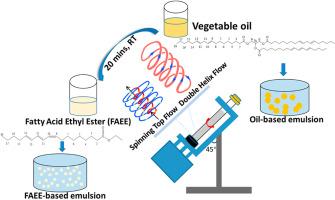
This study investigates the production of fatty acid ethyl esters (FAEE) for organic cosmetic applications, focusing on adhering to green chemistry principles and organic cosmetic standards. To achieve this, the vortex fluidic device (VFD), a high-efficiency thin-film processing platform, was explored to enhance FAEE production from Canola and Tung oil at room temperature. By utilising the central composite design technique, this study systematically varied the rotational speed of the standard VFD, the catalyst concentration, and the ethanol-to-oil ratio, aiming for the highest product yield in 20 min. Scale-up production of Canola-FAEE and Tung-FAEE was further achieved with an upsized VFD, using a benchtop method as the control. The yield of Canola FAEE reached 96% using the upsized VFD processing, demonstrating a 10% improvement over the bench-top method. Additionally, the FAEE transesterified from Tung oil with a relatively high acid value of 3.7 mg/g exhibited an increased yield from 53.2% to 90.5% while preserving the triple conjugated C=C of α-eleostearic acid. In the formulation of skincare emulsions, the FAEE-based emulsion showed smaller particle sizes (350–370 nm) and superior stability compared to oil-based counterparts after 5 days of storage at 50 °C. This research establishes an efficient protocol for producing cosmetic-grade FAEE using VFD technology, highlighting its potential for skincare formulations.
期刊介绍:
The Journal of Cleaner Production is an international, transdisciplinary journal that addresses and discusses theoretical and practical Cleaner Production, Environmental, and Sustainability issues. It aims to help societies become more sustainable by focusing on the concept of 'Cleaner Production', which aims at preventing waste production and increasing efficiencies in energy, water, resources, and human capital use. The journal serves as a platform for corporations, governments, education institutions, regions, and societies to engage in discussions and research related to Cleaner Production, environmental, and sustainability practices.




 京公网安备 11010802042870号
京ICP备2023020795号-1
京公网安备 11010802042870号
京ICP备2023020795号-1

 分享
分享
 求助内容:
求助内容: 应助结果提醒方式:
 扫码关注我们
