Huawei Li, Miao He, Senyao Meng, Ping Wang, Cheng Yang, Jiasai Yao, Zikang Hu and Zhenxing Li
{"title":"Ultrathin two-dimensional mesoporous holmium oxide nanosheet-stabilized copper nanoparticles for stable and efficient electrocatalytic semi-hydrogenation of acetylene†","authors":"Huawei Li, Miao He, Senyao Meng, Ping Wang, Cheng Yang, Jiasai Yao, Zikang Hu and Zhenxing Li","doi":"10.1039/D4QI03125C","DOIUrl":null,"url":null,"abstract":"<p >The removal of acetylene (C<small><sub>2</sub></small>H<small><sub>2</sub></small>) impurities from ethylene (C<small><sub>2</sub></small>H<small><sub>4</sub></small>) is a critical step in the production of high-purity C<small><sub>2</sub></small>H<small><sub>4</sub></small>. Due to its low reaction temperature, low energy consumption and high selectivity for C<small><sub>2</sub></small>H<small><sub>4</sub></small>, the electrocatalytic semi-hydrogenation of C<small><sub>2</sub></small>H<small><sub>2</sub></small> is an ideal method for removing C<small><sub>2</sub></small>H<small><sub>2</sub></small>. Herein, ultrathin two-dimensional (2D) mesoporous holmium oxide nanosheet-stabilized copper nanoparticles (Cu/Ho<small><sub>2</sub></small>O<small><sub>3</sub></small>) for stable and efficient electrocatalytic semi-hydrogenation of C<small><sub>2</sub></small>H<small><sub>2</sub></small> were prepared through a simple and one-step high-temperature calcination-reduction method. The ultra-thin two-dimensional mesoporous structure of holmium oxide creates abundant coordination defects, improving the faradaic efficiency and durability of copper nanoparticles for catalyzing the semi-hydrogenation of C<small><sub>2</sub></small>H<small><sub>2</sub></small>. The as-prepared Cu/Ho<small><sub>2</sub></small>O<small><sub>3</sub></small> achieved a C<small><sub>2</sub></small>H<small><sub>4</sub></small> selectivity of 99.6% and a faradaic efficiency of 98.1% because the presence of oxygen vacancies is conducive to forming electron-rich Cu nanoparticles, thereby promoting the adsorption of electrophilic C<small><sub>2</sub></small>H<small><sub>2</sub></small> and the desorption of nucleophilic C<small><sub>2</sub></small>H<small><sub>4</sub></small>. Meanwhile, the holmium oxide nanosheet with unsaturated coordination sites can stabilize the Cu nanoparticles, and the faradaic efficiency and current density remain stable for more than 600 minutes. This work offers a promising design strategy for a stable and efficient electrocatalyst for the semi-hydrogenation of C<small><sub>2</sub></small>H<small><sub>2</sub></small> to C<small><sub>2</sub></small>H<small><sub>4</sub></small>.</p>","PeriodicalId":79,"journal":{"name":"Inorganic Chemistry Frontiers","volume":" 7","pages":" 2805-2817"},"PeriodicalIF":6.4000,"publicationDate":"2025-02-11","publicationTypes":"Journal Article","fieldsOfStudy":null,"isOpenAccess":false,"openAccessPdf":"","citationCount":"0","resultStr":null,"platform":"Semanticscholar","paperid":null,"PeriodicalName":"Inorganic Chemistry Frontiers","FirstCategoryId":"92","ListUrlMain":"https://pubs.rsc.org/en/content/articlelanding/2025/qi/d4qi03125c","RegionNum":1,"RegionCategory":"化学","ArticlePicture":[],"TitleCN":null,"AbstractTextCN":null,"PMCID":null,"EPubDate":"","PubModel":"","JCR":"Q1","JCRName":"CHEMISTRY, INORGANIC & NUCLEAR","Score":null,"Total":0}
引用次数: 0
Abstract
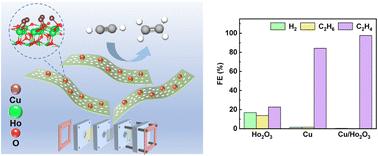
The removal of acetylene (C2H2) impurities from ethylene (C2H4) is a critical step in the production of high-purity C2H4. Due to its low reaction temperature, low energy consumption and high selectivity for C2H4, the electrocatalytic semi-hydrogenation of C2H2 is an ideal method for removing C2H2. Herein, ultrathin two-dimensional (2D) mesoporous holmium oxide nanosheet-stabilized copper nanoparticles (Cu/Ho2O3) for stable and efficient electrocatalytic semi-hydrogenation of C2H2 were prepared through a simple and one-step high-temperature calcination-reduction method. The ultra-thin two-dimensional mesoporous structure of holmium oxide creates abundant coordination defects, improving the faradaic efficiency and durability of copper nanoparticles for catalyzing the semi-hydrogenation of C2H2. The as-prepared Cu/Ho2O3 achieved a C2H4 selectivity of 99.6% and a faradaic efficiency of 98.1% because the presence of oxygen vacancies is conducive to forming electron-rich Cu nanoparticles, thereby promoting the adsorption of electrophilic C2H2 and the desorption of nucleophilic C2H4. Meanwhile, the holmium oxide nanosheet with unsaturated coordination sites can stabilize the Cu nanoparticles, and the faradaic efficiency and current density remain stable for more than 600 minutes. This work offers a promising design strategy for a stable and efficient electrocatalyst for the semi-hydrogenation of C2H2 to C2H4.



 京公网安备 11010802042870号
京ICP备2023020795号-1
京公网安备 11010802042870号
京ICP备2023020795号-1

 分享
分享
 求助内容:
求助内容: 应助结果提醒方式:
 扫码关注我们
