Zhang-Tian Xia, Hui-Ping Chen, Jun-Chao Qi, Hang Peng, Xin Shen, Yong-Ju Bai, Zhen-Yu Wang, Tian-En Yang and Wei-Qiang Liao
{"title":"A high phase transition temperature organic–inorganic Sn(iv)-based metal halide designed by applying amino positional isomerism to the cation†","authors":"Zhang-Tian Xia, Hui-Ping Chen, Jun-Chao Qi, Hang Peng, Xin Shen, Yong-Ju Bai, Zhen-Yu Wang, Tian-En Yang and Wei-Qiang Liao","doi":"10.1039/D4QI03257H","DOIUrl":null,"url":null,"abstract":"<p >Organic–inorganic metal halides (OIMHs) have recently received extensive interest from researchers because of their diverse functionalities, such as phase transition. A high phase transition temperature (<em>T</em><small><sub>c</sub></small>) is highly desirable for the practical applications of OIMH phase transition materials. Here, by applying cation amino positional isomerism to the lead-free Sn(<small>IV</small>)-based OIMH [<em>n</em>-butylammonium]<small><sub>2</sub></small>SnCl<small><sub>6</sub></small> ([NBA]<small><sub>2</sub></small>SnCl<small><sub>6</sub></small>), which has a relatively low <em>T</em><small><sub>c</sub></small> of 226 K, [<em>sec</em>-butylammonium]<small><sub>2</sub></small>SnCl<small><sub>6</sub></small> ([SBA]<small><sub>2</sub></small>SnCl<small><sub>6</sub></small>) was successfully designed with <em>T</em><small><sub>c</sub></small> as high as 430 K. This high <em>T</em><small><sub>c</sub></small> of [SBA]<small><sub>2</sub></small>SnCl<small><sub>6</sub></small> is higher than that of most lead-free OIMHs, and is outstanding among OIMHs. [NBA]<small><sub>2</sub></small>SnCl<small><sub>6</sub></small> and [SBA]<small><sub>2</sub></small>SnCl<small><sub>6</sub></small> are isostructural at room temperature, but the differences in their chemical composition, crystal structure, and phase-transition mechanisms contribute to their distinct <em>T</em><small><sub>c</sub></small>. In addition, [NBA]<small><sub>2</sub></small>SnCl<small><sub>6</sub></small> and [SBA]<small><sub>2</sub></small>SnCl<small><sub>6</sub></small> have wide band gaps (<em>E</em><small><sub>g</sub></small>) of about 3.92 eV and 3.95 eV, respectively. This work provides a new strategy for designing high-<em>T</em><small><sub>c</sub></small> OIMH materials.</p>","PeriodicalId":79,"journal":{"name":"Inorganic Chemistry Frontiers","volume":" 7","pages":" 2825-2832"},"PeriodicalIF":6.4000,"publicationDate":"2025-02-11","publicationTypes":"Journal Article","fieldsOfStudy":null,"isOpenAccess":false,"openAccessPdf":"","citationCount":"0","resultStr":null,"platform":"Semanticscholar","paperid":null,"PeriodicalName":"Inorganic Chemistry Frontiers","FirstCategoryId":"92","ListUrlMain":"https://pubs.rsc.org/en/content/articlelanding/2025/qi/d4qi03257h","RegionNum":1,"RegionCategory":"化学","ArticlePicture":[],"TitleCN":null,"AbstractTextCN":null,"PMCID":null,"EPubDate":"","PubModel":"","JCR":"Q1","JCRName":"CHEMISTRY, INORGANIC & NUCLEAR","Score":null,"Total":0}
引用次数: 0
Abstract
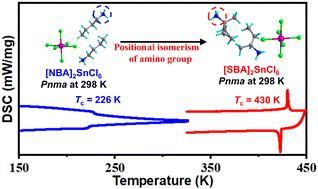
Organic–inorganic metal halides (OIMHs) have recently received extensive interest from researchers because of their diverse functionalities, such as phase transition. A high phase transition temperature (Tc) is highly desirable for the practical applications of OIMH phase transition materials. Here, by applying cation amino positional isomerism to the lead-free Sn(IV)-based OIMH [n-butylammonium]2SnCl6 ([NBA]2SnCl6), which has a relatively low Tc of 226 K, [sec-butylammonium]2SnCl6 ([SBA]2SnCl6) was successfully designed with Tc as high as 430 K. This high Tc of [SBA]2SnCl6 is higher than that of most lead-free OIMHs, and is outstanding among OIMHs. [NBA]2SnCl6 and [SBA]2SnCl6 are isostructural at room temperature, but the differences in their chemical composition, crystal structure, and phase-transition mechanisms contribute to their distinct Tc. In addition, [NBA]2SnCl6 and [SBA]2SnCl6 have wide band gaps (Eg) of about 3.92 eV and 3.95 eV, respectively. This work provides a new strategy for designing high-Tc OIMH materials.



 京公网安备 11010802042870号
京ICP备2023020795号-1
京公网安备 11010802042870号
京ICP备2023020795号-1

 分享
分享
 求助内容:
求助内容: 应助结果提醒方式:
 扫码关注我们
