Xiao Chen, Qinguo Zhang, Ashley Kaswer, Hyunjeong Kim, Maisha Ahmed, Michelle C. Neary, Shu-Yuan Cheng, Guoqi Zhang and Jason M. Rauceo
{"title":"Indium(iii)–terpyridine complexes: synthesis, structures and remarkable antifungal and anticancer activities†","authors":"Xiao Chen, Qinguo Zhang, Ashley Kaswer, Hyunjeong Kim, Maisha Ahmed, Michelle C. Neary, Shu-Yuan Cheng, Guoqi Zhang and Jason M. Rauceo","doi":"10.1039/D4DT03492A","DOIUrl":null,"url":null,"abstract":"<p >Complexes of non-radioactive indium(<small>III</small>) with 2,2′;6′,2′′-terpyridine (tpy) ligands have been rarely explored despite the popularity of tpy as a strong chelating ligand backbone. Herein, three mononuclear indium(<small>III</small>) complexes (<strong>In-1</strong>, <strong>In-2</strong> and <strong>In-3</strong>) of tpy and its 4′-Cl and 4′-pyridyl derivatives have been synthesized and structurally characterized. While the crystal structure of <strong>In-1</strong> has been previously studied, <strong>In-2</strong> and <strong>In-3</strong> were isolated and characterized for the first time. Two different polymorphs of <strong>In-2</strong> were observed by simply varying the concentration of the reactants. Molecules of <strong>In-3</strong> were determined by X-ray crystallography and found to adopt the same mononuclear coordination mode as that found in <strong>In-1</strong> and <strong>In-2</strong>, while the remaining 4′-pyridyl ring was uncoordinated. Bioactivity studies revealed that indium(<small>III</small>) complexes <strong>In-1</strong>, <strong>In-2</strong>, and <strong>In-3</strong> were fungicidal against the human fungal pathogen, <em>Candida albicans</em>, and several other non-<em>albicans Candida</em> species. Moreover, cytotoxicity studies showed these compounds were remarkably antiproliferative against human breast cancer cells (MCF-7 and MDA-MB 468).</p>","PeriodicalId":71,"journal":{"name":"Dalton Transactions","volume":" 11","pages":" 4656-4663"},"PeriodicalIF":3.3000,"publicationDate":"2025-02-11","publicationTypes":"Journal Article","fieldsOfStudy":null,"isOpenAccess":false,"openAccessPdf":"","citationCount":"0","resultStr":null,"platform":"Semanticscholar","paperid":null,"PeriodicalName":"Dalton Transactions","FirstCategoryId":"92","ListUrlMain":"https://pubs.rsc.org/en/content/articlelanding/2025/dt/d4dt03492a","RegionNum":3,"RegionCategory":"化学","ArticlePicture":[],"TitleCN":null,"AbstractTextCN":null,"PMCID":null,"EPubDate":"","PubModel":"","JCR":"Q2","JCRName":"CHEMISTRY, INORGANIC & NUCLEAR","Score":null,"Total":0}
引用次数: 0
Abstract
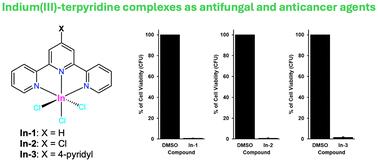
Complexes of non-radioactive indium(III) with 2,2′;6′,2′′-terpyridine (tpy) ligands have been rarely explored despite the popularity of tpy as a strong chelating ligand backbone. Herein, three mononuclear indium(III) complexes (In-1, In-2 and In-3) of tpy and its 4′-Cl and 4′-pyridyl derivatives have been synthesized and structurally characterized. While the crystal structure of In-1 has been previously studied, In-2 and In-3 were isolated and characterized for the first time. Two different polymorphs of In-2 were observed by simply varying the concentration of the reactants. Molecules of In-3 were determined by X-ray crystallography and found to adopt the same mononuclear coordination mode as that found in In-1 and In-2, while the remaining 4′-pyridyl ring was uncoordinated. Bioactivity studies revealed that indium(III) complexes In-1, In-2, and In-3 were fungicidal against the human fungal pathogen, Candida albicans, and several other non-albicans Candida species. Moreover, cytotoxicity studies showed these compounds were remarkably antiproliferative against human breast cancer cells (MCF-7 and MDA-MB 468).
期刊介绍:
Dalton Transactions is a journal for all areas of inorganic chemistry, which encompasses the organometallic, bioinorganic and materials chemistry of the elements, with applications including synthesis, catalysis, energy conversion/storage, electrical devices and medicine. Dalton Transactions welcomes high-quality, original submissions in all of these areas and more, where the advancement of knowledge in inorganic chemistry is significant.



 京公网安备 11010802042870号
京ICP备2023020795号-1
京公网安备 11010802042870号
京ICP备2023020795号-1

 分享
分享
 求助内容:
求助内容: 应助结果提醒方式:
 扫码关注我们
