Wenbo Zhao, Jipeng Chen, Ximeng Liu, Yong Gao, Jie Pu, Qinghe Cao, Ting Meng, Abdelnaby M. Elshahawy, Salah A. Makhlouf, Cao Guan
{"title":"Prokaryote-Inspired and Derived Oxygen Reduction Electrocatalysts for Ultra-Long-Life Zn–Air Batteries","authors":"Wenbo Zhao, Jipeng Chen, Ximeng Liu, Yong Gao, Jie Pu, Qinghe Cao, Ting Meng, Abdelnaby M. Elshahawy, Salah A. Makhlouf, Cao Guan","doi":"10.1002/aenm.202405594","DOIUrl":null,"url":null,"abstract":"<p>The design of efficient oxygen reductionreaction (ORR) catalyst with fast kinetics is crucial for high-performance Zn–air batteries but remains a challenge. Herein, inspired by the oxidative respiratory chain of prokaryotes, an ORR electrocatalyst is reported by mimicking the microstructure of Staphylococcus aureus and simitaneously utilizing this low-cost cell as the precursor. The catalyst consists of MnO<sub>2</sub>/Co<sub>2</sub>P nanocomposites support on Staphylococcus aureus-derived hollow spherical carbon, which not only accelerates electron transfer for improved intrinsic reaction kinetics, but also creates an OH<sup>−</sup> concentration gradient for enhanced mass transfer efficiency. Such bio-inspired and derived ORR catalyst enables rechargeable Zn–air batteries with ultra-long cycling stability of more than 2800 h at a high capacity of 810.3 mAh g<sup>−1</sup>, which is superior among the reported bio-derived oxygen catalysts. A flexible Zn–air battery based on the bio-inspired and derived catalyst is also assembled, and it well integrates with a wireless flexible electronic skin.</p>","PeriodicalId":111,"journal":{"name":"Advanced Energy Materials","volume":"15 20","pages":""},"PeriodicalIF":26.0000,"publicationDate":"2025-02-10","publicationTypes":"Journal Article","fieldsOfStudy":null,"isOpenAccess":false,"openAccessPdf":"","citationCount":"0","resultStr":null,"platform":"Semanticscholar","paperid":null,"PeriodicalName":"Advanced Energy Materials","FirstCategoryId":"88","ListUrlMain":"https://advanced.onlinelibrary.wiley.com/doi/10.1002/aenm.202405594","RegionNum":1,"RegionCategory":"材料科学","ArticlePicture":[],"TitleCN":null,"AbstractTextCN":null,"PMCID":null,"EPubDate":"","PubModel":"","JCR":"Q1","JCRName":"CHEMISTRY, PHYSICAL","Score":null,"Total":0}
引用次数: 0
Abstract
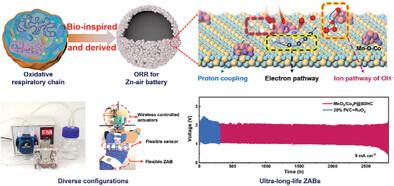
The design of efficient oxygen reductionreaction (ORR) catalyst with fast kinetics is crucial for high-performance Zn–air batteries but remains a challenge. Herein, inspired by the oxidative respiratory chain of prokaryotes, an ORR electrocatalyst is reported by mimicking the microstructure of Staphylococcus aureus and simitaneously utilizing this low-cost cell as the precursor. The catalyst consists of MnO2/Co2P nanocomposites support on Staphylococcus aureus-derived hollow spherical carbon, which not only accelerates electron transfer for improved intrinsic reaction kinetics, but also creates an OH− concentration gradient for enhanced mass transfer efficiency. Such bio-inspired and derived ORR catalyst enables rechargeable Zn–air batteries with ultra-long cycling stability of more than 2800 h at a high capacity of 810.3 mAh g−1, which is superior among the reported bio-derived oxygen catalysts. A flexible Zn–air battery based on the bio-inspired and derived catalyst is also assembled, and it well integrates with a wireless flexible electronic skin.
高效、快速的氧还原反应(ORR)催化剂的设计是高性能锌空气电池的关键,但仍是一个挑战。本文受原核生物氧化呼吸链的启发,通过模拟金黄色葡萄球菌的微观结构,同时利用这种低成本的细胞作为前体,报道了一种ORR电催化剂。该催化剂由MnO2/Co2P纳米复合材料组成,支撑在金黄色葡萄球菌衍生的空心球形碳上,不仅加速了电子转移,改善了固有反应动力学,而且产生了OH -浓度梯度,提高了传质效率。该生物衍生ORR催化剂使可充电锌空气电池在810.3 mAh g−1的高容量下具有超过2800 h的超长循环稳定性,是目前报道的生物衍生氧催化剂中的优势。基于生物灵感和衍生催化剂的柔性锌空气电池也被组装,并与无线柔性电子皮肤很好地集成。
期刊介绍:
Established in 2011, Advanced Energy Materials is an international, interdisciplinary, English-language journal that focuses on materials used in energy harvesting, conversion, and storage. It is regarded as a top-quality journal alongside Advanced Materials, Advanced Functional Materials, and Small.
With a 2022 Impact Factor of 27.8, Advanced Energy Materials is considered a prime source for the best energy-related research. The journal covers a wide range of topics in energy-related research, including organic and inorganic photovoltaics, batteries and supercapacitors, fuel cells, hydrogen generation and storage, thermoelectrics, water splitting and photocatalysis, solar fuels and thermosolar power, magnetocalorics, and piezoelectronics.
The readership of Advanced Energy Materials includes materials scientists, chemists, physicists, and engineers in both academia and industry. The journal is indexed in various databases and collections, such as Advanced Technologies & Aerospace Database, FIZ Karlsruhe, INSPEC (IET), Science Citation Index Expanded, Technology Collection, and Web of Science, among others.



 京公网安备 11010802042870号
京ICP备2023020795号-1
京公网安备 11010802042870号
京ICP备2023020795号-1

 分享
分享
 求助内容:
求助内容: 应助结果提醒方式:
 扫码关注我们
