Denise D Quigley, Nabeel Qureshi, Efrain Talamantes, Zachary Predmore
{"title":"Language Concordance and Interpreter Use for Spanish-Preferring Patients: Qualitative Study of Perspectives from Primary Care Providers.","authors":"Denise D Quigley, Nabeel Qureshi, Efrain Talamantes, Zachary Predmore","doi":"10.1007/s11606-025-09414-9","DOIUrl":null,"url":null,"abstract":"<p><strong>Background: </strong>Poor quality communication and language barriers lead to worse care experiences and inferior health care outcomes for those with limited English proficiency. Fewer than one-third of outpatient providers regularly use professional interpreters when communicating with non-English preferring patients. Effective strategies to address language barriers in primary care are lacking and in demand.</p><p><strong>Objective: </strong>Examine provider perspectives on providing in-person care to Spanish-preferring patients.</p><p><strong>Design: </strong>Partnered with a large, urban Federally Qualified Health Center predominantly caring for Spanish-preferring Hispanic patients, we identified primary care providers who (1) were language-concordant (provider and patient speak same language); (2) used qualified interpreters; and (3) used informal strategies for interpretation/communication.</p><p><strong>Participants: </strong>We interviewed 24 providers (10 language-concordant, 9 who used qualified interpreters, 5 who used informal interpreters and other strategies; response-rate 23%).</p><p><strong>Approach: </strong>We established codes using systematic, inductive procedures to generate insights from responses and identified themes using content analysis.</p><p><strong>Results: </strong>Providers-both language-concordant and those using interpreters-preferred to speak the same language as the patient, employed varying communication strategies, and required more time to care for Spanish-preferring patients for differing reasons. Using interpreters did not always improve communication because using qualified interpreters requires more time for initiating interpretation, connectivity issues, and conducting consecutive interpretation; using any interpreter requires provider-interpreter clarification or staff to translate, and sometimes interpreters had difficulty with medical content/terminology. Provider-patient visits also qualitatively differed based on language spoken and interpreter use in eliciting concerns, topics covered, patient comprehension, and time spent on rapport-building and patient education.</p><p><strong>Conclusions: </strong>Providers described barriers that organizations need to address to facilitate effective communication and language interpretation when caring for Spanish-preferring patients. Research is needed that identifies and tests language support strategies for providers and clinics and structural changes that preserve time during patient visits for providers and patients to spend on health care needs.</p>","PeriodicalId":15860,"journal":{"name":"Journal of General Internal Medicine","volume":" ","pages":"2510-2522"},"PeriodicalIF":4.2000,"publicationDate":"2025-08-01","publicationTypes":"Journal Article","fieldsOfStudy":null,"isOpenAccess":false,"openAccessPdf":"https://www.ncbi.nlm.nih.gov/pmc/articles/PMC12405146/pdf/","citationCount":"0","resultStr":null,"platform":"Semanticscholar","paperid":null,"PeriodicalName":"Journal of General Internal Medicine","FirstCategoryId":"3","ListUrlMain":"https://doi.org/10.1007/s11606-025-09414-9","RegionNum":2,"RegionCategory":"医学","ArticlePicture":[],"TitleCN":null,"AbstractTextCN":null,"PMCID":null,"EPubDate":"2025/2/10 0:00:00","PubModel":"Epub","JCR":"Q1","JCRName":"HEALTH CARE SCIENCES & SERVICES","Score":null,"Total":0}
引用次数: 0
Abstract
Background: Poor quality communication and language barriers lead to worse care experiences and inferior health care outcomes for those with limited English proficiency. Fewer than one-third of outpatient providers regularly use professional interpreters when communicating with non-English preferring patients. Effective strategies to address language barriers in primary care are lacking and in demand.
Objective: Examine provider perspectives on providing in-person care to Spanish-preferring patients.
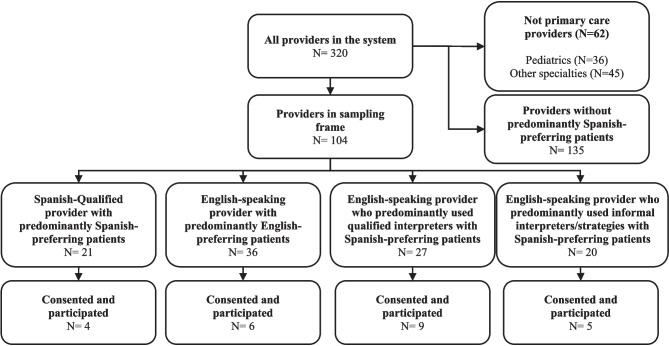
Design: Partnered with a large, urban Federally Qualified Health Center predominantly caring for Spanish-preferring Hispanic patients, we identified primary care providers who (1) were language-concordant (provider and patient speak same language); (2) used qualified interpreters; and (3) used informal strategies for interpretation/communication.
Participants: We interviewed 24 providers (10 language-concordant, 9 who used qualified interpreters, 5 who used informal interpreters and other strategies; response-rate 23%).
Approach: We established codes using systematic, inductive procedures to generate insights from responses and identified themes using content analysis.
Results: Providers-both language-concordant and those using interpreters-preferred to speak the same language as the patient, employed varying communication strategies, and required more time to care for Spanish-preferring patients for differing reasons. Using interpreters did not always improve communication because using qualified interpreters requires more time for initiating interpretation, connectivity issues, and conducting consecutive interpretation; using any interpreter requires provider-interpreter clarification or staff to translate, and sometimes interpreters had difficulty with medical content/terminology. Provider-patient visits also qualitatively differed based on language spoken and interpreter use in eliciting concerns, topics covered, patient comprehension, and time spent on rapport-building and patient education.
Conclusions: Providers described barriers that organizations need to address to facilitate effective communication and language interpretation when caring for Spanish-preferring patients. Research is needed that identifies and tests language support strategies for providers and clinics and structural changes that preserve time during patient visits for providers and patients to spend on health care needs.
期刊介绍:
The Journal of General Internal Medicine is the official journal of the Society of General Internal Medicine. It promotes improved patient care, research, and education in primary care, general internal medicine, and hospital medicine. Its articles focus on topics such as clinical medicine, epidemiology, prevention, health care delivery, curriculum development, and numerous other non-traditional themes, in addition to classic clinical research on problems in internal medicine.




 京公网安备 11010802042870号
京ICP备2023020795号-1
京公网安备 11010802042870号
京ICP备2023020795号-1

 分享
分享
 求助内容:
求助内容: 应助结果提醒方式:
 扫码关注我们
