Linda Klasen, Stefanie Anna Julia Koch, Maike Elena Benz, Johanna Conrad, Ute Alexy, Konrad Blaszkiewicz, Ionut Andone, Ute Nöthlings
{"title":"NutriDiary, a Smartphone-Based Dietary Record App: Description and Usability Evaluation.","authors":"Linda Klasen, Stefanie Anna Julia Koch, Maike Elena Benz, Johanna Conrad, Ute Alexy, Konrad Blaszkiewicz, Ionut Andone, Ute Nöthlings","doi":"10.2196/62776","DOIUrl":null,"url":null,"abstract":"<p><strong>Background: </strong>Repeated applications of short-term dietary assessment instruments are recommended for estimating usual dietary intake. For this purpose, NutriDiary, a smartphone app for collecting weighed dietary records (WDRs) in the German population, was developed.</p><p><strong>Objective: </strong>We aim to describe NutriDiary and evaluate its usability and acceptability.</p><p><strong>Methods: </strong>NutriDiary was developed as a WDR, allowing users to enter food items via text search, barcode scanning, or free text entry. The sample for the evaluation study included 74 participants (n=51, 69% female, aged 18-64 years), including 27 (37.5%) experts and 47 (63.5%) laypersons (including n=22, 30%, nutrition students). Participants completed a 1-day WDR and entered a predefined sample meal (n=17 foods) the following day by using NutriDiary. An evaluation questionnaire was answered from which the system usability scale (SUS) score (0-100) was calculated. A backward selection procedure (PROC REG in SAS; SAS Institute) was used to identify potential predictors for the SUS score (age, sex, status [expert or laypersons], and operating system [iOS or Android]).</p><p><strong>Results: </strong>The median SUS score of 75 (IQR 63-88) indicated good usability. Age was the only characteristic identified as a potential predictor for a lower SUS score (P<.001). The median completion time for an individual WDR was 35 (IQR 19-52) minutes. Older participants took longer to enter the data than younger ones (18-30 y: median 1.5, IQR 1.1-2.0 min/item vs 45-64 y: median 1.8, IQR 1.3-2.3 min/item). Most participants expressed a preference for NutriDiary over the traditional paper-based method.</p><p><strong>Conclusions: </strong>Good usability and acceptability make NutriDiary promising for use in epidemiological studies.</p>","PeriodicalId":36351,"journal":{"name":"JMIR Human Factors","volume":"12 ","pages":"e62776"},"PeriodicalIF":3.0000,"publicationDate":"2025-02-10","publicationTypes":"Journal Article","fieldsOfStudy":null,"isOpenAccess":false,"openAccessPdf":"https://www.ncbi.nlm.nih.gov/pmc/articles/PMC11833184/pdf/","citationCount":"0","resultStr":null,"platform":"Semanticscholar","paperid":null,"PeriodicalName":"JMIR Human Factors","FirstCategoryId":"1085","ListUrlMain":"https://doi.org/10.2196/62776","RegionNum":0,"RegionCategory":null,"ArticlePicture":[],"TitleCN":null,"AbstractTextCN":null,"PMCID":null,"EPubDate":"","PubModel":"","JCR":"Q2","JCRName":"HEALTH CARE SCIENCES & SERVICES","Score":null,"Total":0}
引用次数: 0
Abstract
Background: Repeated applications of short-term dietary assessment instruments are recommended for estimating usual dietary intake. For this purpose, NutriDiary, a smartphone app for collecting weighed dietary records (WDRs) in the German population, was developed.
Objective: We aim to describe NutriDiary and evaluate its usability and acceptability.
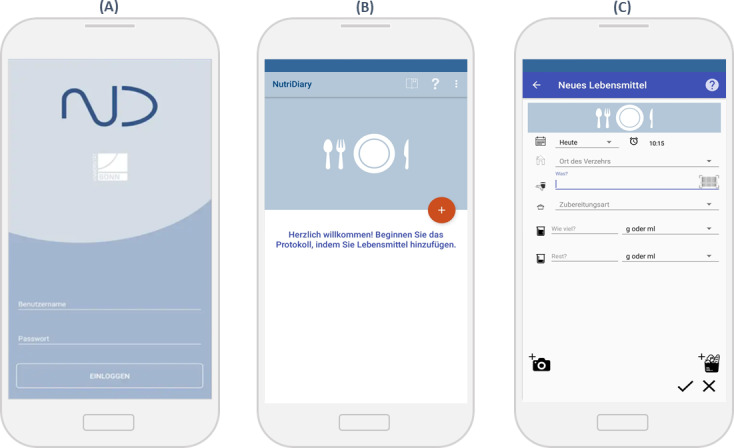
Methods: NutriDiary was developed as a WDR, allowing users to enter food items via text search, barcode scanning, or free text entry. The sample for the evaluation study included 74 participants (n=51, 69% female, aged 18-64 years), including 27 (37.5%) experts and 47 (63.5%) laypersons (including n=22, 30%, nutrition students). Participants completed a 1-day WDR and entered a predefined sample meal (n=17 foods) the following day by using NutriDiary. An evaluation questionnaire was answered from which the system usability scale (SUS) score (0-100) was calculated. A backward selection procedure (PROC REG in SAS; SAS Institute) was used to identify potential predictors for the SUS score (age, sex, status [expert or laypersons], and operating system [iOS or Android]).
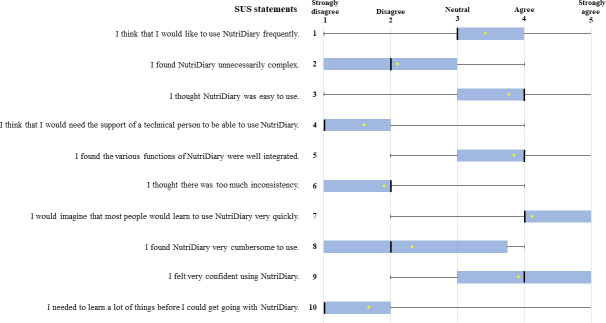
Results: The median SUS score of 75 (IQR 63-88) indicated good usability. Age was the only characteristic identified as a potential predictor for a lower SUS score (P<.001). The median completion time for an individual WDR was 35 (IQR 19-52) minutes. Older participants took longer to enter the data than younger ones (18-30 y: median 1.5, IQR 1.1-2.0 min/item vs 45-64 y: median 1.8, IQR 1.3-2.3 min/item). Most participants expressed a preference for NutriDiary over the traditional paper-based method.
Conclusions: Good usability and acceptability make NutriDiary promising for use in epidemiological studies.






 京公网安备 11010802042870号
京ICP备2023020795号-1
京公网安备 11010802042870号
京ICP备2023020795号-1

 分享
分享
 求助内容:
求助内容: 应助结果提醒方式:
 扫码关注我们
