Effect of coal gasification fine slag's particle size on the processing properties of styrene butadiene rubber and natural rubber composites for replacing commercial silica
You Xu , Tong Zheng , Gongbao Guo , Jiahang Li , Hanjing Luo , Haosong Jiang , Weidong Ai , Yue Li , Cundi Wei
{"title":"Effect of coal gasification fine slag's particle size on the processing properties of styrene butadiene rubber and natural rubber composites for replacing commercial silica","authors":"You Xu , Tong Zheng , Gongbao Guo , Jiahang Li , Hanjing Luo , Haosong Jiang , Weidong Ai , Yue Li , Cundi Wei","doi":"10.1016/j.polymer.2025.128160","DOIUrl":null,"url":null,"abstract":"<div><div>As a by-product of coal chemical industry, highly-discharged coal gasification fine slag has caused environmental problems such as land occupation and dust pollution. In this work, a high-ash coal gasification fine slag (AFS) and its ball milling products were selected to replace commercial precipitated silica (P-silica) and Micro-silica (M-silica) to fill Styrene-butadiene rubber (SBR) and Natural rubber (NR), respectively. The results showed that the filler network type of SBR changed from Particle Direct Contact Network (PDCN) to Rubber Shell Contact Network (RSCN) due to the replacement of P-silica by AFS fillers and the vulcanization speed improved. However, the replacement of M-silica by AFS-filler didn't change the filler network type of NR composites and resulted in a decrease of vulcanization speed. In both SBR and NR composites, the vulcanization speed, tensile strength, and activation energy of rubber molecular chain movement increased with the decrease of AFS-filler's particle size, which indicates that the reduction of AFS-filler's particle size is beneficial to the improvement of vulcanization speed and reinforcement. In addition, the T<sub>90</sub> of SBR filled with AFS fillers at 5 phr substitution was reduced by 29.0 %–43.3 % and the tensile strength was increased by 4.6 %–44.6 % compared to pure P-silica filled SBR. More importantly, the substitution of commercial silica by AFS reduces energy consumption in the rubber industry and opens up new ideas for improving the universality of coal gasification fine slag as rubber fillers.</div></div>","PeriodicalId":405,"journal":{"name":"Polymer","volume":"322 ","pages":"Article 128160"},"PeriodicalIF":4.5000,"publicationDate":"2025-03-21","publicationTypes":"Journal Article","fieldsOfStudy":null,"isOpenAccess":false,"openAccessPdf":"","citationCount":"0","resultStr":null,"platform":"Semanticscholar","paperid":null,"PeriodicalName":"Polymer","FirstCategoryId":"92","ListUrlMain":"https://www.sciencedirect.com/science/article/pii/S0032386125001466","RegionNum":2,"RegionCategory":"化学","ArticlePicture":[],"TitleCN":null,"AbstractTextCN":null,"PMCID":null,"EPubDate":"2025/2/11 0:00:00","PubModel":"Epub","JCR":"Q2","JCRName":"POLYMER SCIENCE","Score":null,"Total":0}
引用次数: 0
Abstract
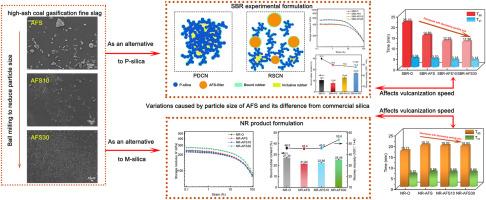
As a by-product of coal chemical industry, highly-discharged coal gasification fine slag has caused environmental problems such as land occupation and dust pollution. In this work, a high-ash coal gasification fine slag (AFS) and its ball milling products were selected to replace commercial precipitated silica (P-silica) and Micro-silica (M-silica) to fill Styrene-butadiene rubber (SBR) and Natural rubber (NR), respectively. The results showed that the filler network type of SBR changed from Particle Direct Contact Network (PDCN) to Rubber Shell Contact Network (RSCN) due to the replacement of P-silica by AFS fillers and the vulcanization speed improved. However, the replacement of M-silica by AFS-filler didn't change the filler network type of NR composites and resulted in a decrease of vulcanization speed. In both SBR and NR composites, the vulcanization speed, tensile strength, and activation energy of rubber molecular chain movement increased with the decrease of AFS-filler's particle size, which indicates that the reduction of AFS-filler's particle size is beneficial to the improvement of vulcanization speed and reinforcement. In addition, the T90 of SBR filled with AFS fillers at 5 phr substitution was reduced by 29.0 %–43.3 % and the tensile strength was increased by 4.6 %–44.6 % compared to pure P-silica filled SBR. More importantly, the substitution of commercial silica by AFS reduces energy consumption in the rubber industry and opens up new ideas for improving the universality of coal gasification fine slag as rubber fillers.
期刊介绍:
Polymer is an interdisciplinary journal dedicated to publishing innovative and significant advances in Polymer Physics, Chemistry and Technology. We welcome submissions on polymer hybrids, nanocomposites, characterisation and self-assembly. Polymer also publishes work on the technological application of polymers in energy and optoelectronics.
The main scope is covered but not limited to the following core areas:
Polymer Materials
Nanocomposites and hybrid nanomaterials
Polymer blends, films, fibres, networks and porous materials
Physical Characterization
Characterisation, modelling and simulation* of molecular and materials properties in bulk, solution, and thin films
Polymer Engineering
Advanced multiscale processing methods
Polymer Synthesis, Modification and Self-assembly
Including designer polymer architectures, mechanisms and kinetics, and supramolecular polymerization
Technological Applications
Polymers for energy generation and storage
Polymer membranes for separation technology
Polymers for opto- and microelectronics.




 京公网安备 11010802042870号
京ICP备2023020795号-1
京公网安备 11010802042870号
京ICP备2023020795号-1

 分享
分享
 求助内容:
求助内容: 应助结果提醒方式:
 扫码关注我们
