Omar El Arwadi , Ajinkya Raut , Jacob L. Meyer , Andreas Polycarpou , Mohammad Naraghi
{"title":"Time and temperature-dependent fracture mechanics of self-healing vitrimers","authors":"Omar El Arwadi , Ajinkya Raut , Jacob L. Meyer , Andreas Polycarpou , Mohammad Naraghi","doi":"10.1016/j.polymer.2025.128148","DOIUrl":null,"url":null,"abstract":"<div><div>This study investigates the formation of exchangeable bonds and recovery of load bearing in bulk vitrimers. The critical load required to fracture compact tension samples in bulk aromatic thermosetting co-polyester (ATSP) and the ability of the material to heal the crack was studied as a function of duration and temperature of healing, and number of cycles. We established a marked improvement in healing efficiency at higher temperature especially in the first healing cycle, as the thermal energy reduces the energy barriers for bond re-formation. However, the healing efficiency progressively dropped in four healing cycles, and the drop was more significant at higher temperatures. We analyzed the cure kinetics of the ATSP by means of differential scanning calorimetry (DSC), thermogravimetric analysis (TGA), and gel fraction tests. The results showed a particularly good thermal stability below 300 °C. The material loss from gel fraction tests was bound to 0.7 %. While not significant by mass, this mass will turn into volatile species and gas form, occupying a much larger volume, leading to formation of voids which serve as physical barrier to curing (material degredation). This is also evidenced in the increase in the fracture surface roughness, as improper bond exchange lead to the formation of volatile species. The formation of volatile species leads to surface asperities, reducing the contact area between the two faces of the crack, and results in a reduction in healing efficiency. The study concludes by outlining the differences between the intrinsic healing in vitrimers with high vitrification temperature and thermoplastics, highlighting the differences between the molecular mechanisms at play.</div></div>","PeriodicalId":405,"journal":{"name":"Polymer","volume":"322 ","pages":"Article 128148"},"PeriodicalIF":4.5000,"publicationDate":"2025-03-21","publicationTypes":"Journal Article","fieldsOfStudy":null,"isOpenAccess":false,"openAccessPdf":"","citationCount":"0","resultStr":null,"platform":"Semanticscholar","paperid":null,"PeriodicalName":"Polymer","FirstCategoryId":"92","ListUrlMain":"https://www.sciencedirect.com/science/article/pii/S003238612500134X","RegionNum":2,"RegionCategory":"化学","ArticlePicture":[],"TitleCN":null,"AbstractTextCN":null,"PMCID":null,"EPubDate":"2025/2/12 0:00:00","PubModel":"Epub","JCR":"Q2","JCRName":"POLYMER SCIENCE","Score":null,"Total":0}
引用次数: 0
Abstract
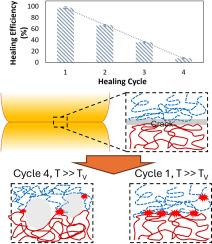
This study investigates the formation of exchangeable bonds and recovery of load bearing in bulk vitrimers. The critical load required to fracture compact tension samples in bulk aromatic thermosetting co-polyester (ATSP) and the ability of the material to heal the crack was studied as a function of duration and temperature of healing, and number of cycles. We established a marked improvement in healing efficiency at higher temperature especially in the first healing cycle, as the thermal energy reduces the energy barriers for bond re-formation. However, the healing efficiency progressively dropped in four healing cycles, and the drop was more significant at higher temperatures. We analyzed the cure kinetics of the ATSP by means of differential scanning calorimetry (DSC), thermogravimetric analysis (TGA), and gel fraction tests. The results showed a particularly good thermal stability below 300 °C. The material loss from gel fraction tests was bound to 0.7 %. While not significant by mass, this mass will turn into volatile species and gas form, occupying a much larger volume, leading to formation of voids which serve as physical barrier to curing (material degredation). This is also evidenced in the increase in the fracture surface roughness, as improper bond exchange lead to the formation of volatile species. The formation of volatile species leads to surface asperities, reducing the contact area between the two faces of the crack, and results in a reduction in healing efficiency. The study concludes by outlining the differences between the intrinsic healing in vitrimers with high vitrification temperature and thermoplastics, highlighting the differences between the molecular mechanisms at play.
期刊介绍:
Polymer is an interdisciplinary journal dedicated to publishing innovative and significant advances in Polymer Physics, Chemistry and Technology. We welcome submissions on polymer hybrids, nanocomposites, characterisation and self-assembly. Polymer also publishes work on the technological application of polymers in energy and optoelectronics.
The main scope is covered but not limited to the following core areas:
Polymer Materials
Nanocomposites and hybrid nanomaterials
Polymer blends, films, fibres, networks and porous materials
Physical Characterization
Characterisation, modelling and simulation* of molecular and materials properties in bulk, solution, and thin films
Polymer Engineering
Advanced multiscale processing methods
Polymer Synthesis, Modification and Self-assembly
Including designer polymer architectures, mechanisms and kinetics, and supramolecular polymerization
Technological Applications
Polymers for energy generation and storage
Polymer membranes for separation technology
Polymers for opto- and microelectronics.




 京公网安备 11010802042870号
京ICP备2023020795号-1
京公网安备 11010802042870号
京ICP备2023020795号-1

 分享
分享
 求助内容:
求助内容: 应助结果提醒方式:
 扫码关注我们
