Xiaomeng Li, Lina Xu, Jianliang Gao, Manqing Yan, Qiyang Wang
{"title":"Highly Stretchable, Tough, and Transparent Chitin Nanofiber-Reinforced Multifunctional Eutectogels for Self-Powered Wearable Sensors","authors":"Xiaomeng Li, Lina Xu, Jianliang Gao, Manqing Yan, Qiyang Wang","doi":"10.1021/acssensors.4c02535","DOIUrl":null,"url":null,"abstract":"Traditional conductive hydrogels have disadvantages for wearable sensors, such as poor electrical conductivity, weak mechanical properties, narrow application temperature range, and required external power supply, which limit their wide application. However, manufacturing hydrogel sensors with excellent mechanical properties and self-adhesive, temperature-resistant, and self-powered properties remains a challenge. Herein, chitin nanofiber-reinforced eutectogels (CAANF) with self-adhesive, self-healing, transparent, environment tolerant, and good mechanical properties were obtained via a simple one-pot method with the deep eutectic solvent (DES) system composed of acrylic acid, acrylamide, and choline chloride (ChCl). High-density hydrogen bond networks between CAANFs can act as strong cross-linking sites, conferring high stretchability (1680%) and elasticity. Moreover, high-density hydrogen bond networks with dynamic reversibility can provide excellent self-healing and adhesion abilities. Due to the unique properties of DES, CAANF eutectic gels also exhibit good ionic conductivity and environmental resistance, allowing the sensor to be applied over a wide temperature range (−30 to 60 °C). Additionally, CAANF-based self-powered flexible sensors can be used to detect human movement, monitor health status, and transmit signals for the encryption and decryption of information according to the Morse code. This work expands the scope of portable applications in the field of wearable electronic devices.","PeriodicalId":24,"journal":{"name":"ACS Sensors","volume":"16 1","pages":""},"PeriodicalIF":9.1000,"publicationDate":"2025-02-12","publicationTypes":"Journal Article","fieldsOfStudy":null,"isOpenAccess":false,"openAccessPdf":"","citationCount":"0","resultStr":null,"platform":"Semanticscholar","paperid":null,"PeriodicalName":"ACS Sensors","FirstCategoryId":"92","ListUrlMain":"https://doi.org/10.1021/acssensors.4c02535","RegionNum":1,"RegionCategory":"化学","ArticlePicture":[],"TitleCN":null,"AbstractTextCN":null,"PMCID":null,"EPubDate":"","PubModel":"","JCR":"Q1","JCRName":"CHEMISTRY, ANALYTICAL","Score":null,"Total":0}
引用次数: 0
Abstract
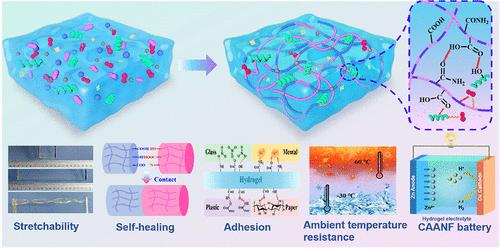
Traditional conductive hydrogels have disadvantages for wearable sensors, such as poor electrical conductivity, weak mechanical properties, narrow application temperature range, and required external power supply, which limit their wide application. However, manufacturing hydrogel sensors with excellent mechanical properties and self-adhesive, temperature-resistant, and self-powered properties remains a challenge. Herein, chitin nanofiber-reinforced eutectogels (CAANF) with self-adhesive, self-healing, transparent, environment tolerant, and good mechanical properties were obtained via a simple one-pot method with the deep eutectic solvent (DES) system composed of acrylic acid, acrylamide, and choline chloride (ChCl). High-density hydrogen bond networks between CAANFs can act as strong cross-linking sites, conferring high stretchability (1680%) and elasticity. Moreover, high-density hydrogen bond networks with dynamic reversibility can provide excellent self-healing and adhesion abilities. Due to the unique properties of DES, CAANF eutectic gels also exhibit good ionic conductivity and environmental resistance, allowing the sensor to be applied over a wide temperature range (−30 to 60 °C). Additionally, CAANF-based self-powered flexible sensors can be used to detect human movement, monitor health status, and transmit signals for the encryption and decryption of information according to the Morse code. This work expands the scope of portable applications in the field of wearable electronic devices.
期刊介绍:
ACS Sensors is a peer-reviewed research journal that focuses on the dissemination of new and original knowledge in the field of sensor science, particularly those that selectively sense chemical or biological species or processes. The journal covers a broad range of topics, including but not limited to biosensors, chemical sensors, gas sensors, intracellular sensors, single molecule sensors, cell chips, and microfluidic devices. It aims to publish articles that address conceptual advances in sensing technology applicable to various types of analytes or application papers that report on the use of existing sensing concepts in new ways or for new analytes.



 京公网安备 11010802042870号
京ICP备2023020795号-1
京公网安备 11010802042870号
京ICP备2023020795号-1

 分享
分享
 求助内容:
求助内容: 应助结果提醒方式:
 扫码关注我们
