Rajkumar Sahoo, Prabal Pramanik, Sudhir Kumar Das and Mintu Halder
{"title":"Ratiometric luminescence sensing of bio-macromolecules via highly sensitive templated pyrene-based nanoGUMBOS†‡","authors":"Rajkumar Sahoo, Prabal Pramanik, Sudhir Kumar Das and Mintu Halder","doi":"10.1039/D5AN00028A","DOIUrl":null,"url":null,"abstract":"<p >A series of pyrene-based ionic liquids, comprises a group of uniform materials based on organic salts (GUMBOS), were synthesized by incorporating pyrene butyrate with quaternary alkyl phosphonium or ammonium cations <em>via</em> ion exchange reaction and by virtue of a variation in alkyl chain-length. Water-suspended crystalline pyrene-assimilated nanoparticles (nanoGUMBOS) were subsequently fabricated from the prepared GUMBOS <em>via</em> reprecipitation method. Photophysical and microscopic measurements were performed to confirm the crystalline molecular-level stacking of pyrene fluorophores inside the nanoparticles. The pyrene moieties within the nanoGUMBOS showed a tendency for enhanced self-association upon photo-excitation, resulting in a novel excited-state aggregation-induced emission (ESAIE). Due to the bathochromically-shifted strong aggregation-induced emission, these nanoGUMBOS are further employed in the sensitive and selective ratiometric detection of biomacromolecules in aqueous and serum albumin media. As the excessive use of some biomacromolecules (heparin and protamine) can lead to undesired side-effects in living systems, hence their detection can be very crucial. In most cases, interaction with biomacromolecules like heparin facilitates the formation of excimer species in pyrene systems, but to our utter surprise, here we observed the opposite phenomenon of excimer disintegration. This presents a convenient method for detecting heparin in aqueous and serum albumin media. Furthermore, using the nanoGUMBOS–heparin complex, we can also detect protamine. A detailed study of the detection mechanism is presented in this report.</p>","PeriodicalId":63,"journal":{"name":"Analyst","volume":" 10","pages":" 2074-2086"},"PeriodicalIF":3.3000,"publicationDate":"2025-02-11","publicationTypes":"Journal Article","fieldsOfStudy":null,"isOpenAccess":false,"openAccessPdf":"","citationCount":"0","resultStr":null,"platform":"Semanticscholar","paperid":null,"PeriodicalName":"Analyst","FirstCategoryId":"92","ListUrlMain":"https://pubs.rsc.org/en/content/articlelanding/2025/an/d5an00028a","RegionNum":3,"RegionCategory":"化学","ArticlePicture":[],"TitleCN":null,"AbstractTextCN":null,"PMCID":null,"EPubDate":"","PubModel":"","JCR":"Q2","JCRName":"CHEMISTRY, ANALYTICAL","Score":null,"Total":0}
引用次数: 0
Abstract
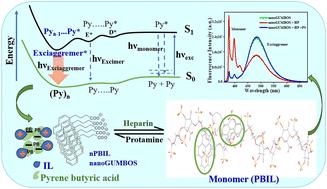
A series of pyrene-based ionic liquids, comprises a group of uniform materials based on organic salts (GUMBOS), were synthesized by incorporating pyrene butyrate with quaternary alkyl phosphonium or ammonium cations via ion exchange reaction and by virtue of a variation in alkyl chain-length. Water-suspended crystalline pyrene-assimilated nanoparticles (nanoGUMBOS) were subsequently fabricated from the prepared GUMBOS via reprecipitation method. Photophysical and microscopic measurements were performed to confirm the crystalline molecular-level stacking of pyrene fluorophores inside the nanoparticles. The pyrene moieties within the nanoGUMBOS showed a tendency for enhanced self-association upon photo-excitation, resulting in a novel excited-state aggregation-induced emission (ESAIE). Due to the bathochromically-shifted strong aggregation-induced emission, these nanoGUMBOS are further employed in the sensitive and selective ratiometric detection of biomacromolecules in aqueous and serum albumin media. As the excessive use of some biomacromolecules (heparin and protamine) can lead to undesired side-effects in living systems, hence their detection can be very crucial. In most cases, interaction with biomacromolecules like heparin facilitates the formation of excimer species in pyrene systems, but to our utter surprise, here we observed the opposite phenomenon of excimer disintegration. This presents a convenient method for detecting heparin in aqueous and serum albumin media. Furthermore, using the nanoGUMBOS–heparin complex, we can also detect protamine. A detailed study of the detection mechanism is presented in this report.



 京公网安备 11010802042870号
京ICP备2023020795号-1
京公网安备 11010802042870号
京ICP备2023020795号-1

 分享
分享
 求助内容:
求助内容: 应助结果提醒方式:
 扫码关注我们
