Thomas W. Radford, Peter R. Wiecha, Alberto Politi, Ioannis Zeimpekis, Otto L. Muskens
{"title":"Inverse Design of Unitary Transmission Matrices in Silicon Photonic Coupled Waveguide Arrays Using a Neural Adjoint Model","authors":"Thomas W. Radford, Peter R. Wiecha, Alberto Politi, Ioannis Zeimpekis, Otto L. Muskens","doi":"10.1021/acsphotonics.4c02081","DOIUrl":null,"url":null,"abstract":"The development of low-loss reconfigurable integrated optical devices enables further research into technologies including photonic signal processing, analogue quantum computing, and optical neural networks. Here, we introduce digital patterning of coupled waveguide arrays as a platform capable of implementing unitary matrix operations. Determining the required device geometry for a specific optical output is computationally challenging and requires a robust and versatile inverse design protocol. In this work we present an approach using high speed neural network surrogate-based gradient optimization, capable of predicting patterns of refractive index perturbations based on switching of the ultralow loss chalcogenide phase change material, antimony triselinide (Sb<sub>2</sub>Se<sub>3</sub>). Results for a 3 × 3 silicon waveguide array are presented, demonstrating control of both amplitude and phase for each transmission matrix element. Network performance is studied using neural network optimization tools such as data set augmentation and supplementation with random noise, resulting in an average fidelity of 0.94 for unitary matrix targets. Our results show that coupled waveguide arrays with perturbation patterns offer new routes for achieving programmable unitary operators, or Hamiltonians for quantum simulators, with a reduced footprint compared to conventional interferometer-mesh technology.","PeriodicalId":23,"journal":{"name":"ACS Photonics","volume":"41 1","pages":""},"PeriodicalIF":6.7000,"publicationDate":"2025-02-12","publicationTypes":"Journal Article","fieldsOfStudy":null,"isOpenAccess":false,"openAccessPdf":"","citationCount":"0","resultStr":null,"platform":"Semanticscholar","paperid":null,"PeriodicalName":"ACS Photonics","FirstCategoryId":"101","ListUrlMain":"https://doi.org/10.1021/acsphotonics.4c02081","RegionNum":1,"RegionCategory":"物理与天体物理","ArticlePicture":[],"TitleCN":null,"AbstractTextCN":null,"PMCID":null,"EPubDate":"","PubModel":"","JCR":"Q1","JCRName":"MATERIALS SCIENCE, MULTIDISCIPLINARY","Score":null,"Total":0}
引用次数: 0
Abstract
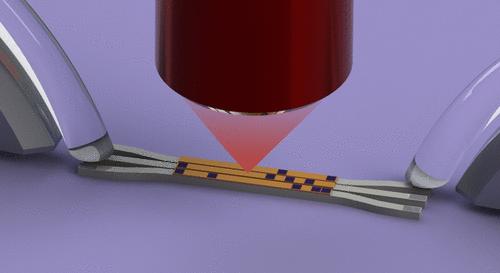
The development of low-loss reconfigurable integrated optical devices enables further research into technologies including photonic signal processing, analogue quantum computing, and optical neural networks. Here, we introduce digital patterning of coupled waveguide arrays as a platform capable of implementing unitary matrix operations. Determining the required device geometry for a specific optical output is computationally challenging and requires a robust and versatile inverse design protocol. In this work we present an approach using high speed neural network surrogate-based gradient optimization, capable of predicting patterns of refractive index perturbations based on switching of the ultralow loss chalcogenide phase change material, antimony triselinide (Sb2Se3). Results for a 3 × 3 silicon waveguide array are presented, demonstrating control of both amplitude and phase for each transmission matrix element. Network performance is studied using neural network optimization tools such as data set augmentation and supplementation with random noise, resulting in an average fidelity of 0.94 for unitary matrix targets. Our results show that coupled waveguide arrays with perturbation patterns offer new routes for achieving programmable unitary operators, or Hamiltonians for quantum simulators, with a reduced footprint compared to conventional interferometer-mesh technology.
期刊介绍:
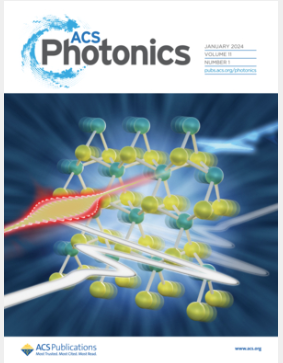
Published as soon as accepted and summarized in monthly issues, ACS Photonics will publish Research Articles, Letters, Perspectives, and Reviews, to encompass the full scope of published research in this field.



 京公网安备 11010802042870号
京ICP备2023020795号-1
京公网安备 11010802042870号
京ICP备2023020795号-1

 分享
分享
 求助内容:
求助内容: 应助结果提醒方式:
 扫码关注我们
