Shane Scott, Maria Villiou, Federico Colombo, Angeles De la Cruz-García, Leon Tydecks, Lotta Toelke, Katharina Siemsen, Christine Selhuber-Unkel
{"title":"Dynamic and Reversible Tuning of Hydrogel Viscoelasticity by Transient Polymer Interactions for Controlling Cell Adhesion","authors":"Shane Scott, Maria Villiou, Federico Colombo, Angeles De la Cruz-García, Leon Tydecks, Lotta Toelke, Katharina Siemsen, Christine Selhuber-Unkel","doi":"10.1002/adma.202408616","DOIUrl":null,"url":null,"abstract":"<p>Cells are highly responsive to changes in their mechanical environment, influencing processes such as stem cell differentiation and tumor progression. To meet the growing demand for materials used for high throughput mechanotransduction studies, simple means of dynamically adjusting the environmental viscoelasticity of cell cultures are needed. Here, a novel method is presented to dynamically and reversibly control the viscoelasticity of naturally derived polymer hydrogels through interactions with poly (ethylene glycol) (PEG). Interactions between PEG and hydrogel polymers, possibly involving hydrogen bonding, stiffen the hydrogel matrices. By dynamically changing the PEG concentration of the solution in which polymer hydrogels are incubated, their viscoelastic properties are adjusted, which in turn affects cell adhesion and cytoskeletal organization. Importantly, this effects is reversible, providing a cost-effective and simple strategy for dynamically adjusting the viscoelasticity of polymer hydrogels. This method holds promise for applications in mechanobiology, biomedicine, and the life sciences.</p>","PeriodicalId":114,"journal":{"name":"Advanced Materials","volume":"37 12","pages":""},"PeriodicalIF":26.8000,"publicationDate":"2025-02-11","publicationTypes":"Journal Article","fieldsOfStudy":null,"isOpenAccess":false,"openAccessPdf":"https://onlinelibrary.wiley.com/doi/epdf/10.1002/adma.202408616","citationCount":"0","resultStr":null,"platform":"Semanticscholar","paperid":null,"PeriodicalName":"Advanced Materials","FirstCategoryId":"88","ListUrlMain":"https://advanced.onlinelibrary.wiley.com/doi/10.1002/adma.202408616","RegionNum":1,"RegionCategory":"材料科学","ArticlePicture":[],"TitleCN":null,"AbstractTextCN":null,"PMCID":null,"EPubDate":"","PubModel":"","JCR":"Q1","JCRName":"CHEMISTRY, MULTIDISCIPLINARY","Score":null,"Total":0}
引用次数: 0
Abstract
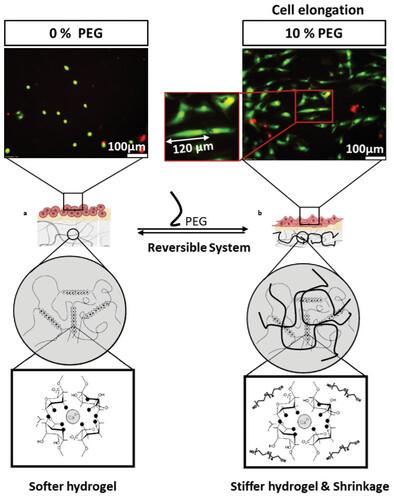
Cells are highly responsive to changes in their mechanical environment, influencing processes such as stem cell differentiation and tumor progression. To meet the growing demand for materials used for high throughput mechanotransduction studies, simple means of dynamically adjusting the environmental viscoelasticity of cell cultures are needed. Here, a novel method is presented to dynamically and reversibly control the viscoelasticity of naturally derived polymer hydrogels through interactions with poly (ethylene glycol) (PEG). Interactions between PEG and hydrogel polymers, possibly involving hydrogen bonding, stiffen the hydrogel matrices. By dynamically changing the PEG concentration of the solution in which polymer hydrogels are incubated, their viscoelastic properties are adjusted, which in turn affects cell adhesion and cytoskeletal organization. Importantly, this effects is reversible, providing a cost-effective and simple strategy for dynamically adjusting the viscoelasticity of polymer hydrogels. This method holds promise for applications in mechanobiology, biomedicine, and the life sciences.
期刊介绍:
Advanced Materials, one of the world's most prestigious journals and the foundation of the Advanced portfolio, is the home of choice for best-in-class materials science for more than 30 years. Following this fast-growing and interdisciplinary field, we are considering and publishing the most important discoveries on any and all materials from materials scientists, chemists, physicists, engineers as well as health and life scientists and bringing you the latest results and trends in modern materials-related research every week.





 京公网安备 11010802042870号
京ICP备2023020795号-1
京公网安备 11010802042870号
京ICP备2023020795号-1

 分享
分享
 求助内容:
求助内容: 应助结果提醒方式:
 扫码关注我们
