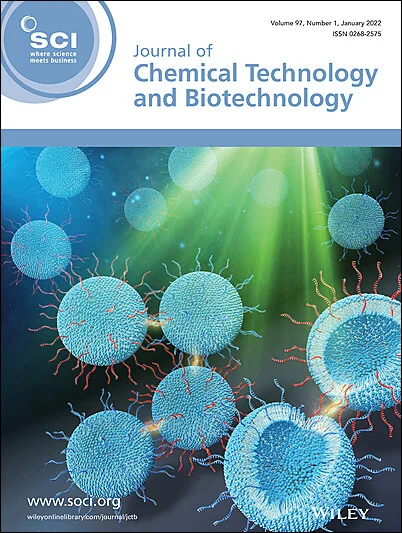
A novel magnetic bifunctional hydrochar catalyst derived from palm leaf residue for biodiesel production: kinetic and thermodynamic studies

IF 2.4 4区 生物学 Q3 BIOTECHNOLOGY & APPLIED MICROBIOLOGY Journal of chemical technology and biotechnology Pub Date : 2024-12-11 DOI:10.1002/jctb.7792
Muhammad Aliyu, Umer Rashid, Toshiki Tsubota, Wan Azlina Wan Ab Karim Ghani, Mohamad Amran Mohd Salleh, Duy Anh Khuong, Kieu Trang Trinh, Nguyen Trung Duc, Daisuke Tashima, Tomi Ryu
{"title":"A novel magnetic bifunctional hydrochar catalyst derived from palm leaf residue for biodiesel production: kinetic and thermodynamic studies","authors":"Muhammad Aliyu,&nbsp;Umer Rashid,&nbsp;Toshiki Tsubota,&nbsp;Wan Azlina Wan Ab Karim Ghani,&nbsp;Mohamad Amran Mohd Salleh,&nbsp;Duy Anh Khuong,&nbsp;Kieu Trang Trinh,&nbsp;Nguyen Trung Duc,&nbsp;Daisuke Tashima,&nbsp;Tomi Ryu","doi":"10.1002/jctb.7792","DOIUrl":null,"url":null,"abstract":"<div>\n \n \n <section>\n \n <h3> BACKGROUND</h3>\n \n <p>Novel magnetic bifunctional hydrochar-based catalysts were produced from activated hydrochar derived from palm leaf residue (PLRAH) via a wet impregnation technique and used to perform one-step waste cooking oil (WCO) transesterification to produce biodiesel. The magnetic bifunctional hydrochar-based catalysts were evaluated for their acid–base properties, crystallinity, functional groups, magnetism, textural properties, thermal stability, chemical composition, and morphology.</p>\n </section>\n \n <section>\n \n <h3> RESULTS</h3>\n \n <p>The PLRAH-Fe<sub>2</sub>O<sub>3</sub>/K<sub>2</sub>O magnetic catalyst performed well in thermal testing, with a large specific surface area of 111.08 m<sup>2</sup> g<sup>−1</sup> and its high basicity value of 7.34 mmol g<sup>−1</sup>, as well as an acidity value of 12.67 mmol g<sup>−1</sup>, significantly contributed to the WCO transesterification. An optimum biodiesel yield of 98.36% was obtained under the following conditions: catalyst loading of 3 wt%, a methanol-to-WCO molar ratio of 12:1, and a reaction temperature of 75 °C for a duration of 4 h and biodiesel yields maintained at &gt;80% after five cycles. The produced biodiesel complied with the physicochemical properties stated in ASTM D6751. The kinetic study also revealed that WCO transesterification using the one-step approach had a pseudo-first order and activation energy (<span></span><math>\n <mrow>\n <msub>\n <mi>E</mi>\n <mi>a</mi>\n </msub>\n </mrow></math>) of 24.27 kJ mol<sup>−1</sup>. Furthermore, the thermodynamic variables, including Gibbs free energy (∆<i>G</i><sup>o</sup>), enthalpy (∆<i>H</i><sup>o</sup>), and entropy (∆<i>S</i><sup>o</sup>) of WCO transesterification, were found to be 7.60 kJ mol<sup>−1</sup>, 24.27 kJ mol<sup>−1</sup>, and −21.78 J mol<sup>−1</sup> K, respectively. This suggests that WCO transesterification was an endothermic and non-spontaneous process.</p>\n </section>\n \n <section>\n \n <h3> CONCLUSION</h3>\n \n <p>The synthesized magnetic bifunctional hydrochar-based catalyst demonstrated outstanding performance for WCO transesterification, highlighting its potential for efficient biodiesel production. © 2024 Society of Chemical Industry (SCI).</p>\n </section>\n </div>","PeriodicalId":15335,"journal":{"name":"Journal of chemical technology and biotechnology","volume":"100 3","pages":"530-544"},"PeriodicalIF":2.4000,"publicationDate":"2024-12-11","publicationTypes":"Journal Article","fieldsOfStudy":null,"isOpenAccess":false,"openAccessPdf":"","citationCount":"0","resultStr":null,"platform":"Semanticscholar","paperid":null,"PeriodicalName":"Journal of chemical technology and biotechnology","FirstCategoryId":"5","ListUrlMain":"https://scijournals.onlinelibrary.wiley.com/doi/10.1002/jctb.7792","RegionNum":4,"RegionCategory":"生物学","ArticlePicture":[],"TitleCN":null,"AbstractTextCN":null,"PMCID":null,"EPubDate":"","PubModel":"","JCR":"Q3","JCRName":"BIOTECHNOLOGY & APPLIED MICROBIOLOGY","Score":null,"Total":0}
引用次数: 0

Abstract

BACKGROUND

Novel magnetic bifunctional hydrochar-based catalysts were produced from activated hydrochar derived from palm leaf residue (PLRAH) via a wet impregnation technique and used to perform one-step waste cooking oil (WCO) transesterification to produce biodiesel. The magnetic bifunctional hydrochar-based catalysts were evaluated for their acid–base properties, crystallinity, functional groups, magnetism, textural properties, thermal stability, chemical composition, and morphology.

RESULTS

The PLRAH-Fe2O3/K2O magnetic catalyst performed well in thermal testing, with a large specific surface area of 111.08 m2 g−1 and its high basicity value of 7.34 mmol g−1, as well as an acidity value of 12.67 mmol g−1, significantly contributed to the WCO transesterification. An optimum biodiesel yield of 98.36% was obtained under the following conditions: catalyst loading of 3 wt%, a methanol-to-WCO molar ratio of 12:1, and a reaction temperature of 75 °C for a duration of 4 h and biodiesel yields maintained at >80% after five cycles. The produced biodiesel complied with the physicochemical properties stated in ASTM D6751. The kinetic study also revealed that WCO transesterification using the one-step approach had a pseudo-first order and activation energy ( E a ) of 24.27 kJ mol−1. Furthermore, the thermodynamic variables, including Gibbs free energy (∆Go), enthalpy (∆Ho), and entropy (∆So) of WCO transesterification, were found to be 7.60 kJ mol−1, 24.27 kJ mol−1, and −21.78 J mol−1 K, respectively. This suggests that WCO transesterification was an endothermic and non-spontaneous process.

CONCLUSION

The synthesized magnetic bifunctional hydrochar-based catalyst demonstrated outstanding performance for WCO transesterification, highlighting its potential for efficient biodiesel production. © 2024 Society of Chemical Industry (SCI).

查看原文
分享 分享
微信好友 朋友圈 QQ好友 复制链接
本刊更多论文
棕榈叶渣制备生物柴油用新型磁性双功能烃类催化剂:动力学和热力学研究
以棕榈叶渣(PLRAH)为原料,采用湿浸渍技术制备了新型磁性双功能水基催化剂,并将其用于一步法废油酯交换制备生物柴油。对磁性双官能团氢基催化剂的酸碱性质、结晶度、官能团、磁性、结构性质、热稳定性、化学成分和形貌进行了评价。结果PLRAH-Fe2O3/K2O磁性催化剂具有良好的热性能,比表面积为111.08 m2 g−1,碱度值为7.34 mmol g−1,酸度值为12.67 mmol g−1,显著促进了WCO的酯交换反应。在催化剂负荷为3wt %、甲醇与wco摩尔比为12:1、反应温度为75℃、反应时间为4h、循环5次后生物柴油收率保持在80%的条件下,生物柴油的最佳产率为98.36%。所生产的生物柴油符合ASTM D6751规定的物理化学性质。动力学研究还表明,一步法的WCO酯交换反应具有准一级反应,活化能(ea)为24.27 kJ mol−1。结果表明,WCO酯交换反应的吉布斯自由能(∆Go)、焓(∆Ho)和熵(∆So)分别为7.60 kJ mol−1、24.27 kJ mol−1和- 21.78 J mol−1 K。这说明WCO酯交换反应是一个吸热的非自发过程。结论所合成的磁性双功能烃基催化剂具有优异的WCO酯交换性能,具有生产高效生物柴油的潜力。©2024化学工业学会(SCI)。
本文章由计算机程序翻译,如有差异,请以英文原文为准。
求助全文
约1分钟内获得全文 去求助
来源期刊
CiteScore
7.00
自引率
5.90%
发文量
268
审稿时长
1.7 months
期刊介绍: Journal of Chemical Technology and Biotechnology(JCTB) is an international, inter-disciplinary peer-reviewed journal concerned with the application of scientific discoveries and advancements in chemical and biological technology that aim towards economically and environmentally sustainable industrial processes.

期刊最新文献
Issue Information Issue Information Tailored GQDs heterojunction membranes for photocatalytic degradation of metronidazole from wastewater Engineering S-scheme NiCoMn-LDH/kaolinite heterojunction from spent battery recycling: synergistic photocatalysis for CO₂ reduction and biomass valorization Efficient degradation of sulfonamides by CoS-activated peracetic acid advanced oxidation system
×
引用
GB/T 7714-2015
复制
MLA
复制
APA
复制
导出至
BibTeX EndNote RefMan NoteFirst NoteExpress
×
×
提示
您的信息不完整,为了账户安全,请先补充。
现在去补充
×
提示
您因"违规操作"
具体请查看互助需知
我知道了
×
提示
现在去查看 取消
×
提示
确定
0
微信
客服QQ
Book学术公众号 扫码关注我们
反馈
×
意见反馈
请填写您的意见或建议
请填写您的手机或邮箱
已复制链接
已复制链接
快去分享给好友吧!
我知道了
×
扫码分享
扫码分享
Book学术官方微信
Book学术文献互助
Book学术文献互助群
群 号:604180095
Book学术
文献互助 智能选刊 最新文献 互助须知 联系我们:info@booksci.cn
Book学术提供免费学术资源搜索服务,方便国内外学者检索中英文文献。致力于提供最便捷和优质的服务体验。
Copyright © 2023 Book学术 All rights reserved.
ghs 京公网安备 11010802042870号 京ICP备2023020795号-1