Muhammad Mostafa Monowar, S M Nuruzzaman Nobel, Maharin Afroj, Md Abdul Hamid, Md Zia Uddin, Md Mohsin Kabir, M F Mridha
{"title":"Advanced sleep disorder detection using multi-layered ensemble learning and advanced data balancing techniques.","authors":"Muhammad Mostafa Monowar, S M Nuruzzaman Nobel, Maharin Afroj, Md Abdul Hamid, Md Zia Uddin, Md Mohsin Kabir, M F Mridha","doi":"10.3389/frai.2024.1506770","DOIUrl":null,"url":null,"abstract":"<p><p>Sleep disorder detection has greatly improved with the integration of machine learning, offering enhanced accuracy and effectiveness. However, the labor-intensive nature of diagnosis still presents challenges. To address these, we propose a novel coordination model aimed at improving detection accuracy and reliability through a multi-model ensemble approach. The proposed method employs a multi-layered ensemble model, starting with the careful selection of N models to capture essential features. Techniques such as thresholding, predictive scoring, and the conversion of Softmax labels into multidimensional feature vectors improve interpretability. Ensemble methods like voting and stacking are used to ensure collaborative decision-making across models. Both the original dataset and one modified using the Synthetic Minority Oversampling Technique (SMOTE) were evaluated to address data imbalance issues. The ensemble model demonstrated superior performance, achieving 96.88% accuracy on the SMOTE-implemented dataset and 95.75% accuracy on the original dataset. Moreover, an eight-fold cross-validation yielded an impressive 99.5% accuracy, indicating the reliability of the model in handling unbalanced data and ensuring precise detection of sleep disorders. Compared to individual models, the proposed ensemble method significantly outperformed traditional models. The combination of models not only enhanced accuracy but also improved the system's ability to handle unbalanced data, a common limitation in traditional methods. This study marks a significant advancement in sleep disorder detection through the integration of innovative ensemble techniques. The proposed approach, combining multiple models and advanced interpretability methods, promises improved patient outcomes and greater diagnostic accuracy, paving the way for future applications in medical diagnostics.</p>","PeriodicalId":33315,"journal":{"name":"Frontiers in Artificial Intelligence","volume":"7 ","pages":"1506770"},"PeriodicalIF":4.7000,"publicationDate":"2025-01-28","publicationTypes":"Journal Article","fieldsOfStudy":null,"isOpenAccess":false,"openAccessPdf":"https://www.ncbi.nlm.nih.gov/pmc/articles/PMC11811781/pdf/","citationCount":"0","resultStr":null,"platform":"Semanticscholar","paperid":null,"PeriodicalName":"Frontiers in Artificial Intelligence","FirstCategoryId":"1085","ListUrlMain":"https://doi.org/10.3389/frai.2024.1506770","RegionNum":0,"RegionCategory":null,"ArticlePicture":[],"TitleCN":null,"AbstractTextCN":null,"PMCID":null,"EPubDate":"2024/1/1 0:00:00","PubModel":"eCollection","JCR":"Q2","JCRName":"COMPUTER SCIENCE, ARTIFICIAL INTELLIGENCE","Score":null,"Total":0}
引用次数: 0
Abstract
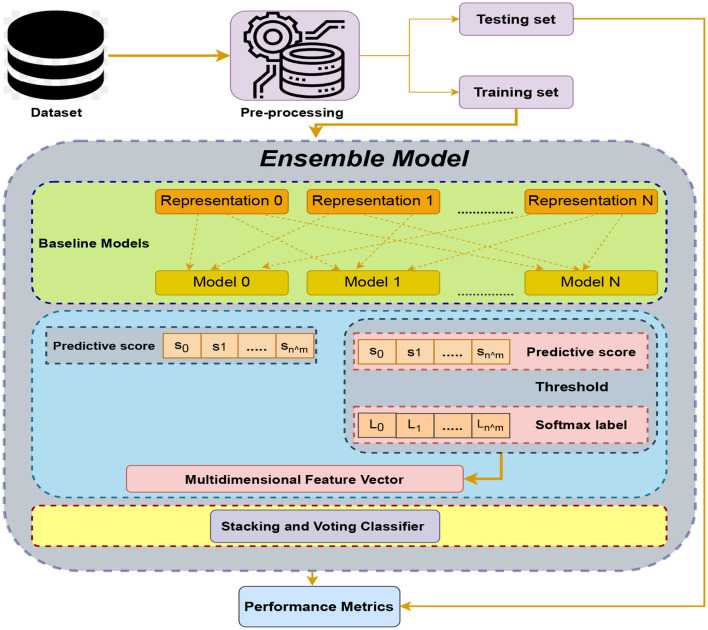
Sleep disorder detection has greatly improved with the integration of machine learning, offering enhanced accuracy and effectiveness. However, the labor-intensive nature of diagnosis still presents challenges. To address these, we propose a novel coordination model aimed at improving detection accuracy and reliability through a multi-model ensemble approach. The proposed method employs a multi-layered ensemble model, starting with the careful selection of N models to capture essential features. Techniques such as thresholding, predictive scoring, and the conversion of Softmax labels into multidimensional feature vectors improve interpretability. Ensemble methods like voting and stacking are used to ensure collaborative decision-making across models. Both the original dataset and one modified using the Synthetic Minority Oversampling Technique (SMOTE) were evaluated to address data imbalance issues. The ensemble model demonstrated superior performance, achieving 96.88% accuracy on the SMOTE-implemented dataset and 95.75% accuracy on the original dataset. Moreover, an eight-fold cross-validation yielded an impressive 99.5% accuracy, indicating the reliability of the model in handling unbalanced data and ensuring precise detection of sleep disorders. Compared to individual models, the proposed ensemble method significantly outperformed traditional models. The combination of models not only enhanced accuracy but also improved the system's ability to handle unbalanced data, a common limitation in traditional methods. This study marks a significant advancement in sleep disorder detection through the integration of innovative ensemble techniques. The proposed approach, combining multiple models and advanced interpretability methods, promises improved patient outcomes and greater diagnostic accuracy, paving the way for future applications in medical diagnostics.





 京公网安备 11010802042870号
京ICP备2023020795号-1
京公网安备 11010802042870号
京ICP备2023020795号-1

 分享
分享
 求助内容:
求助内容: 应助结果提醒方式:
 扫码关注我们
