Weicheng Kong , Yuling Lu , Ximin Yuan , Meng Zhu , Qilin Wu , Ke Yao , Tao Fu , Yong He
{"title":"3D printing of alloys with AB reaction at room temperature","authors":"Weicheng Kong , Yuling Lu , Ximin Yuan , Meng Zhu , Qilin Wu , Ke Yao , Tao Fu , Yong He","doi":"10.1016/j.matt.2025.101999","DOIUrl":null,"url":null,"abstract":"<div><div>The traditional three-dimensional (3D) printing technique requires high energy to break and re-form the metal bonds. Here, we present the latest discovery of the metal polymerization reaction at room temperature with the non-breaking and re-forming bond method, which is similar to the polymerization phenomenon of the AB reaction. The A and B in the AB reaction represent the eutectic gallium–indium liquid metal and transition metal alloy, respectively, and their same atomic structures generate the aggregation to form the new alloy phases, showing that the printed Ga–In–Cu alloy has superior mechanical properties. Moreover, the AB reaction model is established to elucidate the reaction mechanism between the A and the B, which exhibits excellent printable performance. This polymerization reaction of the alloys pioneers a novel approach to the formation of alloys, which has become one of the important trends in future manufacturing industries.</div></div>","PeriodicalId":388,"journal":{"name":"Matter","volume":"8 3","pages":"Article 101999"},"PeriodicalIF":17.5000,"publicationDate":"2025-03-05","publicationTypes":"Journal Article","fieldsOfStudy":null,"isOpenAccess":false,"openAccessPdf":"","citationCount":"0","resultStr":null,"platform":"Semanticscholar","paperid":null,"PeriodicalName":"Matter","FirstCategoryId":"88","ListUrlMain":"https://www.sciencedirect.com/science/article/pii/S2590238525000426","RegionNum":1,"RegionCategory":"材料科学","ArticlePicture":[],"TitleCN":null,"AbstractTextCN":null,"PMCID":null,"EPubDate":"2025/2/13 0:00:00","PubModel":"Epub","JCR":"Q1","JCRName":"MATERIALS SCIENCE, MULTIDISCIPLINARY","Score":null,"Total":0}
引用次数: 0
Abstract
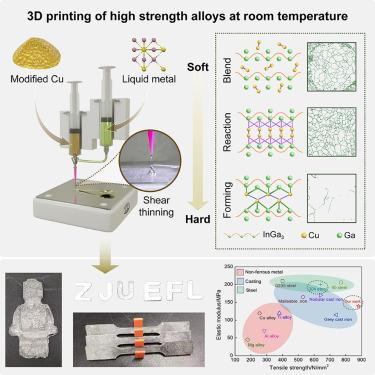
The traditional three-dimensional (3D) printing technique requires high energy to break and re-form the metal bonds. Here, we present the latest discovery of the metal polymerization reaction at room temperature with the non-breaking and re-forming bond method, which is similar to the polymerization phenomenon of the AB reaction. The A and B in the AB reaction represent the eutectic gallium–indium liquid metal and transition metal alloy, respectively, and their same atomic structures generate the aggregation to form the new alloy phases, showing that the printed Ga–In–Cu alloy has superior mechanical properties. Moreover, the AB reaction model is established to elucidate the reaction mechanism between the A and the B, which exhibits excellent printable performance. This polymerization reaction of the alloys pioneers a novel approach to the formation of alloys, which has become one of the important trends in future manufacturing industries.
期刊介绍:
Matter, a monthly journal affiliated with Cell, spans the broad field of materials science from nano to macro levels,covering fundamentals to applications. Embracing groundbreaking technologies,it includes full-length research articles,reviews, perspectives,previews, opinions, personnel stories, and general editorial content.
Matter aims to be the primary resource for researchers in academia and industry, inspiring the next generation of materials scientists.






 京公网安备 11010802042870号
京ICP备2023020795号-1
京公网安备 11010802042870号
京ICP备2023020795号-1

 分享
分享
 求助内容:
求助内容: 应助结果提醒方式:
 扫码关注我们
