{"title":"Coherence Awareness in Diffractive Neural Networks","authors":"Matan Kleiner, Lior Michalei, Tomer Michalei","doi":"10.1002/lpor.202401299","DOIUrl":null,"url":null,"abstract":"<p>Diffractive neural networks hold great promise for applications requiring intensive computational processing. Considerable attention is focused on diffractive networks for either spatially coherent or spatially incoherent illumination. Here, it is illustrated that, as opposed to imaging systems, in diffractive networks the degree of spatial coherence has a dramatic effect. In particular, it is showed that when the spatial coherence length on the object is comparable to the minimal feature size preserved by the optical system, neither the incoherent nor the coherent extremes serve as acceptable approximations. Importantly, this situation is inherent to many settings involving active illumination, including reflected light microscopy, autonomous vehicles and smartphones. Following this observation, a general framework is proposed for training diffractive networks for any specified degree of spatial and temporal coherence, supporting all types of linear and nonlinear layers. Using this method, networks are numerically optimized for image classification, and the dependence of their performance on the coherence properties of the illumination is thoroughly investigated. The concept of coherence-blind networks is further introduced, enabling networks, which have enhanced resilience to changes in illumination conditions. These findings serve as a steppingstone toward adopting all-optical neural networks in real-world applications, leveraging nothing but natural light.</p>","PeriodicalId":204,"journal":{"name":"Laser & Photonics Reviews","volume":"19 10","pages":""},"PeriodicalIF":10.0000,"publicationDate":"2025-02-13","publicationTypes":"Journal Article","fieldsOfStudy":null,"isOpenAccess":false,"openAccessPdf":"https://onlinelibrary.wiley.com/doi/epdf/10.1002/lpor.202401299","citationCount":"0","resultStr":null,"platform":"Semanticscholar","paperid":null,"PeriodicalName":"Laser & Photonics Reviews","FirstCategoryId":"101","ListUrlMain":"https://onlinelibrary.wiley.com/doi/10.1002/lpor.202401299","RegionNum":1,"RegionCategory":"物理与天体物理","ArticlePicture":[],"TitleCN":null,"AbstractTextCN":null,"PMCID":null,"EPubDate":"","PubModel":"","JCR":"Q1","JCRName":"OPTICS","Score":null,"Total":0}
引用次数: 0
Abstract
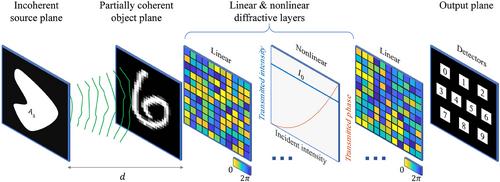
Diffractive neural networks hold great promise for applications requiring intensive computational processing. Considerable attention is focused on diffractive networks for either spatially coherent or spatially incoherent illumination. Here, it is illustrated that, as opposed to imaging systems, in diffractive networks the degree of spatial coherence has a dramatic effect. In particular, it is showed that when the spatial coherence length on the object is comparable to the minimal feature size preserved by the optical system, neither the incoherent nor the coherent extremes serve as acceptable approximations. Importantly, this situation is inherent to many settings involving active illumination, including reflected light microscopy, autonomous vehicles and smartphones. Following this observation, a general framework is proposed for training diffractive networks for any specified degree of spatial and temporal coherence, supporting all types of linear and nonlinear layers. Using this method, networks are numerically optimized for image classification, and the dependence of their performance on the coherence properties of the illumination is thoroughly investigated. The concept of coherence-blind networks is further introduced, enabling networks, which have enhanced resilience to changes in illumination conditions. These findings serve as a steppingstone toward adopting all-optical neural networks in real-world applications, leveraging nothing but natural light.
期刊介绍:
Laser & Photonics Reviews is a reputable journal that publishes high-quality Reviews, original Research Articles, and Perspectives in the field of photonics and optics. It covers both theoretical and experimental aspects, including recent groundbreaking research, specific advancements, and innovative applications.
As evidence of its impact and recognition, Laser & Photonics Reviews boasts a remarkable 2022 Impact Factor of 11.0, according to the Journal Citation Reports from Clarivate Analytics (2023). Moreover, it holds impressive rankings in the InCites Journal Citation Reports: in 2021, it was ranked 6th out of 101 in the field of Optics, 15th out of 161 in Applied Physics, and 12th out of 69 in Condensed Matter Physics.
The journal uses the ISSN numbers 1863-8880 for print and 1863-8899 for online publications.



 京公网安备 11010802042870号
京ICP备2023020795号-1
京公网安备 11010802042870号
京ICP备2023020795号-1

 分享
分享
 求助内容:
求助内容: 应助结果提醒方式:
 扫码关注我们
