{"title":"Translocation, Transformation, and Phytotoxicity of Sulfadiazine and N4-Acetylsulfadiazine in Rice Plants","authors":"Tao Ai, Mingling Yu, Yicheng Dai, Ruipu Yao, Ling N. Jin, Yuanyuan Yu, Xinbin Qiu, Peixin Huang, Xifen Zhu, Jianteng Sun, Lizhong Zhu","doi":"10.1021/acs.jafc.4c10236","DOIUrl":null,"url":null,"abstract":"This study investigates the uptake, biotransformation, and phytotoxicity of sulfadiazine (SDZ) and its acetyl derivative <i>N</i><sub>4</sub>-acetylsulfadiazine (NASDZ) in rice. Results showed that rice was more tolerant to NASDZ, with lower malondialdehyde and reactive oxygen species levels but higher antioxidant enzyme activities (SOD, POD, and CAT). The maximum accumulations of SDZ in roots and shoots were 19.3 ± 1.0 and 3.6 ± 1.1 μg/g, while NASDZ were 18.6 ± 2.5 and 3.5 ± 1.4 μg/g, respectively. SDZ exposure generated more metabolic intermediates, including deamination, hydroxylation, glycosylation, acetylation, and formylation products, while NASDZ metabolism was documented for the first time. Key genes involved in biotransformation include cytochrome P450, acetyltransferase, glycosyltransferases, and methyltransferase. Density functional theory calculations showed structural differences affecting reactive sites and intermediates. SDZ disrupted lipid metabolism, while NASDZ altered carbohydrate and amino acid pathways, highlighting their selective effects on rice metabolism. Our data help understand sulfonamide biotransformation and phytotoxicity in rice.","PeriodicalId":41,"journal":{"name":"Journal of Agricultural and Food Chemistry","volume":"41 1","pages":""},"PeriodicalIF":6.2000,"publicationDate":"2025-02-13","publicationTypes":"Journal Article","fieldsOfStudy":null,"isOpenAccess":false,"openAccessPdf":"","citationCount":"0","resultStr":null,"platform":"Semanticscholar","paperid":null,"PeriodicalName":"Journal of Agricultural and Food Chemistry","FirstCategoryId":"97","ListUrlMain":"https://doi.org/10.1021/acs.jafc.4c10236","RegionNum":1,"RegionCategory":"农林科学","ArticlePicture":[],"TitleCN":null,"AbstractTextCN":null,"PMCID":null,"EPubDate":"","PubModel":"","JCR":"Q1","JCRName":"AGRICULTURE, MULTIDISCIPLINARY","Score":null,"Total":0}
引用次数: 0
Abstract
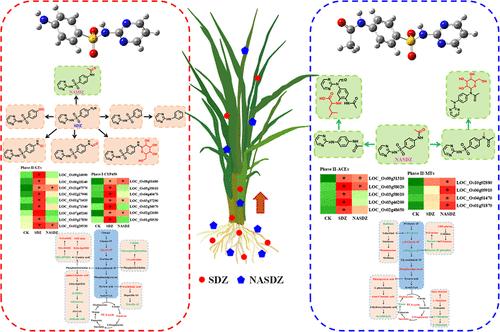
This study investigates the uptake, biotransformation, and phytotoxicity of sulfadiazine (SDZ) and its acetyl derivative N4-acetylsulfadiazine (NASDZ) in rice. Results showed that rice was more tolerant to NASDZ, with lower malondialdehyde and reactive oxygen species levels but higher antioxidant enzyme activities (SOD, POD, and CAT). The maximum accumulations of SDZ in roots and shoots were 19.3 ± 1.0 and 3.6 ± 1.1 μg/g, while NASDZ were 18.6 ± 2.5 and 3.5 ± 1.4 μg/g, respectively. SDZ exposure generated more metabolic intermediates, including deamination, hydroxylation, glycosylation, acetylation, and formylation products, while NASDZ metabolism was documented for the first time. Key genes involved in biotransformation include cytochrome P450, acetyltransferase, glycosyltransferases, and methyltransferase. Density functional theory calculations showed structural differences affecting reactive sites and intermediates. SDZ disrupted lipid metabolism, while NASDZ altered carbohydrate and amino acid pathways, highlighting their selective effects on rice metabolism. Our data help understand sulfonamide biotransformation and phytotoxicity in rice.
期刊介绍:
The Journal of Agricultural and Food Chemistry publishes high-quality, cutting edge original research representing complete studies and research advances dealing with the chemistry and biochemistry of agriculture and food. The Journal also encourages papers with chemistry and/or biochemistry as a major component combined with biological/sensory/nutritional/toxicological evaluation related to agriculture and/or food.



 京公网安备 11010802042870号
京ICP备2023020795号-1
京公网安备 11010802042870号
京ICP备2023020795号-1

 分享
分享
 求助内容:
求助内容: 应助结果提醒方式:
 扫码关注我们
