{"title":"Micro-LED Retinal Projection for Augmented Reality Near-Eye Displays","authors":"Huajian Jin, Zijian Lin, Wenzong Lai, Haonan Jiang, Junhu Cai, Hao Chen, Weijie Hao, Yun Ye, Sheng Xu, Qun Yan, Tailiang Guo, Enguo Chen","doi":"10.1002/lpor.202402083","DOIUrl":null,"url":null,"abstract":"<p>Retinal projection display enables the direct projection of virtual images onto the retina through the pupil center via a projection engine, showing promise in addressing the vergence-accommodation conflict in augmented reality near-eye displays. However, existing RPD architectures universally employ passive luminous micro-electromechanical systems or spatial light modulators, encountering challenges associated with beam aperture limitations and structural inflexibility. In response to these, this paper presents a novel micro-LED retinal projection display architecture that integrates the active luminous full-color micro-LEDs with a pixel-to-pixel imaging fiber bundle, effectively subverting conventional RPD designs. Additionally, the flexible fiber bundle brings an adaptable design that enables optoelectronic separation capabilities. The design principles and feasibility are thoroughly described and validated through simulations and experiments. A full-color µRPD prototype is developed, demonstrating sharp imaging across an extensive focal depth range. Remarkably, the µRPD architecture exhibits a groundbreaking advancement in enabling underwater AR displays without necessitating special waterproof treatments, underscoring its potential versatility and adaptability to challenging environments. This design paves a new way for practical applications of NEDs in complex and demanding conditions, thereby contributing to the evolution of NED systems.</p>","PeriodicalId":204,"journal":{"name":"Laser & Photonics Reviews","volume":"19 14","pages":""},"PeriodicalIF":10.0000,"publicationDate":"2025-02-13","publicationTypes":"Journal Article","fieldsOfStudy":null,"isOpenAccess":false,"openAccessPdf":"","citationCount":"0","resultStr":null,"platform":"Semanticscholar","paperid":null,"PeriodicalName":"Laser & Photonics Reviews","FirstCategoryId":"101","ListUrlMain":"https://onlinelibrary.wiley.com/doi/10.1002/lpor.202402083","RegionNum":1,"RegionCategory":"物理与天体物理","ArticlePicture":[],"TitleCN":null,"AbstractTextCN":null,"PMCID":null,"EPubDate":"","PubModel":"","JCR":"Q1","JCRName":"OPTICS","Score":null,"Total":0}
引用次数: 0
Abstract
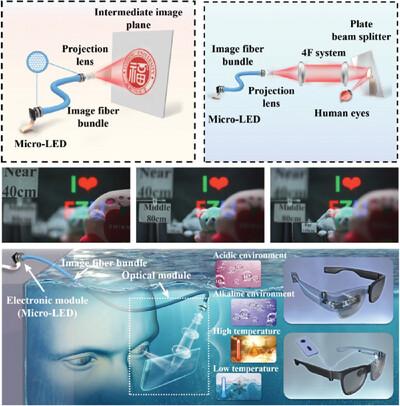
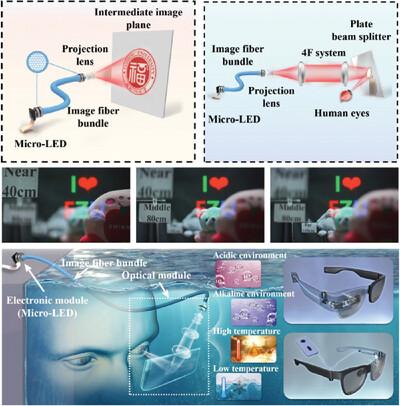
Retinal projection display enables the direct projection of virtual images onto the retina through the pupil center via a projection engine, showing promise in addressing the vergence-accommodation conflict in augmented reality near-eye displays. However, existing RPD architectures universally employ passive luminous micro-electromechanical systems or spatial light modulators, encountering challenges associated with beam aperture limitations and structural inflexibility. In response to these, this paper presents a novel micro-LED retinal projection display architecture that integrates the active luminous full-color micro-LEDs with a pixel-to-pixel imaging fiber bundle, effectively subverting conventional RPD designs. Additionally, the flexible fiber bundle brings an adaptable design that enables optoelectronic separation capabilities. The design principles and feasibility are thoroughly described and validated through simulations and experiments. A full-color µRPD prototype is developed, demonstrating sharp imaging across an extensive focal depth range. Remarkably, the µRPD architecture exhibits a groundbreaking advancement in enabling underwater AR displays without necessitating special waterproof treatments, underscoring its potential versatility and adaptability to challenging environments. This design paves a new way for practical applications of NEDs in complex and demanding conditions, thereby contributing to the evolution of NED systems.
期刊介绍:
Laser & Photonics Reviews is a reputable journal that publishes high-quality Reviews, original Research Articles, and Perspectives in the field of photonics and optics. It covers both theoretical and experimental aspects, including recent groundbreaking research, specific advancements, and innovative applications.
As evidence of its impact and recognition, Laser & Photonics Reviews boasts a remarkable 2022 Impact Factor of 11.0, according to the Journal Citation Reports from Clarivate Analytics (2023). Moreover, it holds impressive rankings in the InCites Journal Citation Reports: in 2021, it was ranked 6th out of 101 in the field of Optics, 15th out of 161 in Applied Physics, and 12th out of 69 in Condensed Matter Physics.
The journal uses the ISSN numbers 1863-8880 for print and 1863-8899 for online publications.



 京公网安备 11010802042870号
京ICP备2023020795号-1
京公网安备 11010802042870号
京ICP备2023020795号-1

 分享
分享
 求助内容:
求助内容: 应助结果提醒方式:
 扫码关注我们
