{"title":"Ion-dipole-interaction-manipulated bilateral interface chemistry for deep rechargeability and high redox activity of Zn-organic batteries","authors":"Yanyan Chen , Bowen Yin , Yinxiang Zeng , Hongfei Wang , Bin-Bin Xie , Deyan Luan , Yong Hu , Xiong Wen (David) Lou","doi":"10.1016/j.chempr.2025.102411","DOIUrl":null,"url":null,"abstract":"<div><div>The practical application of Zn-based batteries is compromised by rampant dendrite growth, unfavorable side reactions, and serious capacity decay. We report a trifunctional glutarimide (Glu) electrolyte additive to stabilize the electrochemical reaction of the Zn anode and facilitate redox activity of the cathode. Theoretical calculations and spectroscopic characterizations reveal that Glu with the electron-withdrawing/donating capability can substitute partially coordinated water and manipulate the solvation structure by reinforced ion-dipole interactions. Meanwhile, Glu can form a solid electrolyte interphase layer and alleviate parasitic reactions. Consequently, Glu renders excellent Zn plating/stripping cycling of 2,000 h at 1 mA cm<sup>−2</sup>/1 mAh cm<sup>−2</sup>. Even at an ultra-high depth of discharge of 85.2%, a stable cycling of 138 h is obtained. The formulated additive serves as the charge redistributor and decouples the cation-anion interaction to stabilize the interaction of ClO<sub>4</sub><sup>−</sup> with the half-oxidized protonated polyaniline, enabling the Zn-organic battery with enhanced energy storage performance.</div></div>","PeriodicalId":268,"journal":{"name":"Chem","volume":"11 6","pages":"Article 102411"},"PeriodicalIF":19.6000,"publicationDate":"2025-06-12","publicationTypes":"Journal Article","fieldsOfStudy":null,"isOpenAccess":false,"openAccessPdf":"","citationCount":"0","resultStr":null,"platform":"Semanticscholar","paperid":null,"PeriodicalName":"Chem","FirstCategoryId":"92","ListUrlMain":"https://www.sciencedirect.com/science/article/pii/S2451929425000014","RegionNum":1,"RegionCategory":"化学","ArticlePicture":[],"TitleCN":null,"AbstractTextCN":null,"PMCID":null,"EPubDate":"2025/2/13 0:00:00","PubModel":"Epub","JCR":"Q1","JCRName":"CHEMISTRY, MULTIDISCIPLINARY","Score":null,"Total":0}
引用次数: 0
Abstract
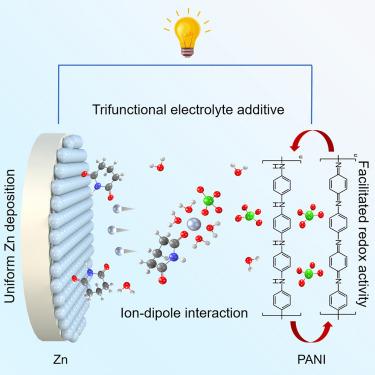
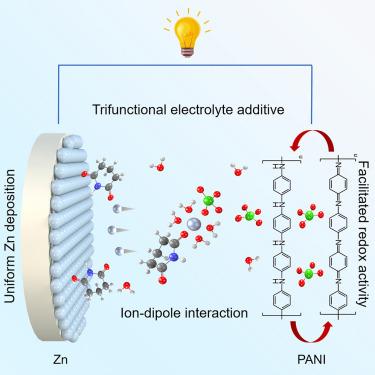
The practical application of Zn-based batteries is compromised by rampant dendrite growth, unfavorable side reactions, and serious capacity decay. We report a trifunctional glutarimide (Glu) electrolyte additive to stabilize the electrochemical reaction of the Zn anode and facilitate redox activity of the cathode. Theoretical calculations and spectroscopic characterizations reveal that Glu with the electron-withdrawing/donating capability can substitute partially coordinated water and manipulate the solvation structure by reinforced ion-dipole interactions. Meanwhile, Glu can form a solid electrolyte interphase layer and alleviate parasitic reactions. Consequently, Glu renders excellent Zn plating/stripping cycling of 2,000 h at 1 mA cm−2/1 mAh cm−2. Even at an ultra-high depth of discharge of 85.2%, a stable cycling of 138 h is obtained. The formulated additive serves as the charge redistributor and decouples the cation-anion interaction to stabilize the interaction of ClO4− with the half-oxidized protonated polyaniline, enabling the Zn-organic battery with enhanced energy storage performance.
锌基电池的实际应用受到猖獗的枝晶生长,不利的副反应和严重的容量衰减的影响。我们报道了一种三功能的谷氨酰亚胺(Glu)电解质添加剂,以稳定锌阳极的电化学反应并促进阴极的氧化还原活性。理论计算和光谱表征表明,具有吸/供电子能力的Glu可以取代部分配位水,并通过增强离子偶极子相互作用操纵溶剂化结构。同时,Glu可以形成固体电解质相间层,减轻寄生反应。因此,Glu在1 mA cm - 2/1 mAh cm - 2下可实现2000 h的优异镀锌/剥离循环。即使在超高放电深度为85.2%的情况下,也能获得138 h的稳定循环。所配制的添加剂起到电荷再分配剂的作用,解耦了阳离子-阴离子相互作用,稳定了ClO4−与半氧化质子化聚苯胺的相互作用,提高了锌有机电池的储能性能。
期刊介绍:
Chem, affiliated with Cell as its sister journal, serves as a platform for groundbreaking research and illustrates how fundamental inquiries in chemistry and its related fields can contribute to addressing future global challenges. It was established in 2016, and is currently edited by Robert Eagling.



 京公网安备 11010802042870号
京ICP备2023020795号-1
京公网安备 11010802042870号
京ICP备2023020795号-1

 分享
分享
 求助内容:
求助内容: 应助结果提醒方式:
 扫码关注我们
