{"title":"Two-dimensional π-conjugated metal–organic frameworks as highly efficient catalysts for CO2 electroreduction","authors":"Cong Wang , Jian Li , Xin Wang , Min Zhang","doi":"10.1016/j.apsusc.2025.162670","DOIUrl":null,"url":null,"abstract":"<div><div>With fossil fuel reserves diminishing, designing and synthesizing electrocatalysts with controllable active sites is essential for converting carbon dioxide (CO<sub>2</sub>) into valuable chemicals. Inspired by the experimental advancement of two-dimensional π-conjugated metal–organic framework (2D <em>c</em>-MOF) nanosheets, we have performed a computational screening to identify optimal single-atom catalysts for the CO<sub>2</sub> reduction reaction (CO<sub>2</sub>RR) across eleven 2D <em>c</em>-MOFs (HTHATN-TM). These frameworks comprise transition metals (TM = Cr, Mn, Fe, Co, Ni, Cu, Zn, Ru, Rh, Pd, or Ag) and hexathiohexaazatrinaphthylene (HTHATN) organic ligands. Our first-principles calculations reveal that HTHATN-Cr and HTHATN-Ru emerge as highly promising CO<sub>2</sub>RR catalysts, exhibiting low limiting potentials of −0.38 V and −0.53 V, respectively, and favoring the production of HCOOH and CH<sub>4</sub>. These findings provide valuable insights for the development of more efficient CO<sub>2</sub>RR catalysts.</div></div>","PeriodicalId":247,"journal":{"name":"Applied Surface Science","volume":"691 ","pages":"Article 162670"},"PeriodicalIF":6.9000,"publicationDate":"2025-05-15","publicationTypes":"Journal Article","fieldsOfStudy":null,"isOpenAccess":false,"openAccessPdf":"","citationCount":"0","resultStr":null,"platform":"Semanticscholar","paperid":null,"PeriodicalName":"Applied Surface Science","FirstCategoryId":"88","ListUrlMain":"https://www.sciencedirect.com/science/article/pii/S0169433225003848","RegionNum":2,"RegionCategory":"材料科学","ArticlePicture":[],"TitleCN":null,"AbstractTextCN":null,"PMCID":null,"EPubDate":"2025/2/12 0:00:00","PubModel":"Epub","JCR":"Q2","JCRName":"CHEMISTRY, PHYSICAL","Score":null,"Total":0}
引用次数: 0
Abstract
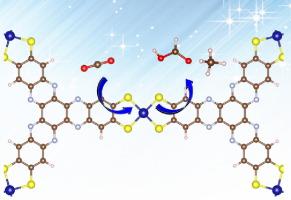
With fossil fuel reserves diminishing, designing and synthesizing electrocatalysts with controllable active sites is essential for converting carbon dioxide (CO2) into valuable chemicals. Inspired by the experimental advancement of two-dimensional π-conjugated metal–organic framework (2D c-MOF) nanosheets, we have performed a computational screening to identify optimal single-atom catalysts for the CO2 reduction reaction (CO2RR) across eleven 2D c-MOFs (HTHATN-TM). These frameworks comprise transition metals (TM = Cr, Mn, Fe, Co, Ni, Cu, Zn, Ru, Rh, Pd, or Ag) and hexathiohexaazatrinaphthylene (HTHATN) organic ligands. Our first-principles calculations reveal that HTHATN-Cr and HTHATN-Ru emerge as highly promising CO2RR catalysts, exhibiting low limiting potentials of −0.38 V and −0.53 V, respectively, and favoring the production of HCOOH and CH4. These findings provide valuable insights for the development of more efficient CO2RR catalysts.
期刊介绍:
Applied Surface Science covers topics contributing to a better understanding of surfaces, interfaces, nanostructures and their applications. The journal is concerned with scientific research on the atomic and molecular level of material properties determined with specific surface analytical techniques and/or computational methods, as well as the processing of such structures.




 京公网安备 11010802042870号
京ICP备2023020795号-1
京公网安备 11010802042870号
京ICP备2023020795号-1

 分享
分享
 求助内容:
求助内容: 应助结果提醒方式:
 扫码关注我们
